Shop assistants fold the same jumper forty times a day, know exactly where everything is (except the one thing you’re looking for), and say “Can I help you?” to people who will almost always reply “I’m just looking, thanks.” For many people, a shop job is their first job in a new country, and it’s one of the best ways to practise real, everyday English. Here’s the English you’ll need on the shop floor.
10 On-the-Job Shop Assistant Words
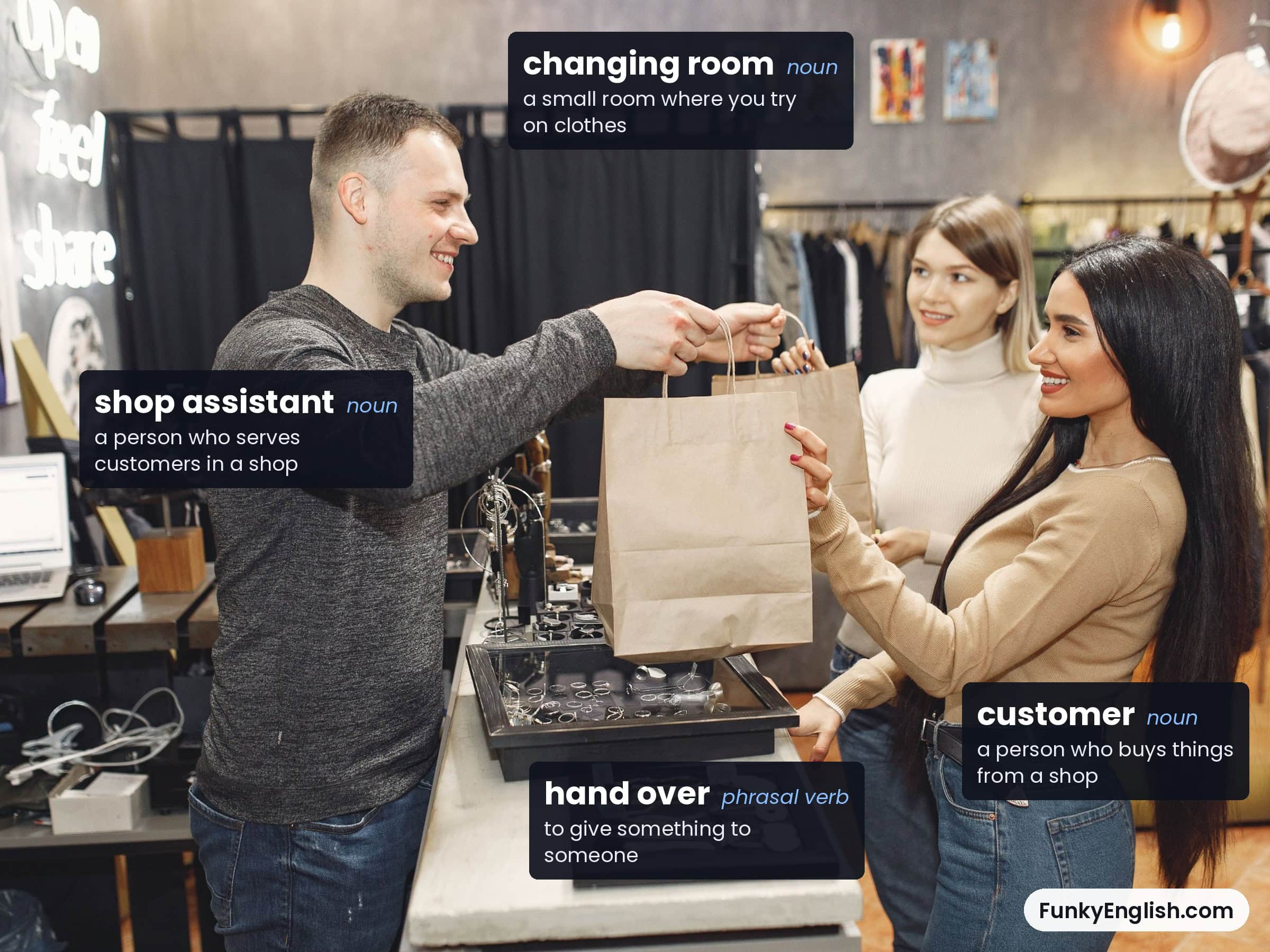
These are the words you’ll hear in a shop, in alphabetical order. The four marked Featured appear in the photo at the top of this page.
changing room (noun): a small private room or cubicle where you try on clothes before you buy them. Also called a fitting room. · Featured
“The changing rooms are at the back, next to the jeans.”
contactless (adjective): paying by tapping your card or phone on the card machine, with no PIN.
“Contactless is fine. Just tap it on the top there.”
customer (noun): a person who buys things from a shop. Someone who is just looking is still a customer. Probably. · Featured
“That customer has been in the changing room for forty minutes.”
exchange (verb): to take something back to a shop and swap it for something else, such as a different size. It’s also a noun: “Can I do an exchange?”
“Can I exchange this for a large, please?”
hand over (phrasal verb): to give something to someone, usually with your hand. Shop assistants hand over bags, receipts and change all day long. · Featured
“He smiled as he handed over the bag.”
receipt (noun): the piece of paper (or email) that shows what you bought and how much you paid. Careful with the pronunciation: ri-SEET. The p is silent.
“Keep your receipt in case you need to bring it back.”
refund (noun): money that a shop gives back to you when you return something. It’s also a verb: “They refunded me straight away.”
“I’d like a refund, please. It doesn’t fit.”
shop assistant (noun): a person who serves customers in a shop. You’ll also hear sales assistant and retail assistant in job adverts. · Featured
“I got a job as a shop assistant in a clothes shop on the high street.”
stock (noun): all the things a shop has to sell. If something is in stock, the shop has it. If it’s out of stock, it doesn’t. Extra stock is kept in the stockroom.
“Let me check if we’ve got any more in stock.”
till (noun): the place where customers pay, with the cash drawer and card machine. In supermarkets, you’ll hear checkout.
“There’s a queue at the till, so can you open the second one?”
What the Job Really Involves
Serving customers is only part of it. On a normal shift, a shop assistant might open up, refill the shelves, fold and tidy displays, work on the till, answer the same question about sizes twenty times, deal with returns and then tidy everything again just before closing. You’re on your feet all day, and the Saturday rush is real.
It’s busiest in the run-up to Christmas and in the sales, especially the Boxing Day sales. The good news? You’ll hear more natural English in one Saturday on the shop floor than in a week of textbooks. If you’re nervous about chatting to customers, our guide to small talk at work will help.
How to Talk About Working in a Shop
shop floor (noun): the part of the shop where customers are, as opposed to the stockroom or the office.
“I’m on the shop floor all morning, then on the till after lunch.”
Saturday job (noun): a part-time job that teenagers and students often do at weekends. For many people in the UK, a Saturday job in a shop is their very first job.
“My first Saturday job was in a shoe shop. I still know every shoe size.”
staff discount (noun): money off things in the shop, just for people who work there.
“The staff discount is the best part of the job. My wardrobe agrees.”
temp (noun): a temporary worker. Lots of shops take on extra temps for Christmas.
“I started as a Christmas temp, and they kept me on.”
restock (verb): to fill the shelves or rails again with new stock.
“Can you restock the socks? The kids’ section has been raided again.”
Working on the till means handling money all day, so you might like our piggy bank vocabulary. For more serving-customers English, see our barista and waiter vocabulary.
Useful Phrases for Shop Assistants and Customers
If you work in the shop:
- “Hi there! Can I help you with anything?”
- “Are you looking for anything in particular?”
- “What size are you after?” In British English, after here means looking for.
- “The changing rooms are just over there.”
- “Let me check in the back for you.” The most useful phrase in retail. It buys you time.
- “Would you like a bag?” In the UK, you may have to pay a small charge for one.
- “Would you like your receipt?”
If you’re the customer:
- “I’m just looking, thanks.” Possibly the most-used sentence in any British shop.
- “Have you got this in a medium?” or “Do you have this in a size 12?”
- “Can I try this on?”
- “Have you got it in any other colours?”
- “Can I pay by card?”
- “I’d like to return this, please. I’ve got the receipt.”
When something goes wrong, stay calm and polite. A simple apology goes a long way: “I’m really sorry about that. Let me sort it out for you.”
UK English vs US English
- shop assistant (UK) / sales clerk or salesperson (US)
- shop (UK) / store (US). British people say store too, mostly for big shops.
- till (UK) / register or cash register (US)
- changing room (UK) / fitting room or dressing room (US)
- queue (UK) / line (US)
- jumper (UK) / sweater (US)
- trousers (UK) / pants (US). Be careful! In the UK, pants means underwear. Asking a British shop assistant where the pants are can lead to a very different conversation.
Shopping Idioms and Expressions
- the customer is always right: an old saying meaning shops should keep customers happy, even when the customer is, in fact, wrong. “He wanted a refund on socks he’d worn for a year. But the customer is always right.”
- shop around: to compare prices in different shops before you buy. “Shop around before you buy a new phone.”
- window shopping: looking at things in shops without buying anything. “We’re not buying anything, just window shopping.”
- a bargain: something that costs much less than usual. “Twenty quid for that coat? What a bargain!”
- a rip-off (informal): something that costs far too much. “Eight pounds for a sandwich? That’s a rip-off.”
- shop till you drop: to shop for a very long time, until you’re exhausted. Popular on the first day of the sales.
- a shopaholic (informal): someone who loves shopping a little too much. “She says she’s not a shopaholic. She just has a lot of bags.” Shop assistants meet them every Saturday.
A Tip for Your First Day
Nobody expects you to know where everything is on day one. When a customer asks something you don’t know, smile and say, “Good question. Let me find out for you.” Then find someone who knows. Customers don’t mind waiting. They mind being ignored.
Quick Check
Free teacher pack: ten jobs, ready to print
Using this page in class? Get worksheets, answer keys, word lists with photos and a lesson plan for ten jobs, from plumber to nurse. Sign up and it’s in your inbox in seconds.
Frequently Asked Questions
A shop assistant serves customers in a shop. The job includes helping people find what they need, working on the till, taking payments, dealing with returns and refunds, and keeping the shop tidy and the shelves full.
In American English, a shop assistant is usually called a sales clerk, a salesperson or a sales associate. American English also says store instead of shop, and register instead of till.
If you need help, say what you’re looking for: “Yes, please. Have you got this in a medium?” If you don’t, the polite and very British answer is “I’m just looking, thanks.”
More from the Careers Vocabulary Series:
- Baker Vocabulary
- Barista Vocabulary
- Builder Vocabulary
- Care Worker Vocabulary
- Carpenter Vocabulary
- Chef Vocabulary
- Dentist Vocabulary
- Doctor Vocabulary
- Electrician Vocabulary
- Farmer Vocabulary
- Firefighter Vocabulary
- Flight Attendant Vocabulary
- Hairdresser Vocabulary
- Mechanic Vocabulary
- Nurse Vocabulary
- Photographer Vocabulary
- Pilot Vocabulary
- Plumber Vocabulary
- Police Officer Vocabulary
- Taxi Driver Vocabulary
- Teacher Vocabulary
- Veterinarian Vocabulary
- Waiter Vocabulary
See all of them on our Jobs and Careers Vocabulary page. Work in a shop, or have a word we missed? Tell us on X: @EnglishStudy.