Full disclosure: I’m a teacher, so this page may be slightly biased. Teachers explain the same thing five different ways, mark homework at midnight and can hear a crisp packet open from the other side of the room. These are the words you need to survive the classroom, on either side of the desk.
10 On-the-Job Teacher Words
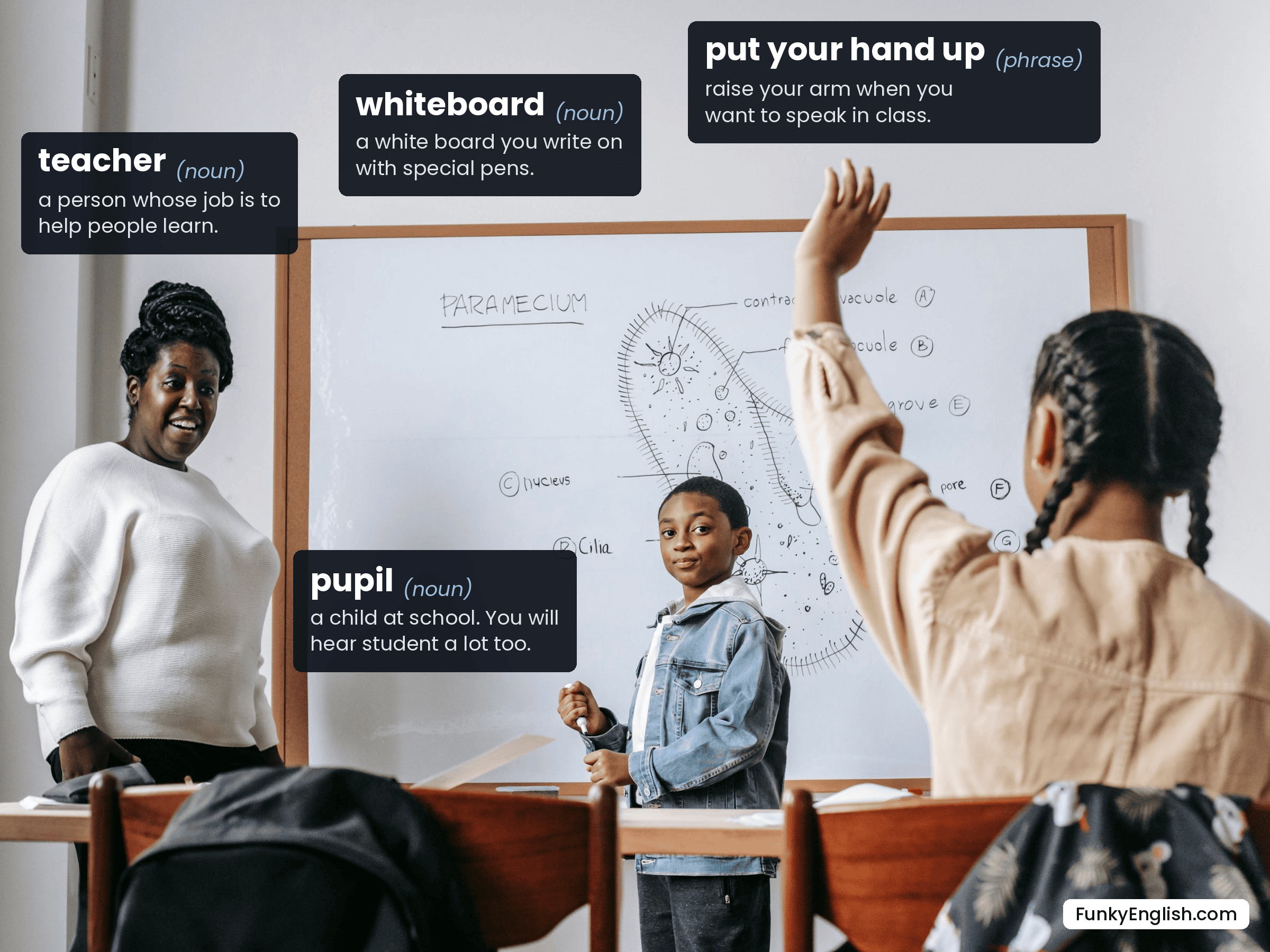
These are the words you’ll hear in any classroom, in alphabetical order. The four marked Featured are in the photo at the top of this page.
homework (noun): work a teacher gives you to do at home.
“”The dog ate my homework.” No, it didn’t. Dogs have standards.”
lesson (noun): a period of time when a teacher teaches a subject.
“Double maths on a Friday afternoon is the longest lesson in the world.”
mark (verb): to check work and give it a score or grade.
“I marked thirty essays last night. Twenty-nine of them started with “Since the dawn of time”.”
pupil (noun): a child at school. In the UK, “pupil” is the official word, but you will hear “student” a lot too. · Featured
“The pupils lined up quietly, which made the teacher very suspicious.”
put your hand up (phrase): to raise your arm when you want to speak or answer a question in class. · Featured
“Put your hand up if you know the answer. Not you, Tom, you always know the answer.”
register (noun): an official list of who is in class. Teachers “take the register” at the start of the day.
“She took the register and noticed three pupils were “at the dentist”. Again.”
staffroom (noun): the room where teachers go to relax, drink tea and talk about you.
“Pupils are not allowed in the staffroom. It’s where we keep the biscuits.”
teacher (noun): a person whose job is to help people learn. · Featured
“A good teacher can make even grammar interesting. Almost.”
timetable (noun): a list of which lessons you have and when.
“Check your timetable. Is it PE or science after lunch?”
whiteboard (noun): a white board you write on with special pens. · Featured
“The boy drew a perfect diagram on the whiteboard, then rubbed it out by accident.”
Classroom English: What Teachers Actually Say
Learners often ask me what teachers really say in British classrooms. Here are the classics, with a translation:
- “Take a seat.” Sit down.
- “Open your books at page 12.” Find page 12. (In US English: “Open your books to page 12″.)
- “Work in pairs.” Do this with the person next to you.
- “Hand in your homework.” Give it to me now. (Hand in is a phrasal verb. Learn it before your teacher uses it on you.)
- “Put your hand up. Don’t shout out.” I can’t hear 28 answers at once.
- “Eyes on me.” Stop talking and look at the front.
- “Pens down.” The test is over. Yes, really over.
- “I’ll wait.” I am now very annoyed.
Pupil or Student?
Officially, children in British schools are pupils. That’s the word you’ll see in government reports and school inspections. But walk into any British secondary school and you’ll hear “students” all day, especially for older teenagers. At university and college, it is always student. In American English, it’s student at every age.
How to Talk About Being a Teacher
According to the UK government’s Get Into Teaching service, to teach in most state schools in England you need a degree and qualified teacher status. A full-time teacher training course usually lasts about nine months, and then your first two years in the job are as an early career teacher, with a mentor to help. Here are the words for the job:
head teacher (noun): the person in charge of a school. Some schools say headmaster or headmistress.
“Being sent to the head teacher’s office is never good news.”
parents’ evening (noun): an evening when parents meet teachers to talk about their child’s progress.
“At parents’ evening, I learned my son is “a joy to have in class”. I’ve met my son.”
PGCE (noun): Postgraduate Certificate in Education, a popular teacher training course in the UK.
“She did a PGCE after her history degree.”
supply teacher (noun): a teacher who covers lessons when the usual teacher is away. Americans say substitute teacher.
“We had a supply teacher today, so naturally nobody did any work.”
term (noun): one of the parts the school year is divided into. Most British schools have three terms.
“Only two weeks until the end of term. Not that anyone is counting.”
UK English vs US English
- head teacher (UK) / principal (US)
- pupil or student (UK) / student (US)
- supply teacher (UK) / substitute teacher (US)
- Year 7 (UK, age 11 to 12) / sixth grade (US)
- maths (UK) / math (US)
- rubber (UK) / eraser (US). Be careful with this one in America.
- break (UK) / recess (US)
School Idioms
- hit the books: to start studying hard.
- teacher’s pet: the pupil the teacher likes best (said unkindly by everyone else).
- learn your lesson: to understand that you should not do something again.
- top of the class: the best in a group.
- you can’t teach an old dog new tricks: older people find it hard to change. (Not true, by the way. I’ve seen it done.)
Quick Check
Free teacher pack: ten jobs, ready to print
Using this page in class? Get worksheets, answer keys, word lists with photos and a lesson plan for ten jobs, from plumber to nurse. Sign up and it’s in your inbox in seconds.
Frequently Asked Questions
Both are correct in British English. Pupil is the official word for children in school, but many British schools say student, especially for teenagers. In American English, student is used at every age.
A head teacher is the person in charge of a school in the UK. In the US, this person is usually called the principal.
You need a degree and qualified teacher status (QTS). Most people get QTS through a teacher training course, which takes about nine months full-time. Your first two years in the job are as an early career teacher.
More from the Careers Vocabulary Series:
- Baker Vocabulary
- Barista Vocabulary
- Builder Vocabulary
- Care Worker Vocabulary
- Carpenter Vocabulary
- Chef Vocabulary
- Dentist Vocabulary
- Doctor Vocabulary
- Electrician Vocabulary
- Farmer Vocabulary
- Firefighter Vocabulary
- Flight Attendant Vocabulary
- Hairdresser Vocabulary
- Mechanic Vocabulary
- Nurse Vocabulary
- Photographer Vocabulary
- Pilot Vocabulary
- Plumber Vocabulary
- Police Officer Vocabulary
- Taxi Driver Vocabulary
- Veterinarian Vocabulary
- Waiter Vocabulary
See them all on our Jobs and Careers Vocabulary page. Teachers: got a classroom phrase we missed? Tell us on X: @EnglishStudy.