How many tenses are there in English, and how do they fit together? This guide shows you the nine main English tenses in one simple grid, with an example and a full lesson for each one.
When I trained as an English teacher, this grid was the first thing we were given. English has three times (past, present and future) and three main forms (simple, continuous and perfect). Three times three makes nine. Learn the grid, and every tense has its place.
The 9 English Tenses at a Glance
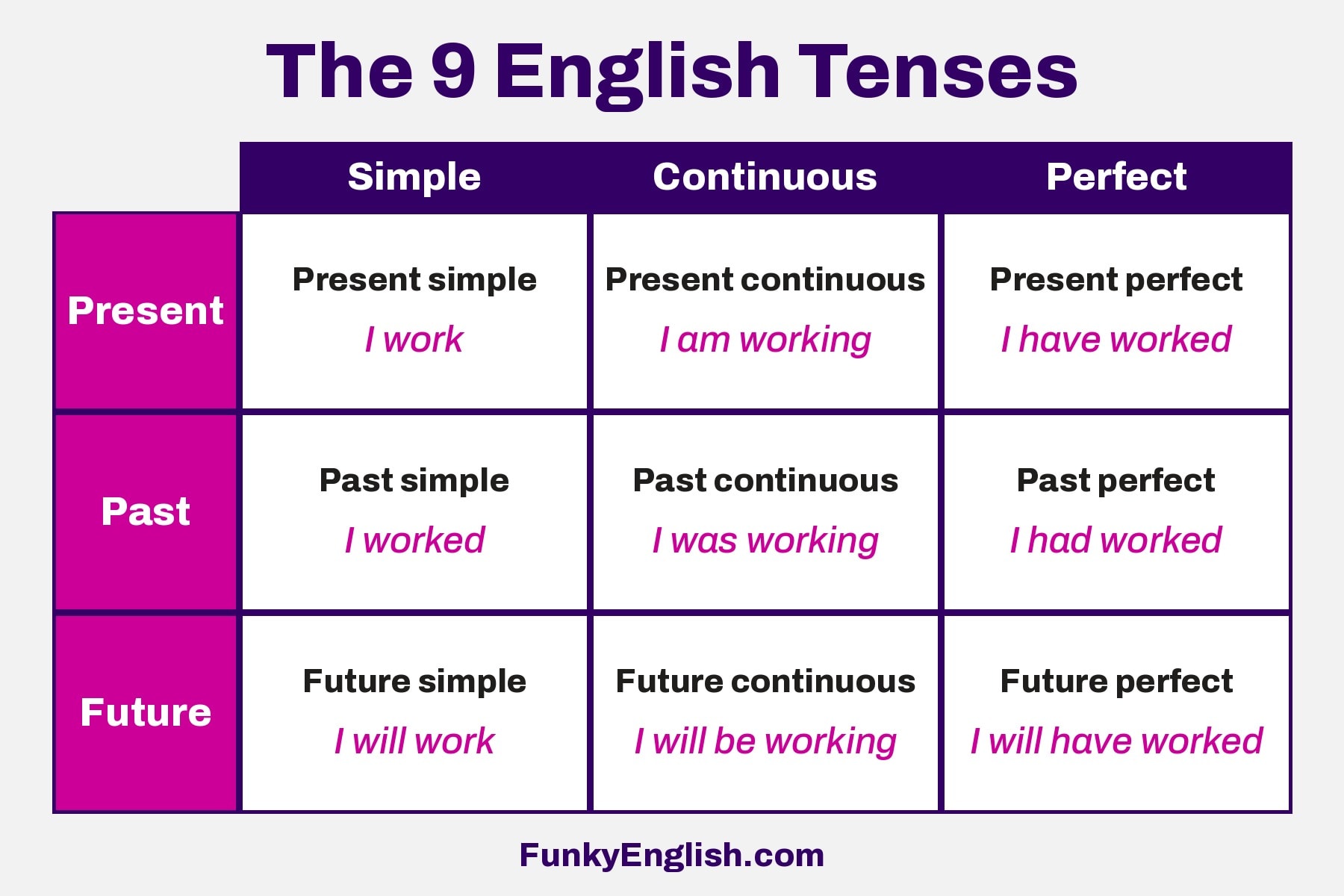
| Simple | Continuous | Perfect | |
|---|---|---|---|
| Present | Present simple I work | Present continuous I am working | Present perfect I have worked |
| Past | Past simple I worked | Past continuous I was working | Past perfect I had worked |
| Future | Future simple I will work | Future continuous I will be working | Future perfect I will have worked |
Click any tense in the table to go to its full lesson.
How the Grid Works
Every tense answers two questions. The row tells you when: past, present or future. The column tells you how we see the action:
- Simple: a fact, a habit or a complete action. “I work.”
- Continuous: an action in progress, formed with be + -ing. “I am working.”
- Perfect: an action seen as finished when we look back, formed with have + the past participle. “I have worked.”
To move along a row, change the form. To move down a column, change the time: am working → was working → will be working.
One Verb, Nine Tenses
Here is the verb work in all nine tenses, so you can compare them side by side.
| Tense | How to form it | Example |
|---|---|---|
| Present simple | verb (+ s) | I work in a school. |
| Present continuous | am / is / are + -ing | I am working at the moment. |
| Present perfect | have / has + past participle | I have worked here for ten years. |
| Past simple | verb + -ed (or an irregular form) | I worked late yesterday. |
| Past continuous | was / were + -ing | I was working when you phoned. |
| Past perfect | had + past participle | I had worked there before I moved. |
| Future simple | will + verb | I will work harder next term. |
| Future continuous | will be + -ing | I will be working at eight tonight. |
| Future perfect | will have + past participle | By June, I will have worked here for a year. |
The Present Tenses
- Present simple: habits, routines and facts. “She gets up at seven every day.”
- Present continuous: something happening right now, or around now. “I’m reading a great book.”
- Present perfect: experiences, recent news, and things that started in the past and continue now. “I’ve lived here since 2015.”
The Past Tenses
- Past simple: a finished action at a finished time. “We went to Spain last year.”
- Past continuous: an action in progress at a moment in the past. “I was cooking when the phone rang.”
- Past perfect: an action that happened before another past action. “The train had left when I arrived.”
The Future Tenses
- Future simple: predictions, promises and decisions made now. “I’ll help you with that.”
- Future continuous: an action in progress at a future time. “This time tomorrow, I’ll be flying to Rome.”
- Future perfect: an action finished before a future time. “By Friday, I’ll have finished the report.”
Note: we also talk about the future with going to (“I’m going to visit my mum”) and with the present continuous (“I’m meeting Tom at six”). These aren’t extra tenses, just other common ways to talk about plans.
The Other Three You’ll Hear About
Many books and courses talk about 12 tenses. The extra three are the perfect continuous tenses. They mix the last two columns of the grid: have been + -ing. We use them to say how long an activity has been going on.
- Present perfect continuous: “I have been working since nine o’clock.”
- Past perfect continuous: “I had been working for hours when she arrived.”
- Future perfect continuous: “By six o’clock, I will have been working for nine hours.”
Once you know the nine tenses in the grid, these three are easy to add.
Which Tenses Should You Learn First?
- Start with four: present simple, present continuous, past simple and future simple. They cover most everyday conversation.
- Then add two: present perfect and past continuous. Now you can talk about experiences and tell stories.
- Finish with the rest: past perfect, future continuous and future perfect. You’ll need them less often, but they make your English much more precise.
Common Mistakes With Tenses
- Not: “I am work in a bank.” Say: “I work in a bank.” (a fact, so present simple)
- Not: “I have seen him yesterday.” Say: “I saw him yesterday.” (finished time, so past simple)
- Not: “When I will arrive, I’ll call you.” Say: “When I arrive, I’ll call you.” (present simple after when)
- Not: “She will has finished by then.” Say: “She will have finished by then.”
All the Tense Lessons
- Present Simple Tense – Daily Routine
- Present Continuous Tense – What Are You Doing?
- Present Perfect Tense – Have You Ever…?
- Past Simple Tense – What Did You Do?
- Past Continuous Tense – What Were You Doing When…?
- Past Perfect Tense – What Had Happened?
- Future Simple Tense – What Will You Do?
- Future Continuous Tense – What Will You Be Doing…?
- Future Perfect Tense – What Will You Have Done?
Frequently Asked Questions
It depends how you count. This guide uses the nine-tense grid: three times (past, present, future) and three forms (simple, continuous, perfect). Many courses teach 12, adding the three perfect continuous tenses. Some grammar books count only two, past and present, and treat everything else as combinations.
Present simple, present continuous, present perfect, past simple, past continuous, past perfect, future simple, future continuous and future perfect.
The simple tenses are the most common in everyday English, especially the present simple and the past simple. They are the best place to start.
Test Yourself
What is FunkyEnglish?
FunkyEnglish is a website that helps you improve your English. We offer quick lessons that teach idioms, slang, phrasal verbs and more. Visit our homepage to see our latest articles, or use the menu to find specific content!