We’ve all been there: you ask for “just a trim” and walk out looking like a different person. Half the battle at the hairdresser’s is explaining what you actually want. Whether you’re booking your first haircut abroad or just want to know what your stylist means by a “consultation”, this guide gives you the words to walk out happy.
10 On-the-Job Hairdresser Words
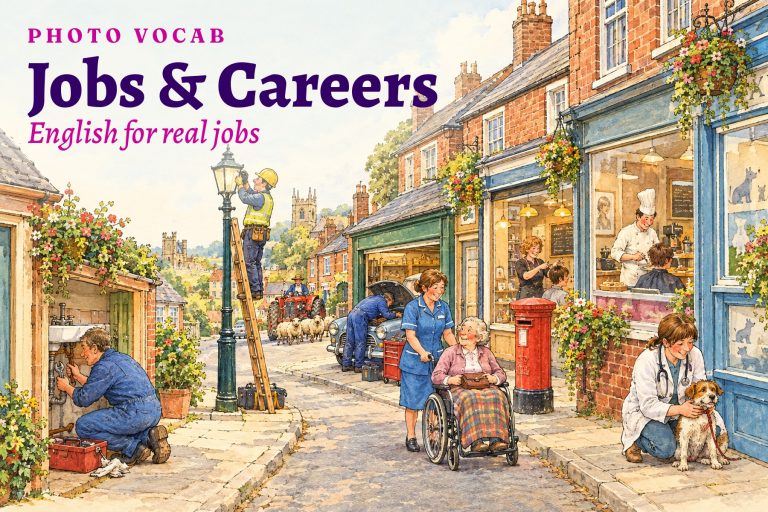
These are the words you’ll hear a hairdresser use every day, in alphabetical order. The three marked Featured appear in the photo at the top of this page.
brush (noun) — a tool with bristles used to smooth or style hair. · Featured
“She reached for the brush to smooth down the front section.”
comb (noun) — a flat tool with teeth used to untangle or section hair.
“He ran a comb through her hair before starting the cut.”
condition (verb) — to apply a product that keeps hair soft and healthy.
“Always condition your hair after shampooing to prevent dryness.”
dye (noun) — a substance used to change the colour of hair.
“She chose a warm brown dye for her first colour appointment.”
hair dryer (noun) — an electrical device used to dry hair with hot air. · Featured
“The hairdresser used a hair dryer and a round brush to add volume.”
hairdresser (noun) — a person whose job is to cut and style hair. · Featured
“The hairdresser asked how much length she wanted to take off.”
scissors (noun) — a tool with two sharp blades used for cutting.
“She trimmed the ends carefully with a pair of scissors.”
shampoo (noun) — a liquid soap used to wash hair.
“The salon uses a sulphate-free shampoo for sensitive scalps.”
style (verb) — to arrange hair in a particular way.
“It took twenty minutes to style her hair for the wedding.”
trim (noun) — a small cut that neatens hair without changing its length much.
“He just wanted a quick trim before his interview.”
How to Talk About Being a Hairdresser
Beyond the salon, here’s vocabulary for talking about hairdressing as a career. You’re on your feet all day, holding sharp scissors near people’s ears and making polite small talk about their holidays at the same time. According to the UK’s National Careers Service, most hairdressers train through a college course or an apprenticeship that mixes paid work with on-the-job training. Here are the words you need to talk about the trade:
apprenticeship (noun) — a paid job that combines work with study, leading to a qualification.
“She started her career with a hairdressing apprenticeship at sixteen.”
attention to detail (noun phrase) — the ability to notice and get small things exactly right.
“Precision cutting takes real attention to detail.”
client (noun) — a person who pays for a professional service.
“Every client gets a consultation before their appointment starts.”
consultation (noun) — a short discussion to understand what someone wants or needs.
“During the consultation, she asked to see a few reference photos.”
dexterity (noun) — skill and speed in using your hands.
“Cutting and styling hair all day requires real dexterity.”
on-the-job training (noun phrase) — learning a skill by actually doing the work, rather than studying in a classroom.
“Most of what she knows came from on-the-job training, not textbooks.”
qualified (adjective) — having the right training, certification, or experience for a job.
“It takes time and practice to become a fully qualified hairdresser.”
salon (noun) — a shop where hairdressing or beauty services are offered.
“The salon was fully booked for a Saturday morning.”
Quick Check
For teachers: free printable worksheet
Using this page in class? Download our free hairdresser vocabulary worksheet: a word list, matching, a gap fill, talking-about-the-job questions and a role play, with an answer key. Two A4 pages, ready to print.
Download the worksheet (PDF)Get the Free Trades English Teacher Pack
Using this page in class? Get all ten jobs in one free PDF: ten worksheets with answer keys, word lists with labelled photos for all 180 words, and a ready-made lesson plan. Sign up below and we’ll send it straight to your inbox.
Frequently Asked Questions
A trim is a small cut that just neatens the ends, while a full haircut usually changes the length or style more significantly.
A consultation is a short conversation before the appointment starts, so the hairdresser understands exactly what the client wants before picking up any scissors.
Everyday English classes often skip the words used in real workplaces. If you’re learning English for work, travel, or exams, knowing this kind of vocabulary makes real conversations — booking an appointment, describing your own job, chatting with your stylist — much easier.
More from the Careers Vocabulary Series:
- Carpenter Vocabulary
- Chef Vocabulary
- Dentist Vocabulary
- Electrician Vocabulary
- Farmer Vocabulary
- Mechanic Vocabulary
- Nurse Vocabulary
- Plumber Vocabulary
- Veterinarian Vocabulary
If you enjoyed this, you might also like our guides to Phrasal Verbs For The Office and Workplace Idioms. Got a hairdresser word we missed, or one that’s different where you live? Tell us on X — @EnglishStudy.