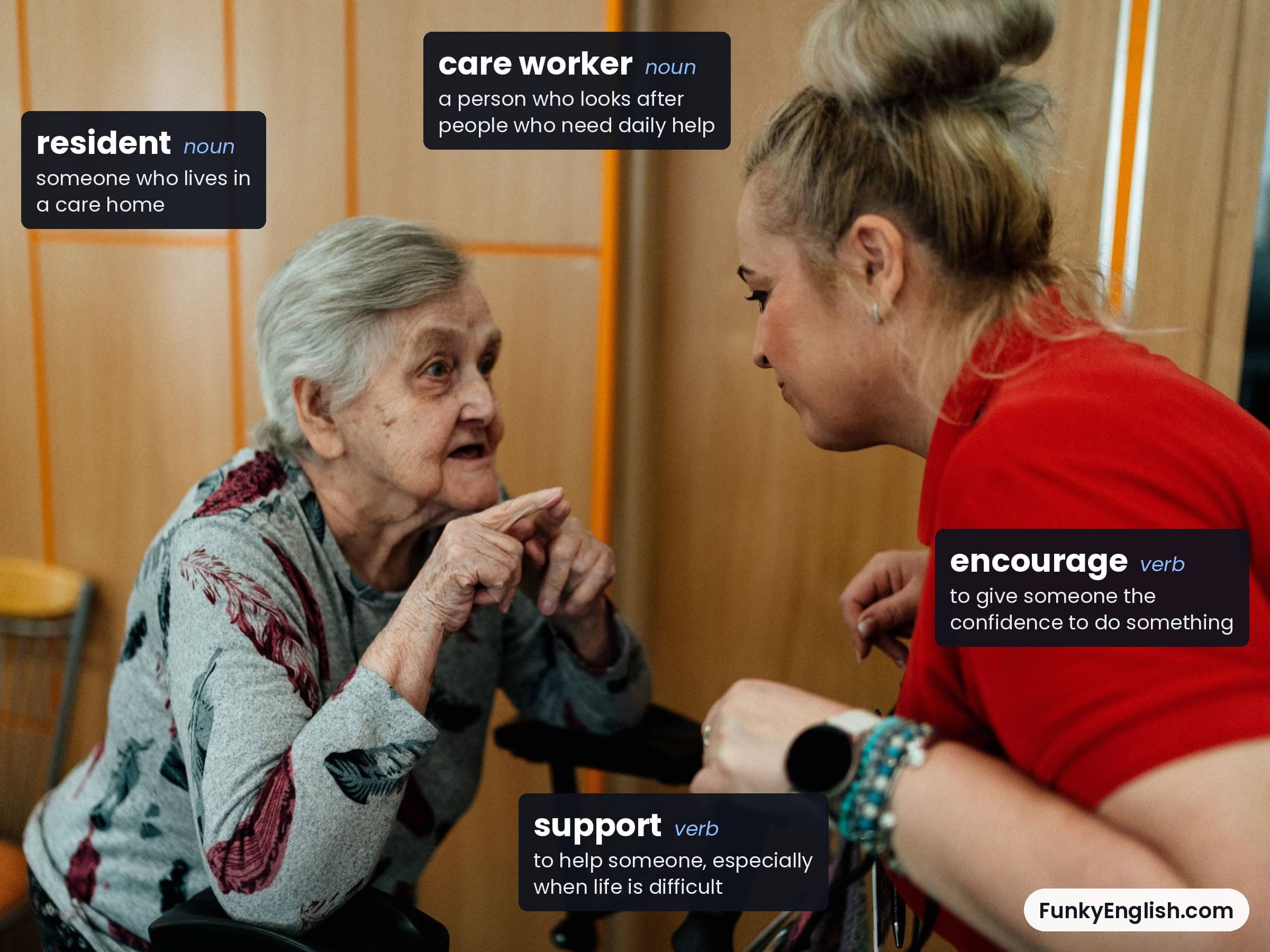
Care workers get people up in the morning, help them wash and dress, make sure they’ve taken their tablets, and then sit and hear the same story about 1962 as if it were the first time. They do it on early shifts, late shifts and night shifts, at weekends and on Christmas Day. It is one of the most important jobs in the country, and one of the least thanked. Here’s the English they use every day.
10 On-the-Job Care Worker Words
These are the words you’ll hear in care work, in alphabetical order. The four marked Featured appear in the photo at the top of this page.
care home (noun): a place where older people or people who need support live and get help 24 hours a day. You may also hear residential home or nursing home (a care home with nurses).
“Mum moved into a care home last spring, and the staff there are wonderful.”
care plan (noun): a written plan that explains the help each person needs and how they like things done.
“Before you help Mr Patel, read his care plan. He likes his tea very weak.”
care worker (noun): a person whose job is looking after people who need help with daily life. Also called a carer or support worker. In hospitals, the job is usually called healthcare assistant. · Featured
“The care worker crouched down so she could talk to Edith face to face.”
dignity (noun): being treated with respect, especially when you need help with private, personal things. Protecting people’s dignity is at the heart of care work.
“Always knock before you go in. It’s about dignity.”
encourage (verb): to give someone the confidence to do something. Care workers encourage people to stay as independent as possible. · Featured
“She encouraged Edith to walk to the dining room on her own.”
handover (noun): when the staff finishing a shift tell the next team what has happened and what they need to know.
“At handover, the night staff said Mr Jones had slept well for the first time in weeks.”
medication (noun): medicine. Care workers often give medication at set times on a medication round. Informally, people say meds.
“Morning medication is at eight, after breakfast.”
mobility (noun): how well someone can move around. Equipment like a walking frame, a wheelchair or a hoist can help.
“Her mobility has really improved since she started using the walking frame.”
resident (noun): a person who lives in a care home. In home care, people often say client instead. · Featured
“Edith is the longest-serving resident. She knows everyone’s business.”
support (verb): to help someone, especially when life is difficult. It’s also a noun: “She needs a lot of support.” · Featured
“We support residents to do as much as they can for themselves.”
What the Job Really Involves
Care work is so much more than “looking after people”. On a single shift, a care worker might help someone wash, dress and eat, give medication, help them move safely around the building, write up notes, talk to worried families and then, at the end of it all, spend ten minutes just holding someone’s hand because they’re having a bad day.
It is hard work. Shifts are often long, sometimes twelve hours, and they include nights and weekends. It’s physically demanding, with a lot of lifting, bending and time on your feet. It’s emotionally demanding too: care workers support people through illness, confusion and, sometimes, the end of their lives. And it’s too often underappreciated.
How to Talk About Working in Care
shift (noun): a fixed period of work. In care you’ll hear earlies, lates and nights.
“I’m on earlies this week, so I start at seven.”
rota (noun): a list showing who works which shifts and when. Americans usually say schedule.
“The new rota is up. I’ve got Christmas Day off!”
home care (noun): care given in people’s own homes. The formal word is domiciliary care (dom-i-SIL-ee-uh-ree).
“In home care, you can visit ten people in one day.”
personal care (noun): the polite, professional phrase for help with washing, dressing and using the toilet.
“She needs help with personal care in the mornings.”
dementia (noun): an illness that affects memory and thinking. Many care home residents live with dementia, and patience is everything.
“Our training covered how to talk calmly to someone living with dementia.”
next of kin (noun): a person’s closest family member, who is contacted if something happens.
“His daughter is his next of kin, so we called her straight away.”
Thinking about a career in care in England? Skills for Care explains the different roles and how to get started. You might also like our nurse and doctor vocabulary.
Useful Phrases for Care Work
With residents:
- “Good morning, Edith! How did you sleep?”
- “Take your time. There’s no rush.”
- “Would you like a cup of tea?” The most important question in any British care home.
- “Let me know if anything hurts.”
- “You’re doing really well.”
- “Is it all right if I help you with that?” Always ask first.
With families:
- “She’s had a good day today.”
- “He ate all his lunch, and he asked for seconds.”
- “She was talking about you this morning.”
And if you’re a family member, please say this more often:
- “Thank you for everything you do for Mum.”
- “We really couldn’t manage without you.”
- “I know it’s not an easy job. Thank you.”
UK English vs US English
- care worker or carer (UK) / caregiver (US)
- caretaker: be careful! In the UK, a caretaker looks after a building, like a school. In the US, it can mean someone who looks after a person.
- care home (UK) / nursing home or assisted living (US)
- rota (UK) / schedule (US)
- walking frame or Zimmer frame (UK) / walker (US)
Kind Words and Idioms
- a heart of gold: a very kind and generous nature. “Every carer on that unit has a heart of gold.”
- go the extra mile: to do more than you have to. “She always goes the extra mile, like painting Edith’s nails on a Friday.”
- TLC (tender loving care): gentle, kind attention. “All he needs is a bit of TLC.”
- a labour of love: hard work you do because you care, not for the money.
- lend a hand: to help. “Could you lend me a hand with the tea trolley?”
A Thank You to Care Workers
Thousands of care workers in the UK have come from all over the world, often thousands of miles from their own families, to look after ours. Together with carers born and raised here, they keep the whole system going, often for long hours and not much pay. The job is tough, stressful and physically demanding, and too many people don’t realise how much it takes.
To all the amazing carers out there: thank you for what you do.
Quick Check
Free teacher pack: ten jobs, ready to print
Using this page in class? Get worksheets, answer keys, word lists with photos and a lesson plan for ten jobs, from plumber to nurse. Sign up and it’s in your inbox in seconds.
Frequently Asked Questions
A care worker helps people who need support with daily life, such as older people or people with disabilities. This can include washing, dressing, meals, medication, moving around safely and, just as importantly, company and conversation.
In the UK, a care worker is paid to look after people. A carer can be a care worker, but the word is also used for family members who look after a relative, often without pay.
In American English, the most common word is caregiver. Be careful with caretaker: in British English, a caretaker looks after a building, such as a school.
More from the Careers Vocabulary Series:
- Baker Vocabulary
- Barista Vocabulary
- Builder Vocabulary
- Carpenter Vocabulary
- Chef Vocabulary
- Dentist Vocabulary
- Doctor Vocabulary
- Electrician Vocabulary
- Farmer Vocabulary
- Firefighter Vocabulary
- Flight Attendant Vocabulary
- Hairdresser Vocabulary
- Mechanic Vocabulary
- Nurse Vocabulary
- Photographer Vocabulary
- Pilot Vocabulary
- Plumber Vocabulary
- Police Officer Vocabulary
- Taxi Driver Vocabulary
- Teacher Vocabulary
- Veterinarian Vocabulary
- Waiter Vocabulary
See all of them on our Jobs and Careers Vocabulary page. Work in care, or have a word we missed? Tell us on X: @EnglishStudy.