
Doctors have about ten minutes to work out what’s wrong with you. You will spend the first nine of them saying “it’s probably nothing”. This page gives you the words for the other minute, so you can explain a sore throat without just pointing at it.
10 On-the-Job Doctor Words
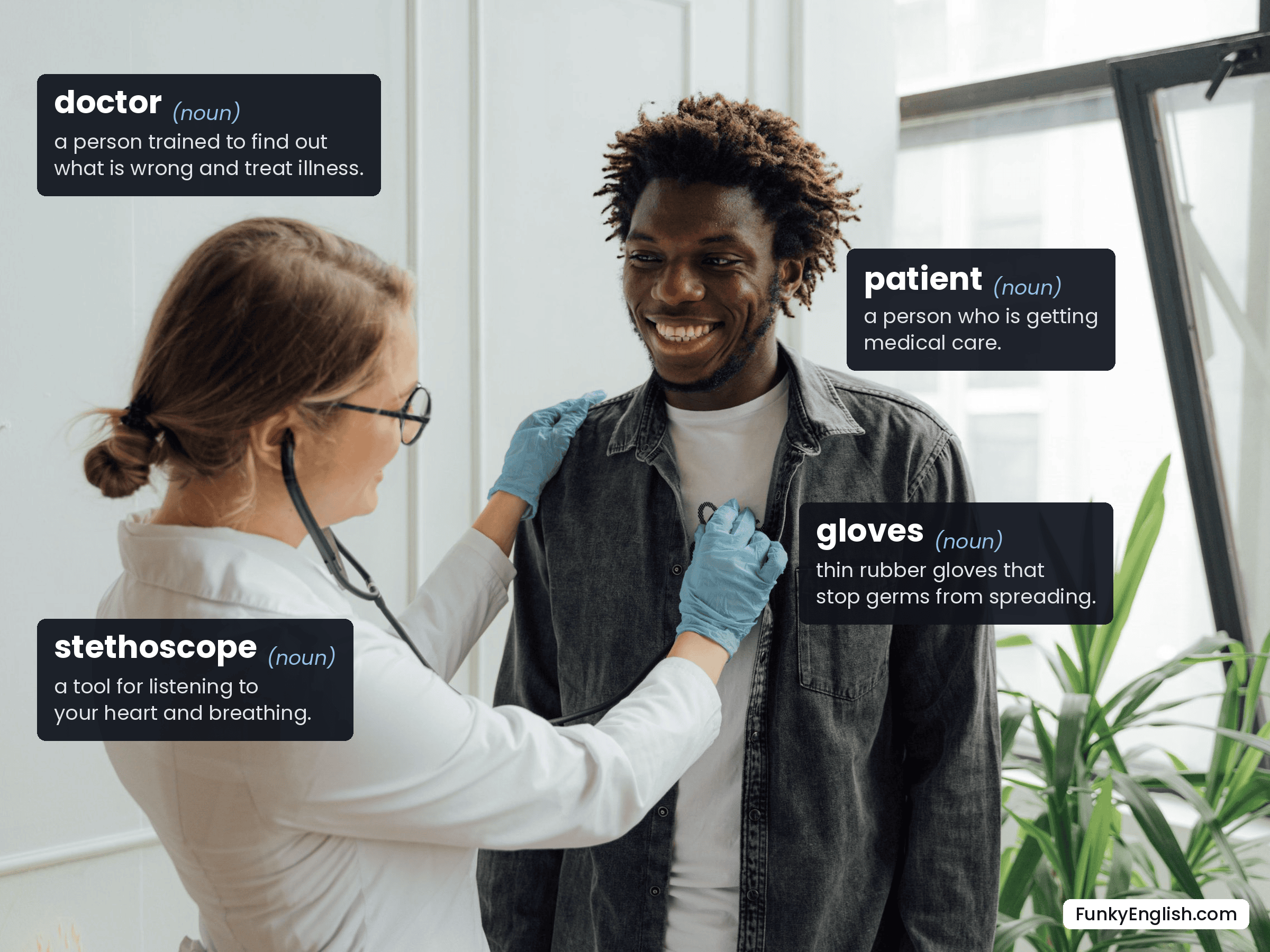
These are the words you’ll hear in any doctor’s surgery, in alphabetical order. The four marked Featured are in the photo at the top of this page.
appointment (noun): an arranged time to see someone, such as a doctor.
“My appointment was at 9:10. I was seen at 9:45. That’s normal.”
check-up (noun): a general examination to make sure you are healthy.
“I feel fine, but it’s been five years, so I’ve booked a check-up.”
diagnosis (noun): the doctor’s decision about what illness you have.
“The diagnosis was a chest infection, not the rare tropical disease I’d found online.”
doctor (noun): a person trained to find out what is wrong with you and treat illness. · Featured
“The doctor smiled, which was either good news or very good acting.”
examine (verb): to look at someone’s body carefully to check for problems.
“She examined his throat and asked him to say “aah”.”
gloves (noun): thin rubber gloves that keep hands clean and stop germs from spreading. · Featured
“The doctor snapped on a fresh pair of gloves before the examination.”
patient (noun): a person who is getting medical care. · Featured
“The patient laughed when the stethoscope touched him. It was cold.”
prescription (noun): a doctor’s written order for medicine, which you take to a pharmacy.
“Take this prescription to the chemist’s and they’ll sort you out.”
stethoscope (noun): a tool for listening to your heart and breathing. · Featured
“Hearing your own heartbeat through a stethoscope is strangely exciting.”
symptom (noun): a sign that you are ill, such as a cough or a high temperature.
“”So, what are your symptoms?” “Well, I feel terrible.””
Going to the Doctor’s: British English
A few words that confuse my students every year:
- GP: short for general practitioner, your family doctor. In Britain you say “I need to see my GP”, not “I need to see my general practitioner”. Nobody says that.
- the surgery: the building where your GP works. If a British friend says they’re “popping down to the surgery”, don’t panic. Nobody is getting an operation.
- A&E: Accident and Emergency, the hospital department for serious problems. Americans say the ER.
- the chemist’s: a shop where you collect your medicine. Pharmacy also works everywhere.
- I feel sick: in British English, this usually means you think you are going to vomit. If you just mean you are ill, say “I’m not well” or “I’m ill”.
How to Describe Your Symptoms
This is the part that really matters. You don’t need medical words, just a few simple patterns:
- I’ve got a headache / a sore throat / a temperature / a cough.
- My back / knee / stomach hurts.
- I feel dizzy / tired / sick.
- It started three days ago.
- It’s worse at night / in the morning.
And one tip from me: point. Doctors are very good at understanding pointing.
How to Talk About Being a Doctor
Becoming a doctor takes a long time. According to the UK’s National Careers Service, a GP usually does a five-year medical degree, two years of foundation training and then about three years of specialist training. That’s around ten years before you get your own surgery and your own stethoscope (you probably get the stethoscope sooner). Here are the words for the job:
consultant (noun): in the UK, a senior hospital doctor who leads a team.
“The consultant came round at ten with six junior doctors behind her.”
junior doctor (noun): in the UK, a qualified doctor who is still training.
“He’s a junior doctor, so he works a lot of night shifts.”
medical school (noun): a university department where people study to become doctors.
“She got into medical school on her second try.”
on call (adjective phrase): available to come to work if needed, often at night.
“I can’t come to the pub tonight. I’m on call.”
specialist (noun): a doctor who knows a lot about one part of the body or one type of illness.
“My GP sent me to a skin specialist.”
surgeon (noun): a doctor who does operations.
“The surgeon said the operation went perfectly. He looked very pleased with himself.”
UK English vs US English
- GP (UK) / family doctor or primary care doctor (US)
- surgery (UK) / doctor’s office (US)
- A&E (UK) / ER (US)
- chemist’s (UK) / drugstore (US), and pharmacy works in both
- I feel sick = I might vomit (UK) / I’m sick = I’m ill (US)
One more: as a verb, to doctor something means to change it dishonestly. “That photo has been doctored” means someone has edited it. Nothing to do with medicine, so don’t let your GP near your holiday pictures.
Doctor Idioms
- an apple a day keeps the doctor away: eat healthy food and you will stay well.
- just what the doctor ordered: exactly what you needed. “A cup of tea and a biscuit? Just what the doctor ordered.”
- under the weather: feeling a bit ill.
- right as rain: completely well again.
- a taste of your own medicine: the same bad treatment you gave to other people.
Quick Check
Free teacher pack: ten jobs, ready to print
Using this page in class? Get worksheets, answer keys, word lists with photos and a lesson plan for ten jobs, from plumber to nurse. Sign up and it’s in your inbox in seconds.
Frequently Asked Questions
GP stands for general practitioner. It is the British name for a family doctor, the doctor you see first for most health problems.
In British English, a surgery is the building where a GP sees patients. It does not mean the person is having an operation.
Usually about ten years for a GP: a five-year medical degree, two years of foundation training and around three years of specialist training. Hospital specialists often train for longer.
More from the Careers Vocabulary Series:
- Baker Vocabulary
- Barista Vocabulary
- Builder Vocabulary
- Care Worker Vocabulary
- Carpenter Vocabulary
- Chef Vocabulary
- Dentist Vocabulary
- Electrician Vocabulary
- Farmer Vocabulary
- Firefighter Vocabulary
- Flight Attendant Vocabulary
- Hairdresser Vocabulary
- Mechanic Vocabulary
- Nurse Vocabulary
- Photographer Vocabulary
- Pilot Vocabulary
- Plumber Vocabulary
- Police Officer Vocabulary
- Taxi Driver Vocabulary
- Teacher Vocabulary
- Veterinarian Vocabulary
- Waiter Vocabulary
See them all on our Jobs and Careers Vocabulary page. Got a word we missed, or a doctor’s surgery story? Tell us on X: @EnglishStudy.


