Christmas Day is over. The presents are open, the turkey is half eaten and someone has fallen asleep in front of the telly. Now comes one of the strangest weeks of the British year: nobody knows what day it is, everyone is eating cheese for breakfast, and then, suddenly, it’s New Year’s Eve. Here’s the English you need for Boxing Day, the week in between and the big countdown.
What Is Boxing Day?
Boxing Day is 26 December, the day after Christmas Day. It’s a bank holiday in the UK, so most people don’t go to work. And no, it has nothing to do with boxing (the sport).
Nobody knows for certain where the name comes from. The favourite explanation is that, long ago, wealthy families gave their servants and local tradespeople a Christmas box of money or gifts on the day after Christmas. Another theory is that churches opened their collection boxes and shared the money with the poor.
Today, Boxing Day is about four things:
- Leftovers: cold turkey, turkey sandwiches, turkey curry. There is always more turkey.
- The sales: shops cut their prices, and some people queue outside before they open.
- A long walk: to “walk off” yesterday’s dinner, usually in wellies, usually in the rain.
- Football: Boxing Day matches are a big tradition, and the grounds are full of families.
Boxing Day Vocabulary
bank holiday (noun): a public holiday in the UK when banks and most offices close. Christmas Day, Boxing Day and New Year’s Day are all bank holidays.
“Boxing Day is a bank holiday, so the trains run a Sunday service.”
bubble and squeak (noun): a very British dish of leftover potatoes and vegetables (often sprouts) fried together until crispy. It’s named after the noises it makes in the pan.
“Boxing Day breakfast is always bubble and squeak with a fried egg on top.”
bargain (noun): something you buy for much less than its usual price.
“I got this coat for half price in the Boxing Day sales. What a bargain!”
leftovers (noun): food that wasn’t eaten and is saved for later.
“We’ll be eating the leftovers until New Year.”
the sales (noun): the time when shops reduce their prices. The Boxing Day sales are some of the biggest of the year.
“Mum was outside the shop at 7am, ready for the sales.”
walk off (phrasal verb): to go for a walk to feel less full or to get rid of a feeling.
“Let’s go and walk off that Christmas pudding.”
The Week in Between: Twixmas
The days between Christmas and New Year have a few funny informal names. Twixmas (from betwixt, an old word for “between”) is the best known. Some people call it the Christmas limbo. Whatever you call it, it’s the week when:
- Nobody knows what day it is.
- Cheese and chocolate count as a balanced breakfast.
- You watch films you’ve already seen three times.
- Your out-of-office is still on, and that’s perfectly fine.
Need the phrases for leaving work before the break? See Christmas at work. And if you still have a ticket, panto season isn’t over yet: here’s what to shout at a pantomime.
New Year’s Eve in Britain
On 31 December, British people celebrate the end of the year with parties, fireworks and a lot of slightly out-of-tune singing. Some go out to pubs and parties, some go to see fireworks, and plenty stay at home in their pyjamas and watch the countdown on TV. All of these are completely acceptable.
- The countdown: everyone shouts the last ten seconds together. “Ten, nine, eight…”
- Big Ben: in London, the famous clock strikes midnight, followed by huge fireworks over the River Thames.
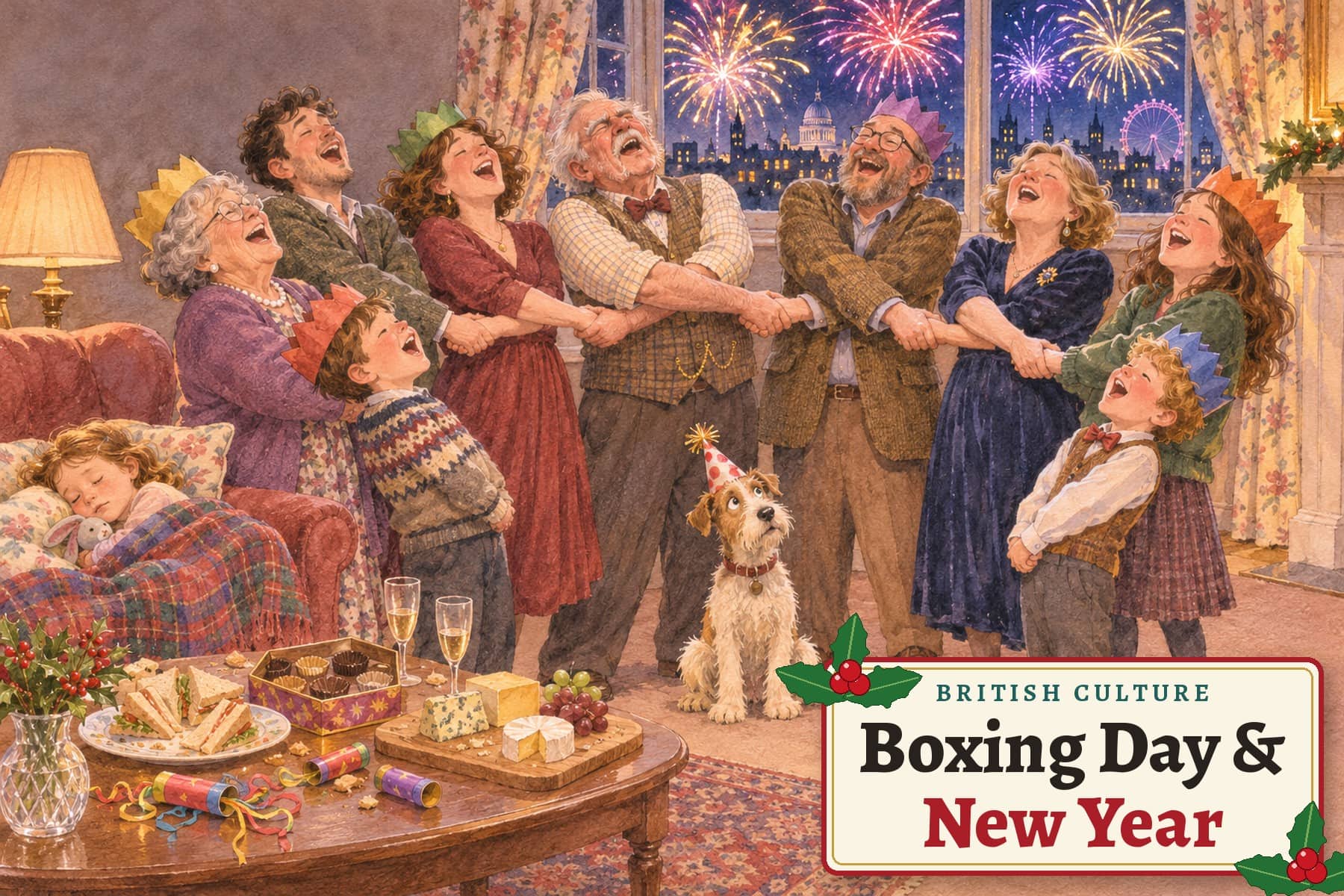
- “Auld Lang Syne”: a traditional Scottish song by Robert Burns, sung just after midnight. People stand in a circle, cross their arms and hold hands. Almost nobody knows all the words, so most people sing the first two lines and then hum enthusiastically.
- Hogmanay: the Scottish name for New Year’s Eve, with some of the biggest celebrations in the world.
- First-footing: a Scottish tradition. The first person to enter your home after midnight brings luck for the year, especially if they bring a small gift like shortbread or a piece of coal.
New Year Vocabulary
countdown (noun): counting backwards to zero before an event, like midnight on New Year’s Eve.
“We all held hands for the countdown.”
New Year’s resolution (noun): a promise you make to yourself to do something better in the new year.
“My New Year’s resolution is to go to the gym. It lasted until 4 January.”
ring in the New Year (phrase): to celebrate the start of the new year.
“We rang in the New Year with fireworks on the beach.”
see in the New Year (phrasal verb): to stay awake until midnight on New Year’s Eve.
“The kids were desperate to see in the New Year, but they were asleep by ten.”
fresh start (noun): a chance to begin again and do things differently.
“January always feels like a fresh start.”
Useful Phrases
- “Did you have a good Christmas?” The question everyone asks for the first two weeks of January.
- “What are you doing for New Year’s Eve?” Or just: “What are you doing for New Year?”
- “Happy New Year!” or “All the best for the New Year!”
- “Have you made any resolutions?”
- “See you next year!” The classic joke on 31 December, when you’re actually seeing someone the next day.
Fresh Start Idioms
- turn over a new leaf: to start behaving in a better way. “No more biscuits after midnight. I’m turning over a new leaf.”
- out with the old, in with the new: get rid of old things and welcome new ones.
- a clean slate: a chance to start again, without past mistakes counting.
- new year, new me: a jokey phrase people say (and post online) when they promise to change. It rarely lasts past January.
For teachers
Free Christmas lesson pack
Picture vocabulary, Christmas idioms and slang, card messages, what to shout at a panto, a very British Christmas story and a word search, with an answer key. Eight pages, ready to print.
Pop your email in and we’ll send it straight over. No partridge, no pear tree.
Frequently Asked Questions
Nobody knows for certain. The most popular explanation is that, in the past, wealthy families gave their servants and local tradespeople a “Christmas box” of money or gifts on the day after Christmas. Another idea is that churches opened their collection boxes for the poor that day.
Yes. Boxing Day (26 December) is a bank holiday in the UK, so most people have the day off work.
Hogmanay is the Scottish name for New Year’s Eve, and the celebrations are some of the biggest in the world. In Scotland, 2 January is also a bank holiday, so there is time to recover.
Test Yourself
Quick Check
🎄 More Christmas English: Christmas at work · pantomime · what to write in a Christmas card · Father Christmas vocabulary · Christmas dinner vocabulary · Christmas vocabulary · Christmas idioms and slang
What is FunkyEnglish?
FunkyEnglish is a website that helps you improve your English. We offer quick lessons that teach idioms, slang, phrasal verbs and more. Visit our homepage to see our latest articles, or use the menu to find specific content!