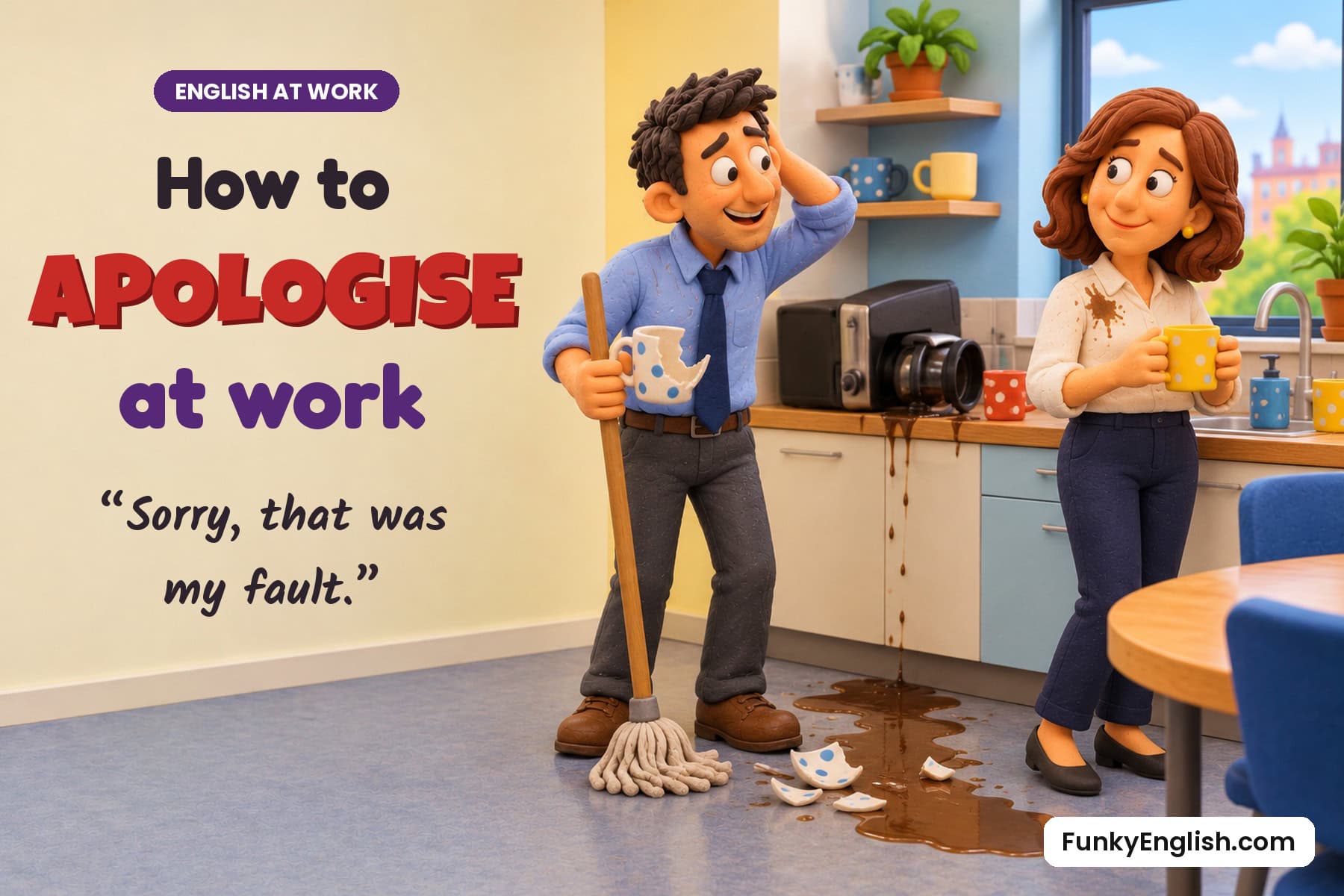
You knocked the coffee machine over. There’s a puddle on the floor, a broken mug in your hand and a brown splash on your colleague’s favourite shirt. Everyone makes mistakes at work. What people remember is how you apologise. Here’s how to say sorry in English, from tiny slips to big mistakes.
The Four Steps of a Good Apology
A good apology at work is short, clear and honest. It usually has four parts:
- Say sorry clearly: “I’m really sorry.”
- Take responsibility: “That was my fault.”
- Fix it: “I’ll clean it up and pay for the dry cleaning.”
- Stop it happening again: “I’ll be more careful with the machine.”
Notice what’s missing: excuses. “Sorry, but the machine is wobbly” turns an apology into a complaint.
Saying Sorry for Small Mistakes
For little slips, keep it quick and light:
- “Sorry about that!”
- “Oops, my mistake.”
- “Sorry, I sent you the wrong file.”
- “Apologies for the confusion.”
- “Sorry, I’ll sort it out.”
Saying Sorry for Bigger Mistakes
When something really matters, slow down and take it seriously:
- “I’m really sorry. That was my fault.”
- “I apologise for the mistake in the report.”
- “I take full responsibility.”
- “I should have checked the figures more carefully.”
- “It won’t happen again.”
Fixing the Problem
An apology sounds much stronger when you show what you’re doing about it:
- “I’ll correct it straight away.”
- “I’ve already sent the right version.”
- “Here’s what I’ll do to make sure it doesn’t happen again.”
Apologising to Customers and Clients
With customers, the language is a little more formal:
- “Please accept our apologies for the delay.”
- “We apologise for any inconvenience caused.”
- “Thank you for your patience.”
Apologising by Email
Here’s an example of owning up to a mistake:
Subject: Correction: sales figures
Hi Priya,
I’m sorry, I made a mistake in the figures I sent yesterday. The December total should be £42,000, not £24,000.
I’ve attached the corrected version and checked the rest of the report. Apologies for any confusion.
Best wishes,
Tom
Grammar Tip: Sorry and Apologise
- Apologise for + -ing or a noun: “I apologise for being late.” “I apologise for the mistake.”
- Sorry for / sorry about: “Sorry for the delay.” “Sorry about the coffee.”
- Sorry to + verb: “Sorry to keep you waiting.”
- Spelling: British English uses apologise. American English uses apologize.
Say This, Not That
| Sounds bad | Sounds better |
|---|---|
| It wasn’t my fault. | I’m sorry, I should have checked. |
| Sorry, but the system crashed. | Sorry, that was my mistake. I’ll fix it. |
| Calm down, it’s only a small mistake. | I’m really sorry about this. |
| Sorry if you were offended. | I’m sorry I upset you. |
| Whatever, I’ll fix it. | I’ll sort it out straight away. |
Why British People Say Sorry All the Time
British people are famous for saying sorry, often when they’ve done nothing wrong at all. Here’s what they actually mean:
- “Sorry?” (with a rising tone) Could you say that again?
- “Sorry, but…” I’m about to complain.
- “Sorry to bother you…” I’m about to bother you.
- “I’m sorry you feel that way.” I’m not sorry at all.
- “Sorry!” (said to a door they’ve just walked into) Pure reflex.
So if a British colleague says sorry when you bump into them, don’t worry. It’s not an apology, it’s a national habit.
More English at Work
This lesson is part of our English at Work series. Next, learn what British colleagues really mean, how to start and end an email, how to make small talk at work, how to follow up politely, how to ask for help politely, how to say no politely and how to disagree politely. For the full meaning of apologise, see the Cambridge Dictionary.
Frequently Asked Questions
Say sorry clearly, take responsibility without excuses, explain how you’ll fix it and how you’ll stop it happening again. Keep it short.
Both are fine. “Sorry” is friendlier and more common. “I apologise” and “please accept our apologies” are more formal, so they suit emails to clients.
With friendly colleagues and for tiny mistakes, yes, it’s casual and common. For anything serious, or with clients and managers, say “sorry, my mistake” instead.
Test Yourself
Quick Check
What is FunkyEnglish?
FunkyEnglish is a website that helps you improve your English. We offer quick lessons that teach idioms, slang, phrasal verbs and more. Visit our homepage to see our latest articles, or use the menu to find specific content!