
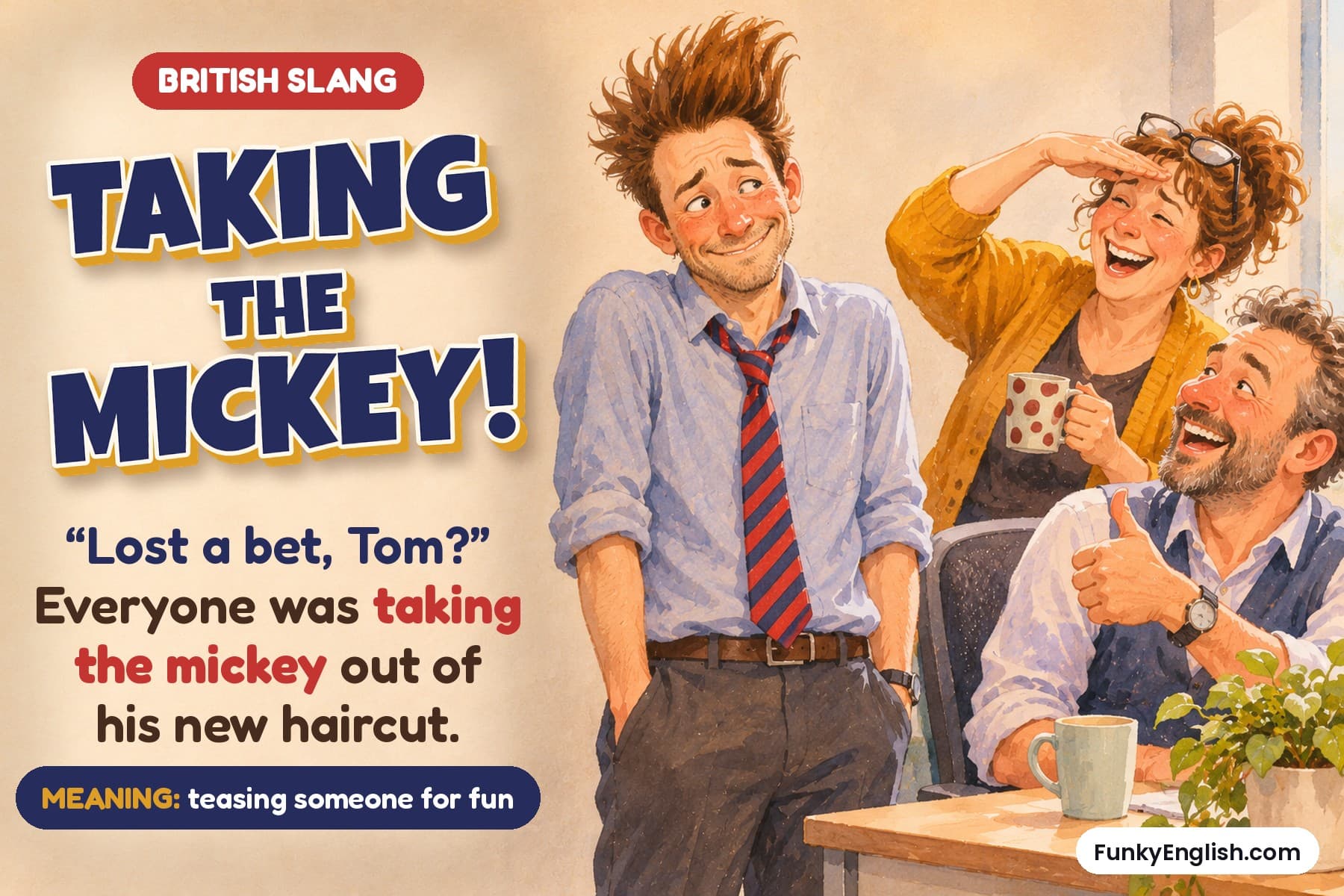
British English Slang – Taking the Mickey.
(phrase) To tease someone or make fun of them, usually in a playful way. It can also mean to take advantage of someone or to be unreasonable.
You come into work on Monday with a brand-new haircut. By ten o’clock, one colleague has asked if you lost a bet, another is humming the theme tune to a cartoon you’d rather not be compared to, and someone has drawn you on the whiteboard. They’re all taking the mickey. Welcome to the team.
In Britain, taking the mickey is a kind of affection. If your friends and colleagues tease you, it usually means they like you. If they’re very polite to you all the time, that’s when to worry. It’s closely related to banter, the friendly back-and-forth teasing that British people love.
Two Meanings of “Taking the Mickey”
1. Teasing someone (playful). This is the most common meaning. You usually take the mickey out of someone.
- “Everyone took the mickey out of my Christmas jumper. It’s got a light-up reindeer on it. Of course they did.”
- “Don’t take it seriously. He’s only taking the mickey.”
2. Being unreasonable or taking advantage (annoyed). Here, there’s no “out of”, and the speaker isn’t laughing.
- “Fifteen pounds for a coffee? They’re taking the mickey.”
- “He’s borrowed my car three times this week without asking. He’s really taking the mickey now.”
Tone of voice makes the difference. Said with a grin, it’s a joke. Said with folded arms, it’s a complaint. If you hear a playful joke and take it as a serious complaint, you get the wrong end of the stick. For another British way to say something’s gone too far, see Take the Biscuit.
Mick, Mickey or Michael?
You’ll hear several versions, and they all mean the same thing:
- take the mickey: the standard form.
- take the mick: shorter and very common in speech. “Are you taking the mick?”
- a mickey-take (noun): a joke at someone’s expense. “It was just a bit of a mickey-take. Nobody meant it.”
- extract the Michael: a jokey, mock-posh version. Michael is the “proper” name for Mickey, so this sounds like a very formal person trying to be rude. It’s rare, but it always gets a smile.
Where Does It Come From?
The most widely accepted explanation is Cockney rhyming slang. In rhyming slang, you replace a word with a phrase that rhymes with it, and then often drop the rhyming part. Here, Mickey Bliss rhymes with a much ruder word for urine. So take the Mickey Bliss became take the mickey, a polite way of saying a far less polite British expression that means the same thing. (Learn more rhyming slang in our British slang guide.)
According to the word historian Michael Quinion at World Wide Words, the phrase appears in print by 1935, already in a shortened form (“to take the mike out of”), so it’s probably older. Nobody knows who Mickey Bliss was, or if he was ever a real person. Like a lot of slang, the details are a little uncertain.
Is It Rude?
Taking the mickey is informal but not rude. It’s fine with friends, family and colleagues you know well. Avoid it in formal writing and with people you’ve just met. The ruder version (the one Mickey Bliss rhymes with) is very common in Britain, but it’s best to recognise it rather than use it, especially at work.
Not sure if a British colleague is joking or being serious? Our guide to what British colleagues really mean can help you read between the lines.
When you’re taking the mickey, it helps to read the room. If people stop laughing or someone looks hurt, it’s time to drop the joke.
Example:
- “Are you taking the mickey? You’ve eaten all the biscuits again!”
- “My brother always takes the mickey out of my driving.”
- “Don’t worry, I’m only taking the mick. Your hat looks great.”
- “Charging for a glass of tap water? That restaurant is taking the mickey.”
In the News
Spotted in the newsRelated slang: Banter · Plonker · 50 British slang wordsfunkyenglish.comWhat is slang?
Slang is very informal language. It’s usually spoken rather than written, and is often used by a particular group of people or in a particular place. Slang changes over time, and using it well is a great way to sound more natural when speaking English.
Frequently Asked Questions
Taking the mickey is British slang for teasing someone or making fun of them, usually in a friendly way. It can also mean being unreasonable or taking advantage, as in “Fifteen pounds for a coffee? They’re taking the mickey.”
No. It’s informal, but it isn’t rude, so it’s fine with friends and colleagues you know well. It comes from a much ruder expression, which is best avoided, especially at work.
It most likely comes from Cockney rhyming slang: “Mickey Bliss” rhymes with a rude word for urine. The phrase has appeared in print since at least the 1930s.
Test Yourself
What is FunkyEnglish?
FunkyEnglish is a website that helps you improve your English. We offer quick lessons that teach idioms, slang, phrasal verbs and more. Visit our homepage to see our latest articles, or use the menu to find specific content!


