Police officers deal with everything from stolen bikes to lost tourists to the occasional escaped cow on the motorway. Binge-watching British crime dramas? This page will help you follow every word, from “arrest” to “the Old Bill”.
10 On-the-Job Police Officer Words
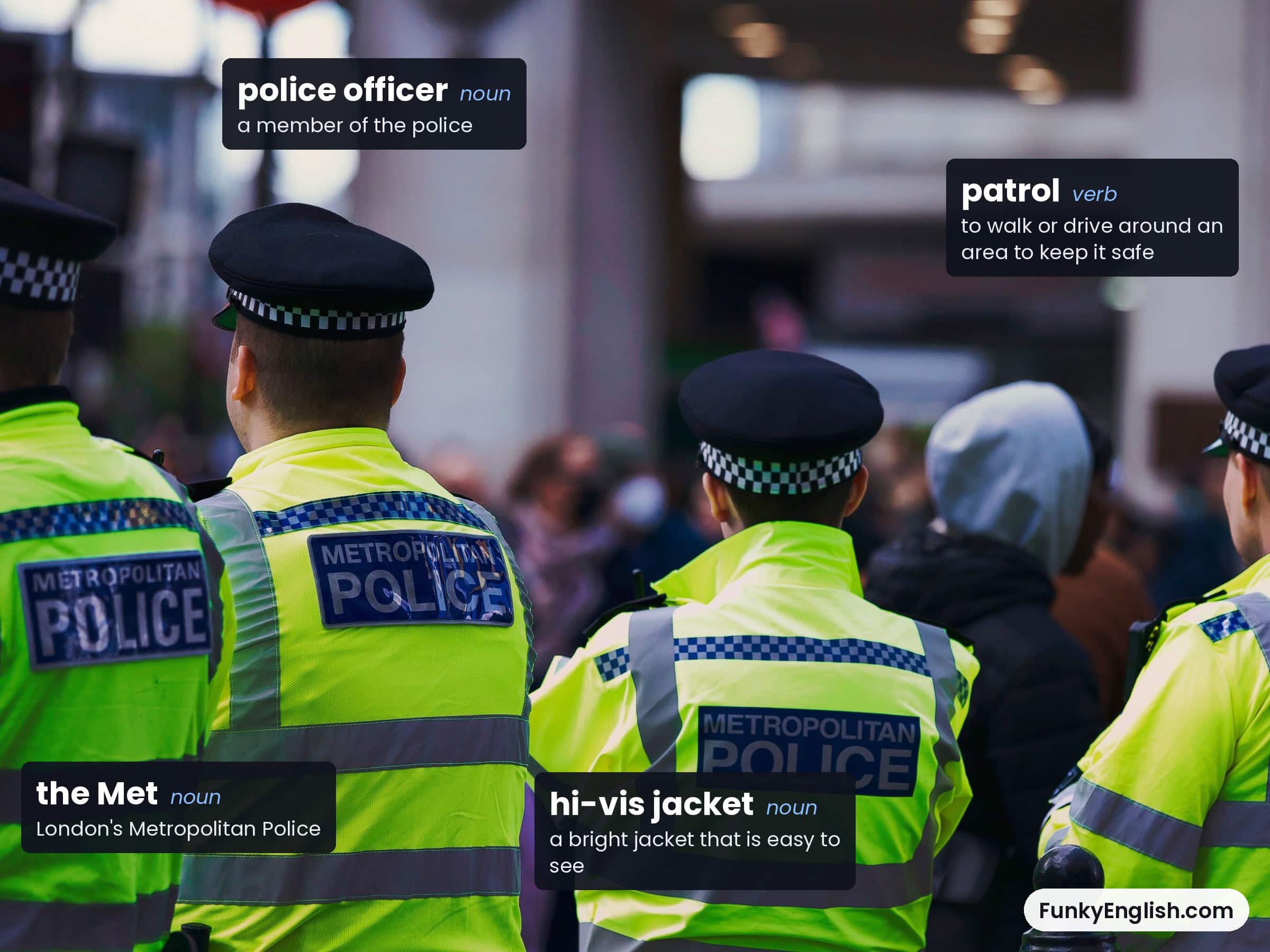
These are the words a police officer uses every day, in alphabetical order. The four marked Featured appear in the photo at the top of this page.
arrest (verb): to take someone to a police station because you think they have committed a crime. The noun is also arrest.
“He was arrested for shoplifting, which was awkward, because it was his own shop.”
crime (noun): something illegal, which you can be punished for.
“Most crime in the town centre happens late on Friday and Saturday nights.”
evidence (noun): information or objects that help to prove something happened.
“The police took the broken glass away as evidence.”
hi-vis jacket (noun): short for high-visibility jacket: a bright yellow or orange jacket with shiny stripes that is easy to see, even in the dark. Builders, cyclists and rail workers wear them too. Fun fact: put one on and you can walk almost anywhere looking like you’re in charge. · Featured
“The officers put on their hi-vis jackets before they stepped onto the motorway.”
investigate (verb): to try to find out the facts about a crime or problem.
“Detectives are investigating a break-in at the bakery. The only thing taken was a sausage roll.”
patrol (verb): to walk or drive around an area to keep it safe. You can also be on patrol. · Featured
“Two officers patrol the high street every Saturday afternoon.”
police officer (noun): a member of the police. In the UK, most officers have the rank of police constable, or PC. · Featured
“A police officer helped the lost tourist find her hotel.”
radio (noun): a small device officers carry to talk to each other and to the control room.
“She called for back-up on her radio.”
suspect (noun): a person the police think may have committed a crime. Careful with the stress: a SUSpect (noun), but to suSPECT (verb).
“The suspect ran off down an alley, still holding the stolen handbag.”
the Met (noun): short for the Metropolitan Police, the police force for most of London and the biggest in the UK. · Featured
“The Met has thousands of officers on duty during big events in London.”
Policeman, Police Officer, Bobby or Copper?
The safe, standard word is police officer. It works for everyone, which is why it’s replaced policeman and policewoman in most official English (just like firefighter replaced fireman).
British English also has some friendlier, more informal words. A bobby is an old-fashioned, affectionate word for a police officer, especially one on foot. It comes from Sir Robert Peel, who set up the Metropolitan Police in 1829. Copper is informal and very common, and the Old Bill is slang for the police in general. Cop is understood everywhere but sounds more American.
And the hats? Most officers on patrol wear a peaked cap with a black and white checked band. In England and Wales, you might also see the tall, rounded police helmet, the one every tourist wants a photo with.
How to Talk About Being a Police Officer
Long shifts, mountains of paperwork and no two days the same. There’s more than one way in, too: you can do a degree apprenticeship, study for a policing degree first, or join an entry programme after a different degree. The College of Policing lists every route, and all of them include a fitness test and background checks. The vocabulary of the job:
back-up (noun): extra officers who come to help.
“When the crowd got bigger, they called for back-up.”
background check (noun): a check on someone’s history, including any crimes, before they start a job.
“Every new recruit has to pass a background check.”
beat (noun): the area that an officer regularly patrols.
“For twenty years, the high street was his beat. He knew every shopkeeper by name.”
off duty (adjective): not working at the moment. The opposite is on duty.
“She was off duty, but she still stopped to help at the accident.”
paperwork (noun): the forms and reports that have to be written after an incident.
“Ten minutes to make the arrest, two hours to do the paperwork.”
PCSO (noun): short for police community support officer: a uniformed member of staff who patrols and helps the public, but has fewer powers than a police officer.
“A PCSO came into school to talk about road safety.”
shift (noun): a set period of work, which for police officers can be day or night.
“He’s on the night shift all week, so he sleeps until lunchtime.”
special constable (noun): a volunteer police officer who has a different day job.
“My dentist is a special constable at the weekends.”
UK English vs US English
- 999 (UK) / 911 (US) for emergencies. In the UK, 101 is the number for non-emergencies.
- police constable (UK) / patrol officer (US)
- police station (UK and US) / precinct (US, in some cities)
- copper (UK) / cop (US, now common everywhere)
- torch (UK) / flashlight (US)
Crime and Police Idioms
Crime dramas are full of these:
- caught red-handed: caught while doing something wrong.
- smell a rat: to suspect something is wrong.
- the long arm of the law: the power of the police to find and catch criminals.
- a slap on the wrist: a very small punishment.
- on the run: trying to escape from the police.
Quick Check
Free teacher pack: ten jobs, ready to print
Using this page in class? Get worksheets, answer keys, word lists with photos and a lesson plan for ten jobs, from plumber to nurse. Sign up and it’s in your inbox in seconds.
Frequently Asked Questions
Say police officer. It is the standard job title and works for men and women. Policeman and policewoman are still understood but sound old-fashioned in official English.
The Met is short for the Metropolitan Police, the police force for most of London and the largest in the UK.
Call 999 in an emergency, when someone is in danger or a crime is happening now. For non-emergencies, such as reporting a crime that has already happened, call 101.
More from the Careers Vocabulary Series:
- Baker Vocabulary
- Barista Vocabulary
- Builder Vocabulary
- Care Worker Vocabulary
- Carpenter Vocabulary
- Chef Vocabulary
- Dentist Vocabulary
- Doctor Vocabulary
- Electrician Vocabulary
- Farmer Vocabulary
- Firefighter Vocabulary
- Flight Attendant Vocabulary
- Hairdresser Vocabulary
- Mechanic Vocabulary
- Nurse Vocabulary
- Photographer Vocabulary
- Pilot Vocabulary
- Plumber Vocabulary
- Taxi Driver Vocabulary
- Teacher Vocabulary
- Veterinarian Vocabulary
- Waiter Vocabulary
See all of them on our Jobs and Careers Vocabulary page. Got a police word we missed, or one that’s different where you live? Tell us on X: @EnglishStudy.