Firefighters run towards the danger everyone else is running away from. They put out fires, cut people free from crashed cars, rescue cats from trees (yes, really) and still find time to visit schools. Here’s the vocabulary you’d hear at a fire station, from the first alarm to the last mug of tea.
10 On-the-Job Firefighter Words
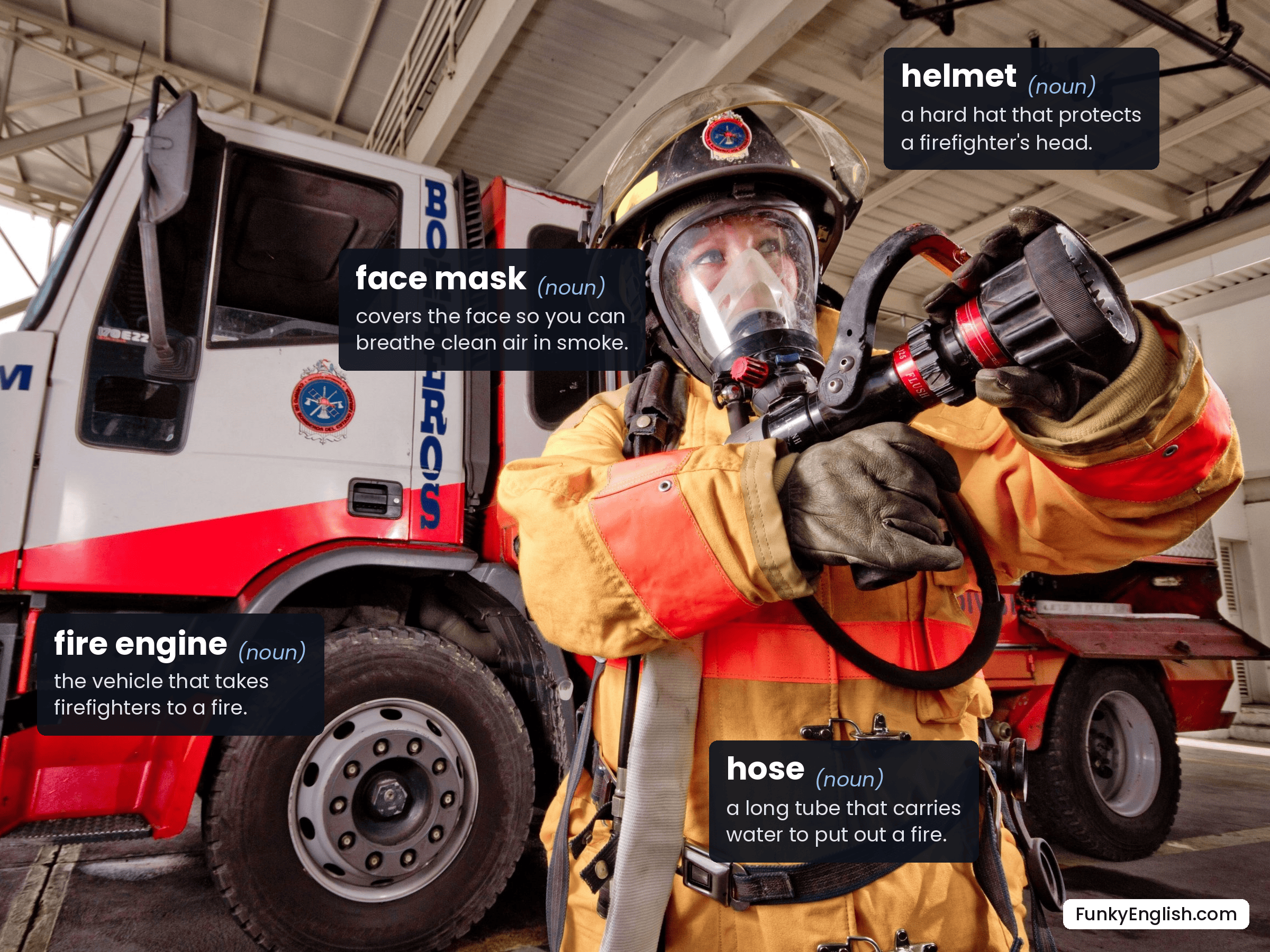
These are the words a firefighter uses every day, in alphabetical order. The four marked Featured appear in the photo at the top of this page.
alarm (noun): a loud sound that warns people of danger, such as a fire.
“The alarm went off at 2am, and the crew were out of the door in under a minute.”
blaze (noun): a large, strong fire.
“Firefighters fought the blaze for six hours before it was under control.”
crew (noun): a team of people who work together, especially on one fire engine.
“Each crew checks its equipment at the start of every shift.”
extinguish (verb): to put out a fire.
“They used foam to extinguish the fire in the kitchen.”
face mask (noun): covers the face so a firefighter can breathe clean air from a tank on their back. Together, the mask and tank are called breathing apparatus, or BA. · Featured
“You can’t see a thing in thick smoke, so the face mask goes on before you go in.”
fire engine (noun): the vehicle that takes firefighters, water and equipment to a fire. Americans say fire truck. · Featured
“The fire engine raced down the high street with its siren on.”
fire hydrant (noun): a water pipe in the street that firefighters connect their hoses to.
“In the UK, a small yellow sign with a black H shows where the nearest hydrant is.”
helmet (noun): a hard hat that protects a firefighter’s head. Most have a clear visor that comes down to protect the eyes. · Featured
“Her helmet was covered in soot by the end of the night.”
hose (noun): a long tube that carries water to put out a fire. The metal or plastic end you hold is the nozzle. · Featured
“Two firefighters held the hose steady while the water pressure built up.”
ladder (noun): a set of steps for climbing up, often fixed to the top of a fire engine.
“They used the ladder to reach a man trapped on the third floor.”
Fireman, Firewoman or Firefighter?
You will still hear people say fireman, especially in older films, books and children’s songs. But the job title today is firefighter, and it’s the word you should use.
Why the change? Because women do the job too. The UK’s first woman firefighter joined East Sussex Fire Brigade in 1976, and London’s first, Sue Batten, joined in 1982. The London Fire Brigade replaced “fireman” with “firefighter” in its contracts in the late 1980s, and in 2017 the head of the brigade said there is “no such thing as a fireman” anymore. Firewoman exists in the dictionary, but you will rarely hear it. “Firefighter” works for everyone, so it’s the safe choice.
This is part of a bigger pattern in English. Lots of job titles have moved away from “-man”: police officer (not policeman), flight attendant (not air hostess or steward) and chair or chairperson (not chairman). In exams and at work, the newer words are the ones to learn.
How to Talk About Being a Firefighter
Long shifts, hard training and a lot of waiting, then suddenly a lot of running. According to the UK’s National Careers Service, you can join through an apprenticeship or apply directly to your local fire and rescue service, and you’ll need to pass fitness and medical checks. Here are the words you need to talk about the job:
call-out (noun): an occasion when firefighters are sent to an emergency.
“It was a quiet night: only two call-outs, and both were false alarms.”
false alarm (noun): when an alarm goes off but there is no real fire.
“Burnt toast is the most common cause of false alarms.”
fire station (noun): the building where firefighters work and keep their fire engines.
“The fire station has an open day every summer.”
fitness test (noun): a test to check you are strong and fit enough for the job.
“He trained for months before his firefighter fitness test.”
on-call firefighter (noun): a firefighter who has another job but is ready to respond to emergencies when needed. Some people still use the older term retained firefighter.
“Most firefighters in small villages are on-call firefighters.”
rescue (verb): to save someone from a dangerous situation.
“The crew rescued a family of four from the burning building.”
smoke alarm (noun): a small device on the ceiling that beeps loudly when it detects smoke.
“Firefighters say you should test your smoke alarm once a month.”
watch (noun): in UK fire stations, a team that works the same shift pattern, often named by colour, such as Red Watch or Blue Watch.
“She’s on Blue Watch, so she works the same shifts as her crew.”
UK English vs US English
- fire engine (UK) / fire truck (US)
- fire brigade or fire and rescue service (UK) / fire department (US)
- 999 (UK) / 911 (US)
- fire station (UK and US) / firehouse (mainly US)
- pavement (UK) / sidewalk (US): where you find a fire hydrant in the US. In the UK, most hydrants are hidden under a small metal cover in the pavement.
Want more on the vehicle itself? See our Fire Engine Vocabulary page.
Fire Idioms
Fire has given English plenty of expressions:
- play with fire: to do something risky that could hurt you.
- fight fire with fire: to respond to an attack using the same methods.
- add fuel to the fire: to make a bad situation worse.
- there’s no smoke without fire: if people are talking about something, it’s probably partly true.
- too many irons in the fire: trying to do too many things at once.
Quick Check
Free teacher pack: ten jobs, ready to print
Using this page in class? Get worksheets, answer keys, word lists with photos and a lesson plan for ten jobs, from plumber to nurse. Sign up and it’s in your inbox in seconds.
Frequently Asked Questions
Say firefighter. It is the official job title and works for men and women. Fireman is now old-fashioned, and you will mostly see it in older books and films.
They are the same vehicle. Fire engine is British English and fire truck is American English.
In the UK you call 999 and ask for the fire service. 112 also works. In the US and Canada, the number is 911.
More from the Careers Vocabulary Series:
- Baker Vocabulary
- Barista Vocabulary
- Builder Vocabulary
- Care Worker Vocabulary
- Carpenter Vocabulary
- Chef Vocabulary
- Dentist Vocabulary
- Doctor Vocabulary
- Electrician Vocabulary
- Farmer Vocabulary
- Flight Attendant Vocabulary
- Hairdresser Vocabulary
- Mechanic Vocabulary
- Nurse Vocabulary
- Photographer Vocabulary
- Pilot Vocabulary
- Plumber Vocabulary
- Police Officer Vocabulary
- Taxi Driver Vocabulary
- Teacher Vocabulary
- Veterinarian Vocabulary
- Waiter Vocabulary
See all of them on our Jobs and Careers Vocabulary page. Got a firefighter word we missed, or one that’s different where you live? Tell us on X: @EnglishStudy.