Builders start early, finish early and drink more tea than almost anyone else in Britain. Here’s the English of the building site, from the scaffolding to the cement mixer, plus a few words that will help you spot a cowboy before he disappears with your deposit.
10 On-the-Job Builder Words
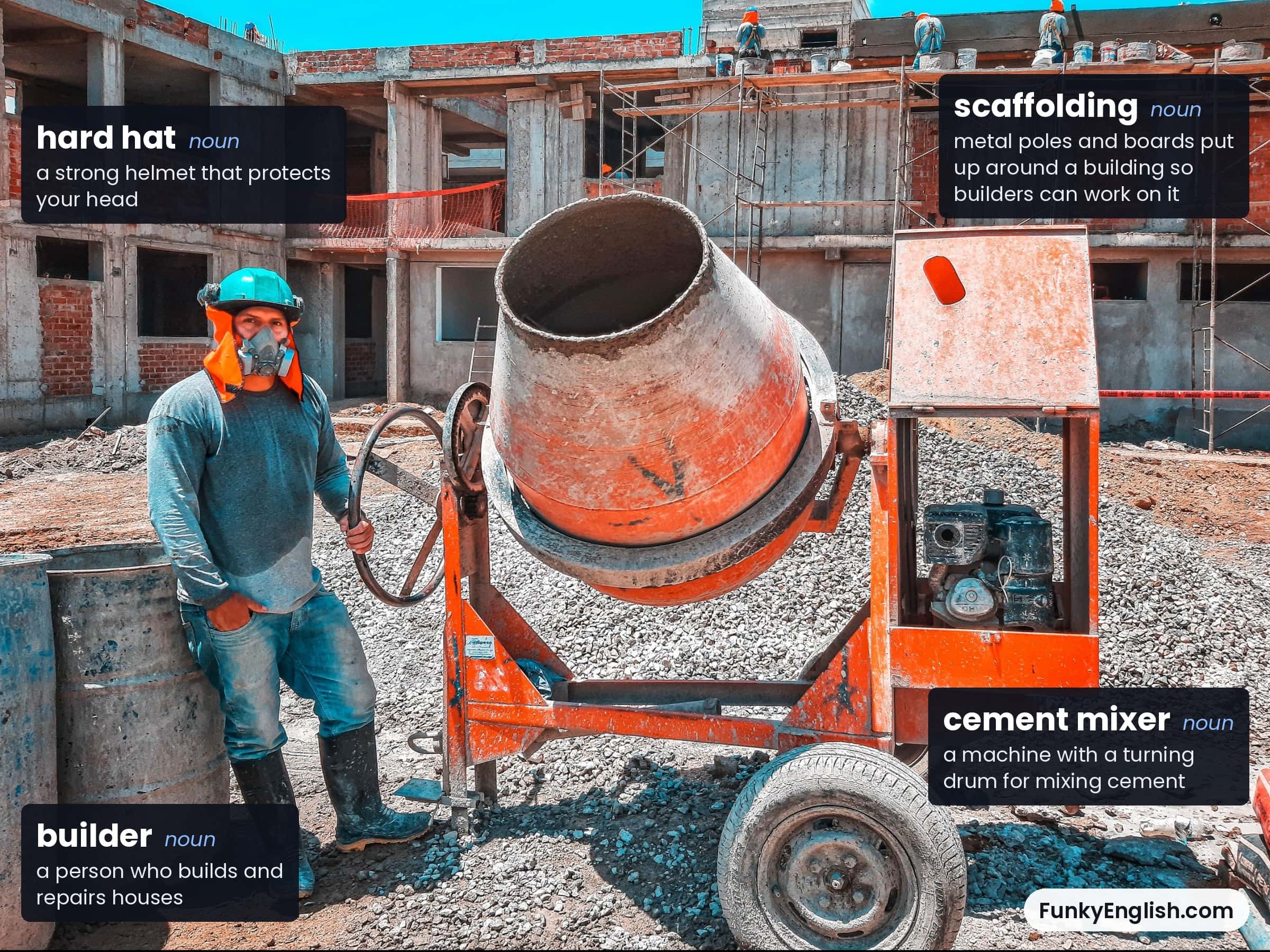
These are the words you’ll hear on a building site, in alphabetical order. The four marked Featured appear in the photo at the top of this page.
brick (noun): a hard block of baked clay used to build walls. Someone whose job is building with bricks is a bricklayer.
“A good bricklayer can lay hundreds of bricks a day. I struggle to build a sandcastle.”
builder (noun): a person whose job is building and repairing houses and other buildings. · Featured
“The builder said it would take two weeks. That was in March.”
building site (noun): a place where a building is being built. Americans say construction site.
“Visitors must report to the office before entering the building site.”
cement mixer (noun): a machine with a big turning drum that mixes cement, sand, stones and water to make concrete. · Featured
“The cement mixer has been turning since 7am, and so has my headache.”
concrete (noun): a hard building material made from cement, sand, stones and water.
“Once the concrete sets, you can’t change your mind about where the patio goes.”
hard hat (noun): a strong helmet that protects your head on a building site. · Featured
“No hard hat, no entry. Even for the boss.”
ladder (noun): two long poles joined by steps, used for climbing up and down.
“Never walk under a ladder. It’s bad luck, and someone might drop a brick.”
scaffolding (noun): a frame of metal poles and wooden boards put up around a building so builders can work on the higher parts. · Featured
“There’s been scaffolding on our street for so long that I’ve forgotten what the house looks like.”
trowel (noun): a small tool with a flat blade, used to spread cement between bricks.
“He spread the cement with his trowel like butter on toast.”
wheelbarrow (noun): a small cart with one wheel at the front and two handles, used to move heavy things.
“Pushing a full wheelbarrow uphill is the best workout nobody wants.”
Tea Breaks, Wellies and Cowboys
Britain’s building sites have a culture all of their own. Builders start very early, often before 8am, and the tea break is sacred. On a muddy site, wellies are as important as the hard hat. On most UK sites, workers also need a CSCS card to show they have had health and safety training. Here’s how people talk about building work:
builder’s tea (noun): strong tea with milk and usually two sugars, the colour of a brick.
“Two builder’s teas, please. One sugar for me, three for Dave.”
cowboy builder (noun): a builder who does bad work, charges too much or disappears halfway through the job.
“The cowboy builder took our money and left us with half a kitchen.”
extension (noun): a new room or part added to a house.
“We’re building an extension at the back, so the kitchen is in the garden for now.”
quote (noun): the price a builder says they will charge before starting the work.
“Always get three quotes before you choose a builder.”
site manager (noun): the person in charge of the building site.
“The site manager checked everyone was wearing a hard hat.”
wellies (noun): tall rubber boots that keep your feet dry. Short for wellington boots. Americans say rubber boots.
“Wear your wellies, the site is a sea of mud today.”
Other jobs on the same site: see our carpenter, electrician and plumber vocabulary. The person who designed the building in the first place? That’s the architect.
UK English vs US English
- building site (UK) / construction site (US)
- builder (UK) / contractor or construction worker (US)
- skip (UK, a big metal container for rubbish) / dumpster (US)
- wellies (UK) / rubber boots (US)
- ground floor (UK) / first floor (US). Confusing, but true.
Building Idioms
English builds a lot of its expressions with bricks and concrete:
- like talking to a brick wall: when someone doesn’t listen to you at all. “Asking my son to tidy his room is like talking to a brick wall.”
- hit a brick wall: to reach a point where you can’t make progress. “The investigation hit a brick wall.”
- set in stone: fixed and impossible to change. “The dates aren’t set in stone yet.”
- lay the foundations: to do the basic work that something bigger is built on. “Good grammar lays the foundations for fluent English.”
- build bridges: to improve relationships between people. “After the argument, she tried to build bridges with her sister.”
Quick Check
Free teacher pack: ten jobs, ready to print
Using this page in class? Get worksheets, answer keys, word lists with photos and a lesson plan for ten jobs, from plumber to nurse. Sign up and it’s in your inbox in seconds.
Frequently Asked Questions
Builder’s tea is strong British tea with milk and usually sugar. It is named after builders, who are famous for their tea breaks.
A cowboy builder is a builder who does poor work, overcharges or leaves a job unfinished. It is informal British English.
An architect designs a building and draws the plans. A builder does the actual building work on site.
More from the Careers Vocabulary Series:
- Baker Vocabulary
- Barista Vocabulary
- Care Worker Vocabulary
- Carpenter Vocabulary
- Chef Vocabulary
- Dentist Vocabulary
- Doctor Vocabulary
- Electrician Vocabulary
- Farmer Vocabulary
- Firefighter Vocabulary
- Flight Attendant Vocabulary
- Hairdresser Vocabulary
- Mechanic Vocabulary
- Nurse Vocabulary
- Photographer Vocabulary
- Pilot Vocabulary
- Plumber Vocabulary
- Police Officer Vocabulary
- Taxi Driver Vocabulary
- Teacher Vocabulary
- Veterinarian Vocabulary
- Waiter Vocabulary
See all of them on our Jobs and Careers Vocabulary page. How do you take your builder’s tea? Tell us on X: @EnglishStudy.