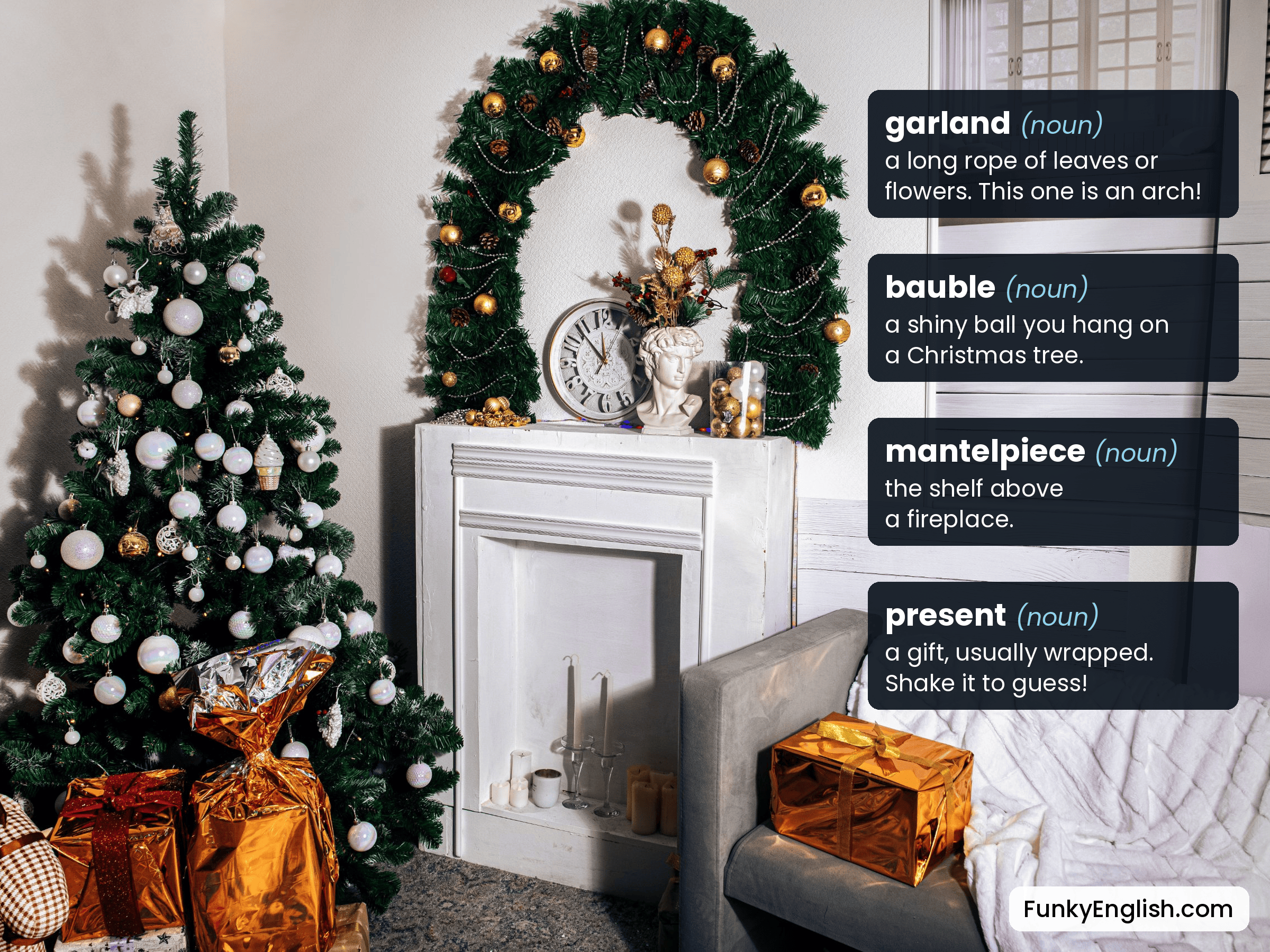
In Britain, Christmas starts somewhere around the end of October, when the mince pies appear in the supermarket right next to the Halloween sweets. By December, every front room has a tree, a pile of presents and at least one bauble the cat has already knocked off. Here are the words you need to get through it.
Words in the Photo
Four words you can see in the photo at the top of this page, in alphabetical order.
bauble (noun): a shiny decoration, usually a ball, that you hang on a Christmas tree. · In the photo
“We always buy one new bauble every year, so the tree is a bit of a family history.”
garland (noun): a long rope of leaves, flowers or decorations. The one in the photo is bent into an arch. · In the photo
“Mum wrapped a garland around the banister.”
mantelpiece (noun): the shelf above a fireplace. You will also hear mantel. · In the photo
“The Christmas cards go on the mantelpiece until there’s no room left.”
present (noun): something you give someone, usually wrapped. · In the photo
“I shook my present, but I still couldn’t guess what it was.”
12 More Christmas Words
The words you will hear all through December, from the office party to the school nativity play.
advent calendar (noun): a calendar with 24 little doors, one for each day from 1 December. There is usually a chocolate behind each door.
“My brother opened all the doors on his advent calendar on the first day.”
carol (noun): a traditional Christmas song.
“Some children sang carols at our door and we gave them a mince pie each.”
Christmas Eve (noun): 24 December, the day before Christmas.
“We always wrap the last presents on Christmas Eve, usually at midnight.”
Christmas jumper (noun): a knitted top with a festive picture on it, the sillier the better.
“His Christmas jumper had a reindeer with a flashing red nose.”
cracker (noun): a paper tube that two people pull until it goes bang. Inside are a paper hat, a small toy and a very bad joke.
“Grandad wore his cracker hat all afternoon.”
fairy lights (noun): a string of small electric lights for decorating.
“It took us an hour to untangle the fairy lights.”
mince pie (noun): a small sweet pie filled with dried fruit and spices. No meat, despite the name!
“We leave a mince pie out for Father Christmas.”
mistletoe (noun): a plant with white berries. Tradition says if you stand under it, someone might kiss you.
“He spent the whole party trying to avoid the mistletoe.”
stocking (noun): a big sock you hang up on Christmas Eve for small presents.
“There was a satsuma at the bottom of my stocking, like every year.”
tinsel (noun): long, shiny strips of decoration that get everywhere.
“We were still finding tinsel behind the sofa in March.”
wrap (verb): to cover a present in paper. Wrapping paper is the paper you use.
“I’m terrible at wrapping. Everything ends up looking like a potato.”
wreath (noun): a ring of leaves and decorations, often hung on the front door.
“Our neighbours have a wreath on the door from the first of December.”
Christmas in Britain and America
Same holiday, slightly different words:
- Father Christmas (UK) or Santa (US): British people say both, but Father Christmas is the traditional British name.
- Happy Christmas or Merry Christmas: both are fine everywhere. Happy Christmas just sounds a little more British.
- Fairy lights (UK) or Christmas lights (US): the same tangled string of bulbs.
- Crackers: very British. Most Americans have never pulled one.
- Boxing Day: 26 December is a public holiday in the UK. It has nothing to do with boxing. Most people spend it eating leftovers and watching telly.
And if you see Xmas written on a card, it just means Christmas.
More Festive English
Want more? Try our Christmas idioms and British Christmas slang, the idiom like turkeys voting for Christmas, or see all our photo vocabulary lessons. For the full meaning of bauble, see the Cambridge Dictionary.
For teachers
Free Christmas lesson pack
Picture vocabulary, Christmas idioms and slang, card messages, what to shout at a panto, a very British Christmas story and a word search, with an answer key. Eight pages, ready to print.
Pop your email in and we’ll send it straight over. No partridge, no pear tree.
Frequently Asked Questions
Most families put the tree up in early December. Tradition says you take it down by Twelfth Night, 5 or 6 January, or you’ll have bad luck all year.
Both are correct. Merry Christmas is more common in cards and songs, and Happy Christmas sounds a little more British. Nobody will mind which one you use.
Boxing Day is 26 December, the day after Christmas. It is a public holiday in the UK. The most popular explanation is that it was the day servants and workers were given a box with money or gifts.
Test Yourself
Quick Check
🎄 More Christmas English: Boxing Day and New Year · Christmas at work · pantomime · what to write in a Christmas card · Father Christmas vocabulary · Christmas dinner vocabulary · Christmas idioms and slang · like turkeys voting for Christmas · Xmas · wrap up
What is FunkyEnglish?
FunkyEnglish is a website that helps you improve your English. We offer quick lessons that teach idioms, slang, phrasal verbs and more. Visit our homepage to see our latest articles, or use the menu to find specific content!