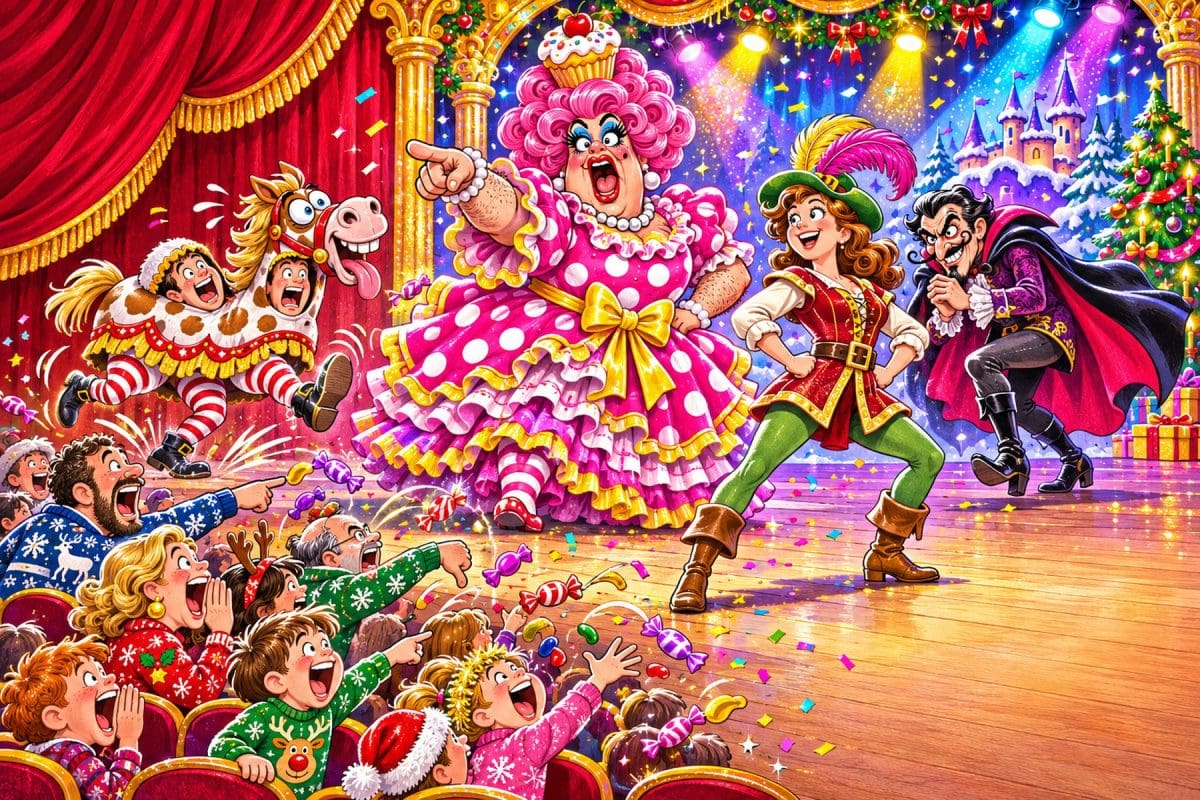
Imagine a theatre full of grown adults in Christmas jumpers, booing a man in a cape, shouting at a woman in tights and arguing with a large man in a dress. Nobody is angry. Everyone is having the time of their life. This is pantomime, or panto, and it is one of the strangest and best British Christmas traditions. Here’s what it is, who’s who, and, most importantly, what to shout.
What Is a Pantomime?
A pantomime is a funny family show, with songs, jokes and silly costumes, that runs in theatres all over the UK around Christmas and New Year. The story is usually a well-known fairy tale, but nobody cares much about the story. What matters is the noise.
Popular pantos include Cinderella, Aladdin, Jack and the Beanstalk, Snow White, Dick Whittington, Peter Pan and Puss in Boots. You’ll find one in big city theatres, small-town halls and, every year, at least one primary school.
The big difference from normal theatre: the audience joins in. Loudly. In a normal play, shouting at the actors gets you thrown out. In a panto, if you don’t shout, the actors will tell you off.
Who’s Who in a Pantomime
the dame (noun): a funny older woman, often the hero’s mother, always played by a man in an enormous wig, bright make-up and a new ridiculous dress for every scene. The star of the show.
“The dame came on in a dress made to look like a Christmas pudding, and the whole theatre cheered.”
the principal boy (noun): the young hero of the story, traditionally played by a young woman in a tunic, tights and boots. Yes, really. Panto loves to swap things around.
“The principal boy slapped her thigh and promised to save the day.”
the villain (noun): the baddie: an evil king, a wicked witch or a greedy landlord. The audience boos and hisses every time they appear. They love it.
“The villain swished his cape and the audience booed so loudly the floor shook.”
the good fairy (noun): a kind magical character who helps the hero and usually speaks in rhyme.
“The good fairy waved her wand and turned the pumpkin into a golden coach.”
the pantomime horse (noun): a horse (or cow) costume worn by two people, one at the front and one at the back. They rarely agree on which way to go.
“The pantomime horse tried to sit down, but only the back half managed it.”
What to Shout at a Pantomime
This is the most important section. If you go to a panto, you need these lines:
- “He’s behind you!” (or “She’s behind you!” or “It’s behind you!”): when the villain or a ghost creeps up on the hero. The hero always looks the wrong way, so you shout it again. And again.
- “Oh no it isn’t!” / “Oh yes it is!”: the great panto argument. An actor says something, the audience disagrees, and it goes back and forth until somebody gives up. It’s never the audience.
- “Boo!” and “Hiss!”: whenever the villain walks on stage.
- “Hooray!”: whenever the hero wins.
- “Hello, boys and girls!” / “Hello!”: the comic character greets the audience, and you shout back. If it isn’t loud enough, they will make you do it again.
- “Look out!”: a general warning, useful in any situation involving a custard pie.
More Panto Vocabulary
slapstick (noun): silly physical comedy: people falling over, getting hit with custard pies, slipping on banana skins.
“There was so much slapstick that the front row went home covered in foam.”
audience participation (noun): when the people watching join in with the show by shouting, singing or helping on stage.
“Panto is all about audience participation, so don’t sit there quietly.”
song sheet (noun): a big board with the words of a song, lowered onto the stage so the audience can sing along. One half of the theatre always competes against the other.
“The song sheet came down, and Dad sang louder than anyone. We were so embarrassed.”
panto season (noun): the weeks around Christmas when pantomimes are on. For many actors, it’s the busiest (and best-paid) time of the year.
“It wouldn’t be Christmas without panto season.”
over the top (phrase): (also OTT) much too much, in a way that is funny or ridiculous. The perfect description of every panto costume.
“The dame’s final dress was so over the top it had its own fairy lights.”
Panto Phrases in Everyday English
Pantomime is so well known in Britain that people use it to talk about real life, especially in newspapers and football:
- a pantomime villain: someone everyone loves to hate. “The referee has become the pantomime villain of the season.”
- it’s turned into a pantomime: a situation has become ridiculous and chaotic. “The meeting turned into a complete pantomime.”
- “Oh no it isn’t!”: said jokingly when someone disagrees with you. “This is the best pizza in town.” “Oh no it isn’t!” “Oh yes it is!”
- like a pantomime horse: two people who can’t work together. “They tried to carry the sofa upstairs like a pantomime horse.”
UK vs US: Careful With This One
In British English, a pantomime is the Christmas show. In American English, pantomime usually means telling a story with actions and no words, which British people call mime. So if an American friend invites you to a pantomime, don’t expect shouting. Expect silence. It’s the opposite!
Want more British traditions? Try Bonfire Night and pinch punch, first of the month.
For teachers
Free Christmas lesson pack
Picture vocabulary, Christmas idioms and slang, card messages, what to shout at a panto, a very British Christmas story and a word search, with an answer key. Eight pages, ready to print.
Pop your email in and we’ll send it straight over. No partridge, no pear tree.
Frequently Asked Questions
It is what the audience shouts to warn the hero that the villain (or a ghost) is creeping up behind them. The hero always turns the wrong way, so the audience has to shout it again, louder.
Most pantomimes run from late November or early December until early January, so Christmas and New Year are the busiest times.
It is a long comic tradition. The dame is usually an older woman, such as the hero’s mother, played over the top by a man in a huge wig and outrageous dresses.
Test Yourself
Quick Check
🎄 More Christmas English: Boxing Day and New Year · Christmas at work · Father Christmas vocabulary · what to write in a Christmas card · Christmas dinner vocabulary · Christmas vocabulary · Christmas idioms and slang
What is FunkyEnglish?
FunkyEnglish is a website that helps you improve your English. We offer quick lessons that teach idioms, slang, phrasal verbs and more. Visit our homepage to see our latest articles, or use the menu to find specific content!