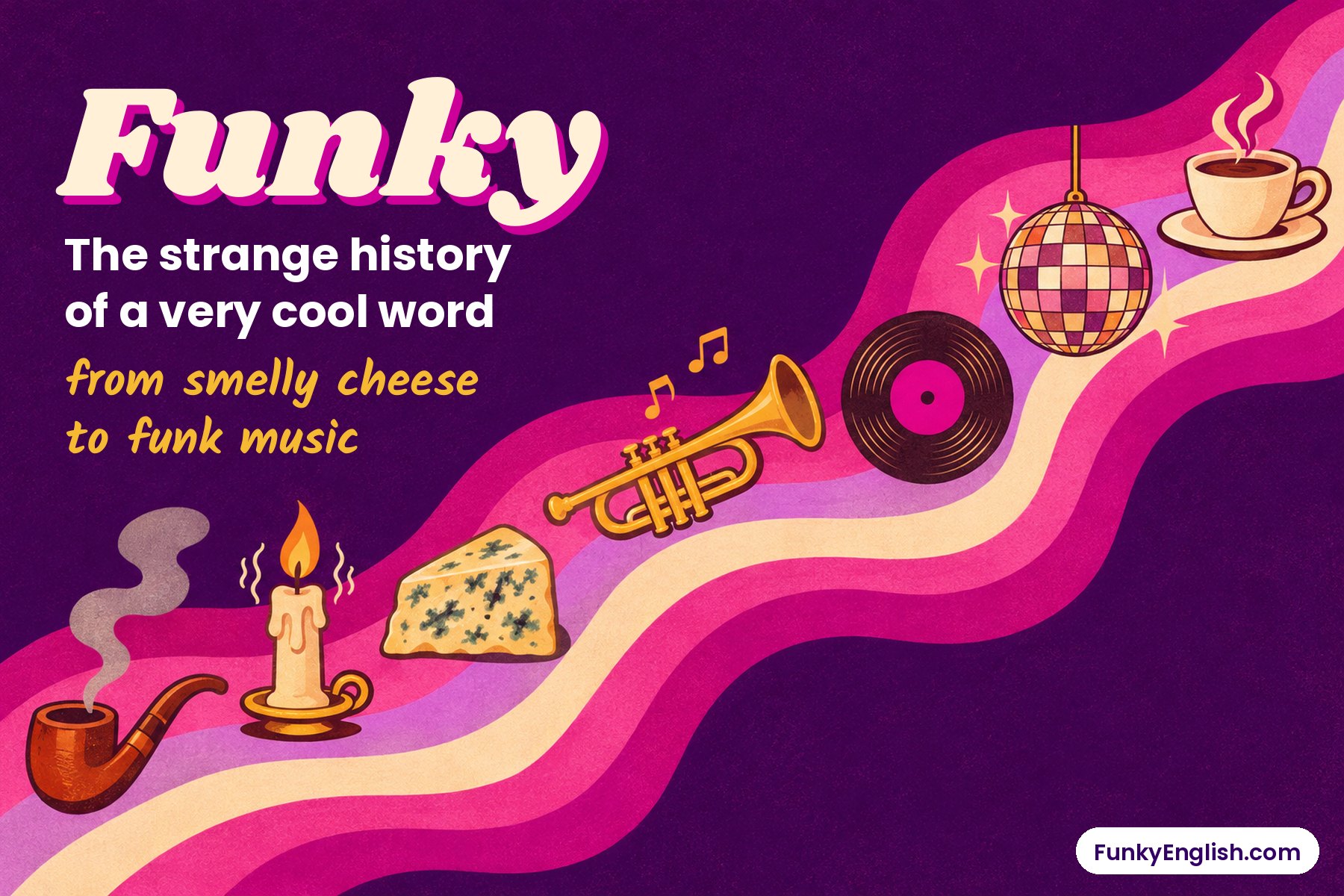
Imagine you are a word. Four hundred years ago, people used you to describe a room full of stale pipe smoke. A hundred years later, you meant being terrified. Then you meant smelly cheese. Then someone in New Orleans picked up a trumpet, and suddenly you were the coolest word in the room.
That word is funky, and it’s the first half of this website’s name. So it seems only fair to tell its story: where it came from, how it changed, and how you can use it today without accidentally insulting someone’s cooking.
What Does Funky Mean Today?
In modern English, funky has two main meanings, and they are almost opposites:
- Cool, unusual and fun – “What a funky little café!” “I love your funky socks.”
- Smelling bad or strange – “This milk smells a bit funky.” “Something funky is going on in the fridge.”
And then there is funk, the music: bass, drums and a groove you can feel in your knees. How did one little word end up doing all of this? It’s a long, slightly smelly story.
Chapter 1: Smoke and Smells (1600s)
The oldest meaning of funk in English is a bad smell. Word historians date it to the early 1600s, and it was often used for air thick with tobacco smoke. It probably came from a French dialect word meaning to smoke, which goes back to the Latin fumigare, the same root as fumes and fumigate.
So the first funky thing in English was a smoky room. Not a great start.
Chapter 2: Fear (1700s)
In the 1700s, a different funk appeared, meaning fear. It seems to have started as student slang at Oxford University. If you were in a funk, you were scared stiff, and if you funked something, you were too scared to do it. Nobody is quite sure where this meaning came from. One idea links it to an old Flemish word for distress.
This meaning lives on in British English today. In a blue funk means in a panic, though it now sounds a bit old-fashioned. More common is in a funk, which today usually means feeling low or fed up rather than terrified.
Chapter 3: Mouldy Cheese (1784)
The adjective funky itself first appears in the 1780s. The earliest record describes something old and musty, including cheese. So for most of its life, calling something “funky” was not a compliment. You did not want funky bread, funky socks or a funky kitchen.
Chapter 4: Jazz Changes Everything (around 1900)
Then, around the start of the 20th century, something remarkable happened. In the jazz clubs of New Orleans, Black musicians took this unloved word and turned it into praise. Funky music was earthy, raw and full of feeling. It had sweat in it. It was real. A famous early blues tune connected to the cornet player Buddy Bolden even had “funky” in its title.
It’s worth knowing that in the early 1900s the word was also sometimes used in an unkind, racist way about Black people. The jazz musicians who made it a compliment took that back too.
By the 1950s, funky was the word for a soulful, bluesy style of jazz, and magazines were explaining it to their readers. In the late 1950s and 1960s, the music grew into its own genre with its own name: funk. Think heavy bass lines, tight drums and horns, and musicians like James Brown making the whole room move.
Chapter 5: Funky Goes Mainstream (1960s–today)
Once the music became popular, the word escaped from the clubs. By the 1960s and 70s, funky meant stylish, fashionable and excellent. Funky clothes, funky hair, funky furniture. Today, British people use it most for things that are a bit different in a good way: a funky café with mismatched chairs, a funky lamp, a funky pattern on a jumper.
This is the same journey that wicked and bad made in slang: a negative word flipped into a positive one. English loves doing that. And the opposite of funky? In Britain, probably naff.
When Funky Smells Good
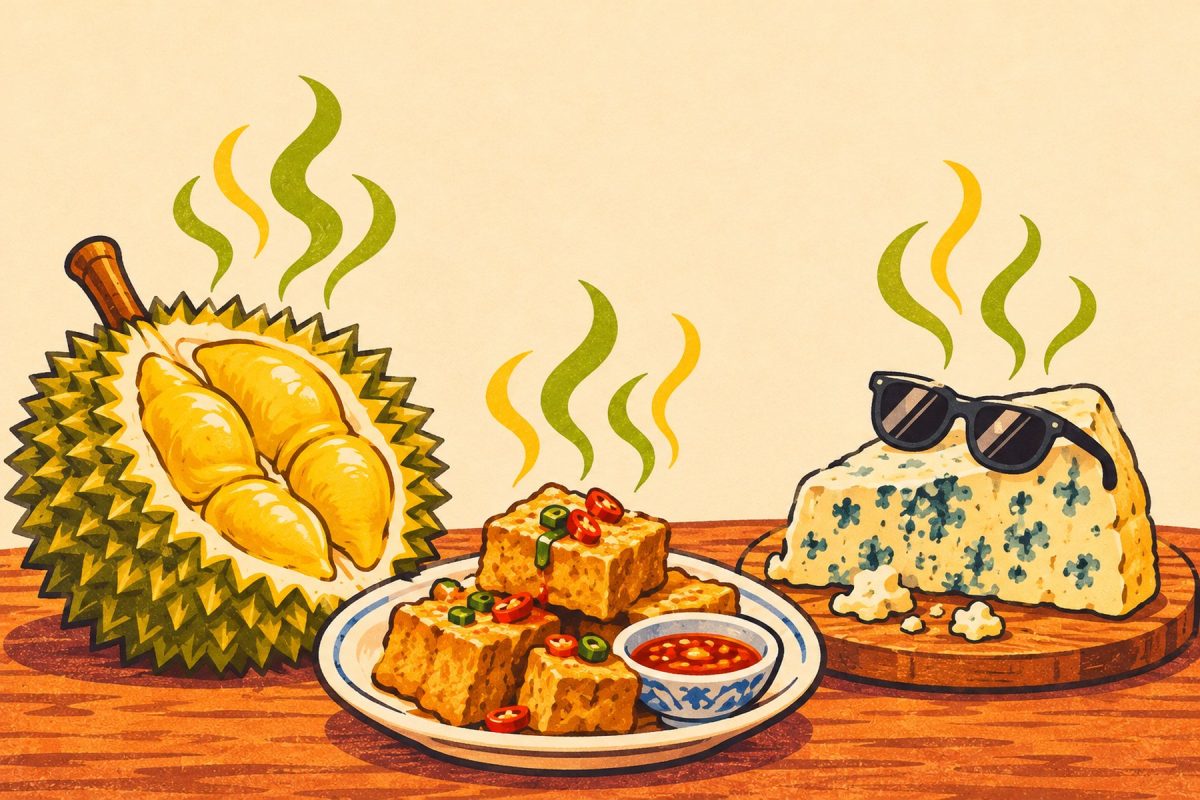
Here’s the twist. The old “bad smell” meaning never went away, and in the world of food it has become a compliment of its own. Chefs and food writers use funky for strong, fermented, pungent flavours that smell challenging but taste amazing.
- Strong cheeses – the kind you keep in a box at the back of the fridge so the butter doesn’t complain.
- Durian – the Southeast Asian fruit so famous for its smell that some hotels and trains ban it. Fans say it tastes like custard.
- Stinky tofu – fermented tofu sold at night markets in China and other parts of Asia. You smell it long before you see it.
I think all three taste wonderful. Maybe I have a very sophisticated palate. Maybe my taste buds are crying out for help.
So context is everything. “This milk smells funky” means throw it away. “This cheese is lovely and funky” means please pass it over here.
How to Use Funky
- funky + noun (cool) – a funky café, funky shoes, a funky design
- smell / taste funky (strange, often bad) – “The fridge smells funky.”
- a funky flavour / a nice funky edge (food, positive) – “The kimchi gives it a nice funky edge.”
- in a funk (feeling low) – “I’ve been in a funk since the exams.”
- funk (the music) – “My dad only listens to 70s funk.”
Comparatives: funky, funkier, the funkiest. “That’s the funkiest lamp I’ve ever seen.”
Funky is informal. Use it with friends, in reviews and on social media, not in a formal essay.
Why FunkyEnglish?
The name started as a family idea. My brother built a very successful website called FunkyPool, which has been running for many years, and the plan (pipe dream?) was a whole family of “Funky” websites. FunkyEnglish launched in about 2009 and has changed a bit since then. Still a bit funky, and still teaching English the fun way (or at least trying to!).
We like to think the name fits. English is full of words like funky that change, flip and surprise you. That’s what makes it fun to learn. Want more words with a strange history? Try fading British words or our 50 British slang words.
Learn More
Look it upFunky – Online Etymology Dictionaryetymonline.comFrequently Asked Questions
Both. When you talk about style, music, places or design, funky is a compliment: cool, unusual and fun. When you talk about smells, funky usually means bad, unless you are talking about strong cheese or other fermented food, where it can be praise.
It means feeling low, fed up or stuck for a while. “I’ve been in a bit of a funk since the holidays ended.” In older British English, “in a blue funk” meant in a state of panic.
No. Funky is informal and friendly. It’s perfect for talking with friends, describing a café, an outfit or a song. Avoid it in a formal essay or a job application.
The name came from a family idea for a set of “Funky” websites. My brother has run FunkyPool for years, and FunkyEnglish started in 2009. The aim has always been the same: English lessons that are a bit cool, a bit different, and fun.
Test Yourself
Five quick questions. Get them all right and you’re officially funky. The good kind.
Quick Check
What is FunkyEnglish?
FunkyEnglish is a website that helps you improve your English. We offer quick lessons that teach idioms, slang, phrasal verbs and more. Visit our homepage to see our latest articles, or use the menu to find specific content!