“What did you do at the weekend?” Every English teacher asks it on Monday morning, usually before anyone is fully awake. As homework, it often comes in two parts: write about what you usually do at weekends (present simple), then what you did last weekend (past simple). Here are model answers for both. Borrow the grammar, not the weekend: Teacher can tell when four students all visited the same grandma.
10 Sentences About My Weekend (Present Simple)
We use the present simple for things we do regularly. Notice the time words: on Saturday mornings, on Sunday, at weekends.
- I sleep in on Saturday mornings.
- I have a big breakfast at about ten.
- My dad makes pancakes.
- We go shopping in town.
- I meet my friends in the park.
- We ride our bikes by the river.
- On Saturday evening, we watch a film at home.
- On Sunday, we visit my grandparents.
- My grandma cooks a roast dinner.
- I finish my homework on Sunday night.
The Same 10 Sentences in the Past Simple
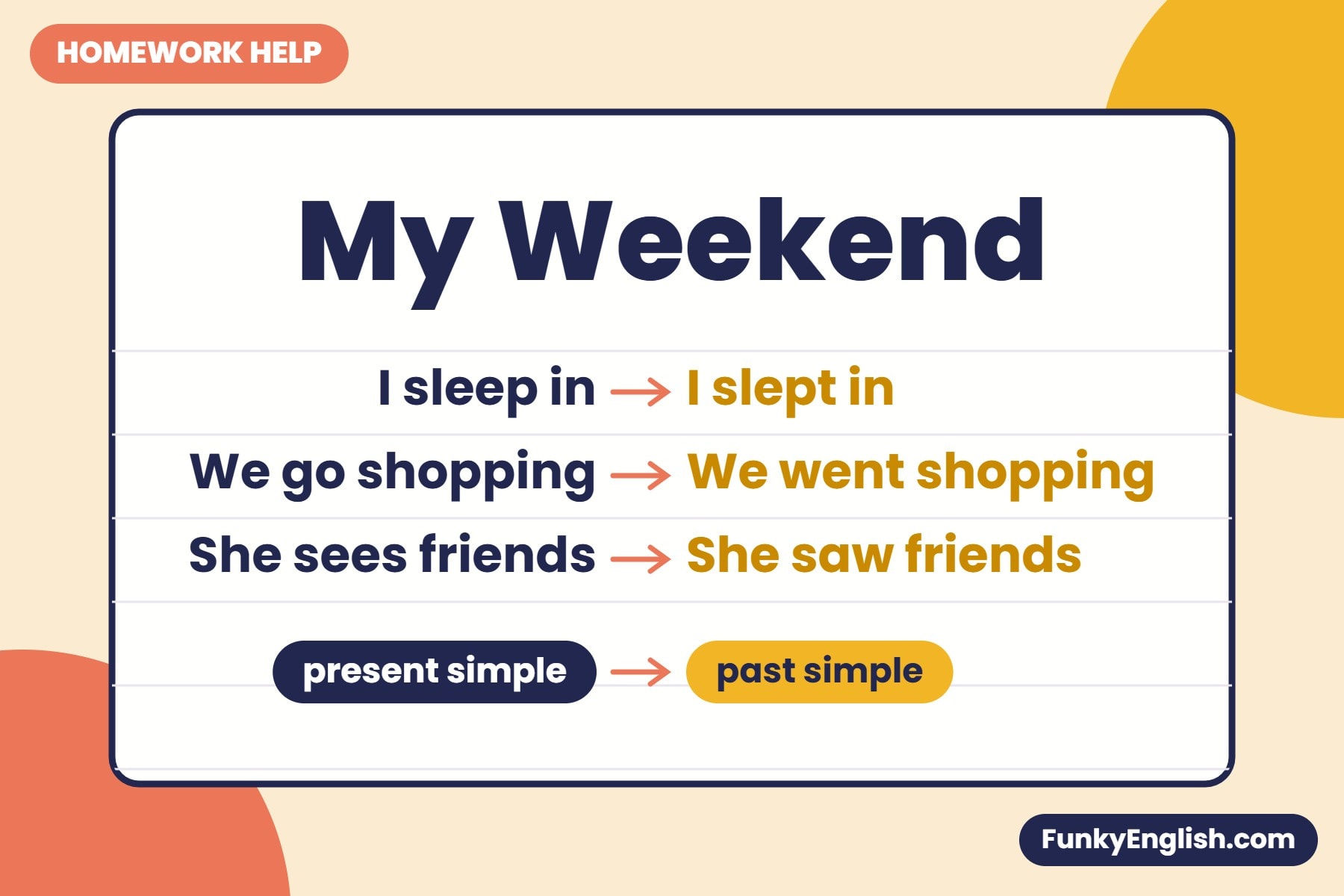
Now it’s Monday and you’re talking about last weekend. We use the past simple for finished actions in the past.
- I slept in last Saturday morning.
- I had a big breakfast at about ten.
- My dad made pancakes.
- We went shopping in town.
- I met my friends in the park.
- We rode our bikes by the river.
- On Saturday evening, we watched a film at home.
- On Sunday, we visited my grandparents.
- My grandma cooked a roast dinner.
- I finished my homework on Sunday night.
Present and Past Side by Side
| Present simple (every weekend) | Past simple (last weekend) |
|---|---|
| I sleep in on Saturday mornings. | I slept in last Saturday morning. |
| I have a big breakfast at about ten. | I had a big breakfast at about ten. |
| My dad makes pancakes. | My dad made pancakes. |
| We go shopping in town. | We went shopping in town. |
| I meet my friends in the park. | I met my friends in the park. |
| We ride our bikes by the river. | We rode our bikes by the river. |
| On Saturday evening, we watch a film at home. | On Saturday evening, we watched a film at home. |
| On Sunday, we visit my grandparents. | On Sunday, we visited my grandparents. |
| My grandma cooks a roast dinner. | My grandma cooked a roast dinner. |
| I finish my homework on Sunday night. | I finished my homework on Sunday night. |
My Weekend: Paragraph Examples
Present simple: At weekends, I sleep in on Saturday morning. First, I have a big breakfast, usually pancakes, because my dad makes them. Then we go shopping in town. In the afternoon, I meet my friends in the park and we ride our bikes by the river. On Saturday evening, we watch a film at home. On Sunday, we visit my grandparents and my grandma cooks a roast dinner. Finally, I finish my homework on Sunday night.
Past simple: Last weekend, I slept in on Saturday morning. First, I had a big breakfast, pancakes again, because my dad made them. Then we went shopping in town. In the afternoon, I met my friends in the park and we rode our bikes by the river. On Saturday evening, we watched a film at home. On Sunday, we visited my grandparents and my grandma cooked a roast dinner. Finally, I finished my homework on Sunday night. Well, most of it.
The linking words in bold (first, then, in the afternoon, finally) turn a list into a story. They also make teachers smile, which never hurts.
How to Change Present Simple to Past Simple
- Regular verbs: add -ed. watch → watched, visit → visited, cook → cooked, finish → finished.
- Irregular weekend verbs: learn them! sleep → slept, go → went, meet → met, ride → rode, make → made, have → had, see → saw, buy → bought, swim → swam, spend → spent.
- Phrasal verbs change the verb only. sleep in → slept in, go out → went out, hang out → hung out.
- Change the time words. at weekends → last weekend, on Saturdays → last Saturday, every Sunday → on Sunday.
- Questions use did. What did you do at the weekend? Did you go out? (Not What did you did?)
- At the weekend or on the weekend? British English says at the weekend; American English says on the weekend. Both are fine, just be consistent.
The British Council has a clear past simple reference page if you want more examples.
Now Write Your Own
Copy these sentence starters and finish them with your own weekend:
- At weekends, I usually …
- On Saturday morning, I …
- My favourite thing to do at the weekend is … because …
- On Sunday, my family …
- In the evening, we …
Then change each one to the past simple, starting with Last weekend, …. If your weekend involved a long walk, our hiking vocabulary will help, and you can find the weekday version on our My School Day page.
More Homework Help
Got another one of these to write? We’ve done the same for other homework classics:
- My School Day (present simple and past simple)
- Yesterday’s Routine (my daily routine in the past simple)
- My Holiday (past simple questions and answers)
- My Family (have and have got)
- My Best Friend (present simple with he and she)
- My Future Plans (going to and will)
- Describe Your House (there is and there are)
- My Town (there is, there are, some and any)
- My Favourite Food (a, an and some)
- My Hobby (like and enjoy + -ing)
Frequently Asked Questions
Use the past simple: I went to the cinema, I met my friends, I stayed at home and slept. Add a detail to sound natural: I went shopping with my mum and bought new trainers.
At the weekend is British English and on the weekend is American English. Both are correct. In British English, at weekends means every weekend.
The past simple of sleep in is slept in: I slept in last Saturday. Sleep is irregular, so sleeped in is not correct.
Test Yourself
Quick Check
What is FunkyEnglish?
FunkyEnglish is a website that helps you improve your English. We offer quick lessons that teach idioms, slang, phrasal verbs and more. Visit our homepage to see our latest articles, or use the menu to find specific content!