“Describe your house” is homework that sounds personal but is really a grammar test in disguise: can you use there is and there are without mixing them up? Here are ten model sentences, the same house in the past (for when your teacher asks about the house you grew up in), and the rules. You don’t need to live in a palace. Teacher certainly doesn’t.
10 Sentences About My House (Present Simple)
We use there is for one thing and there are for two or more. Everything else is the present simple.
- I live in a terraced house on a quiet street.
- There are three bedrooms upstairs.
- There‘s a bathroom next to my bedroom.
- Downstairs, there‘s a kitchen and a living room.
- There are two sofas in the living room.
- There‘s a small garden behind the house.
- There isn’t a garage, so we park on the street.
- There are lots of plants on the windowsills.
- My bedroom has got a desk under the window.
- There‘s always a queue for the bathroom in the morning.
The Same 10 Sentences in the Past (My Old House)
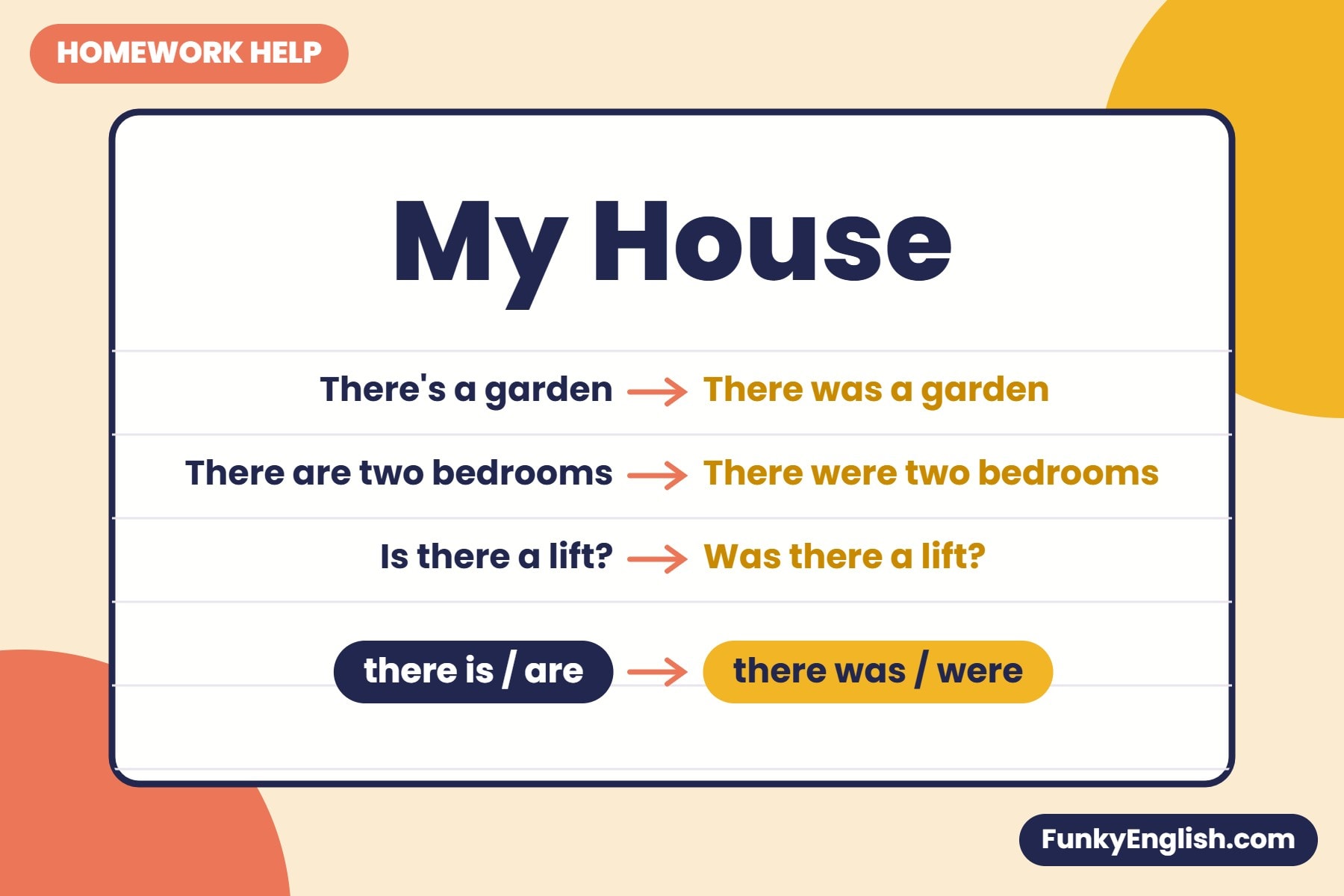
Describing a house you used to live in? There is becomes there was, there are becomes there were, and other verbs go into the past simple.
- I lived in a terraced house on a quiet street.
- There were three bedrooms upstairs.
- There was a bathroom next to my bedroom.
- Downstairs, there was a kitchen and a living room.
- There were two sofas in the living room.
- There was a small garden behind the house.
- There wasn’t a garage, so we parked on the street.
- There were lots of plants on the windowsills.
- My bedroom had a desk under the window.
- There was always a queue for the bathroom in the morning.
Present and Past Side by Side
| My house now | My old house |
|---|---|
| I live in a terraced house on a quiet street. | I lived in a terraced house on a quiet street. |
| There are three bedrooms upstairs. | There were three bedrooms upstairs. |
| There‘s a bathroom next to my bedroom. | There was a bathroom next to my bedroom. |
| Downstairs, there‘s a kitchen and a living room. | Downstairs, there was a kitchen and a living room. |
| There are two sofas in the living room. | There were two sofas in the living room. |
| There‘s a small garden behind the house. | There was a small garden behind the house. |
| There isn’t a garage, so we park on the street. | There wasn’t a garage, so we parked on the street. |
| There are lots of plants on the windowsills. | There were lots of plants on the windowsills. |
| My bedroom has got a desk under the window. | My bedroom had a desk under the window. |
| There‘s always a queue for the bathroom in the morning. | There was always a queue for the bathroom in the morning. |
My House: Paragraph Examples
Present: I live in a terraced house on a quiet street. Downstairs, there‘s a kitchen and a living room with two very old sofas. Upstairs, there are three bedrooms and a bathroom. My bedroom is the smallest, but it‘s got a desk under the window, so I can see the street while I pretend to do homework. Behind the house, there‘s a small garden. There isn’t a garage, so we park on the street. My favourite room is the kitchen, because that’s where the food is.
Past: When I was little, we lived in a flat on the fourth floor. There were two bedrooms, so I shared a room with my sister. There wasn’t a garden, but there was a balcony with a lot of plants. There was a lift, but it was usually broken, so we took the stairs. I didn’t mind. My legs did.
Words like downstairs, upstairs, behind, next to and under tell the reader where things are. Without them, a description is just a shopping list of rooms.
Rules: There Is, There Are and House Words
- There is + one thing (or uncountable). There’s a sofa. There’s some furniture.
- There are + two or more. There are three bedrooms. Not there is three bedrooms.
- Negatives use any with plurals. There isn’t a garage. There aren’t any trees.
- Questions flip the words. Is there a garden? Are there any shops near your house?
- Past: was and were. there is → there was, there are → there were.
- Where things are: next to, opposite, behind, in front of, between, under, upstairs, downstairs.
- Types of home (British English): a flat (US: apartment), a detached house (no neighbours joined on), a semi-detached house (joined on one side), a terraced house (joined on both sides) and a bungalow (only one floor).
Terraced houses are so typical of Britain that Wikipedia has a whole article on the terraced house and its history.
Now Write Your Own
Copy these sentence starters and finish them about your own home:
- I live in a house / flat in …
- Downstairs, there is … and there are …
- My bedroom has got …
- There isn’t a …, but there’s a …
- My favourite room is … because …
Then describe the house you lived in when you were little, using there was and there were. Want to say who lives there too? Try our My Family model answers, or the weekday version on My School Day.
More Homework Help
Got another one of these to write? We’ve done the same for other homework classics:
- My School Day (present simple and past simple)
- My Weekend (present simple and past simple)
- Yesterday’s Routine (my daily routine in the past simple)
- My Holiday (past simple questions and answers)
- My Family (have and have got)
- My Best Friend (present simple with he and she)
- My Future Plans (going to and will)
- My Town (there is, there are, some and any)
- My Favourite Food (a, an and some)
- My Hobby (like and enjoy + -ing)
Frequently Asked Questions
Say what type of home it is and where it is, then go room by room with there is and there are: Downstairs there is a kitchen, upstairs there are three bedrooms. Finish with your favourite room and why.
Use there is for one thing or an uncountable noun (there is a garden, there is some furniture) and there are for two or more things (there are three bedrooms). In the past, use there was and there were.
A terraced house is one of a row of houses joined together on both sides. A semi-detached house is joined on one side, and a detached house stands on its own.
Test Yourself
Quick Check
What is FunkyEnglish?
FunkyEnglish is a website that helps you improve your English. We offer quick lessons that teach idioms, slang, phrasal verbs and more. Visit our homepage to see our latest articles, or use the menu to find specific content!