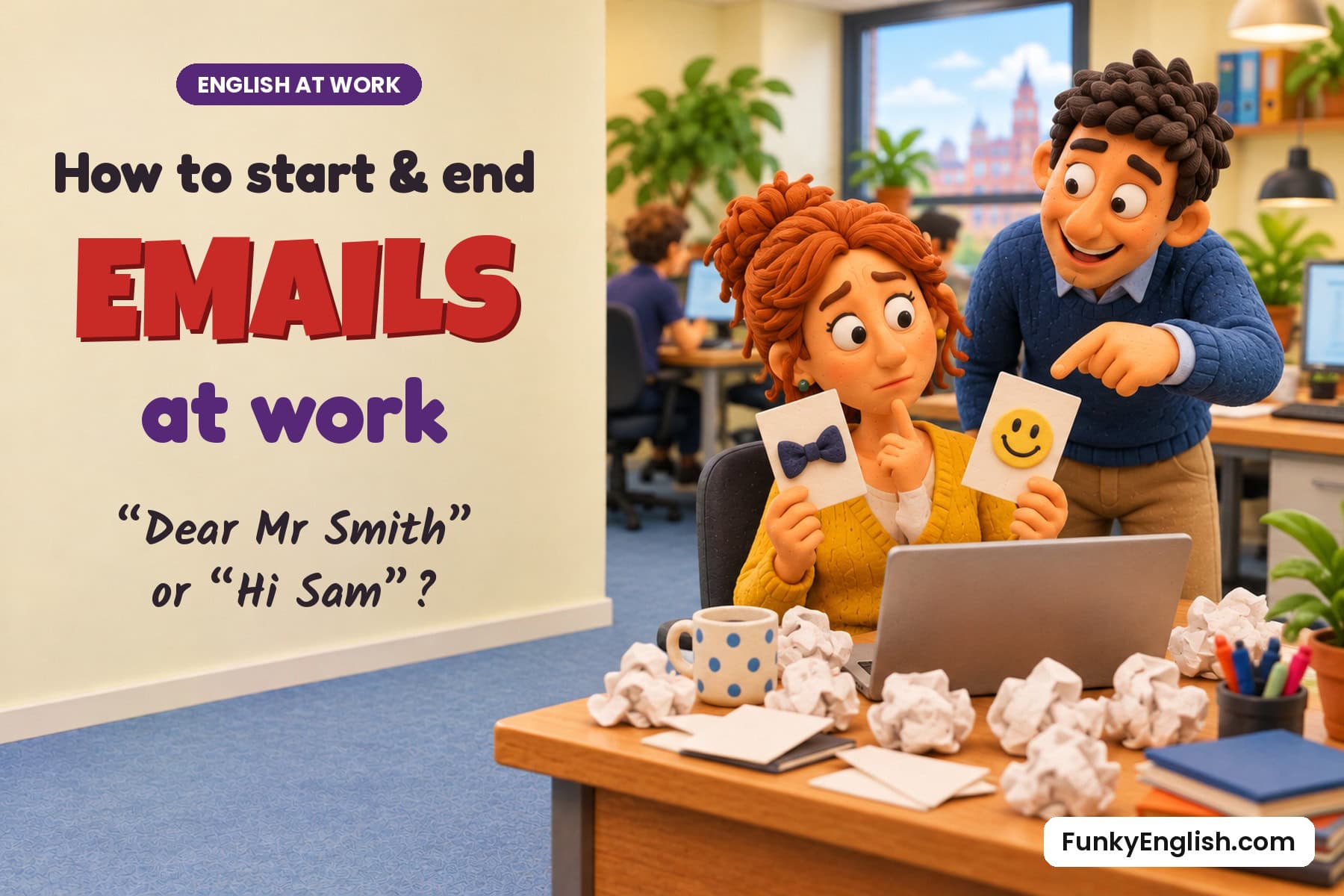
You’ve written the whole email. The hard part is done. Then you get stuck on the first two words and the last two. “Dear Sir” sounds like a letter from 1850. “Hey!” sounds like a text to your mate. Your desk is covered in crumpled paper. Here’s how to start and end emails at work in English, and get it right every time.
First, Choose Your Level
- Formal: new clients, job applications, people you’ve never met, anyone very senior.
- Neutral: most colleagues and people you work with regularly. This is the safe middle.
- Informal: close colleagues and your team. Only use it when they write to you this way too.
A simple rule: match the other person. If they write “Hi Tom”, you can write “Hi Sarah” back.
How to Start an Email
| Formal | Neutral | Informal |
|---|---|---|
| Dear Mr Smith, | Dear Sam, | Hi Sam, |
| Dear Ms Patel, | Hi Sam, | Morning! |
| Dear Sir or Madam, | Hello Sam, | Hiya, |
- Use Ms for a woman unless you know she prefers Mrs or Miss.
- In British English, there’s usually no full stop after Mr, Mrs, Ms and Dr. American English often adds one: Mr. Smith.
- Use the surname with a title (Dear Mr Smith) or the first name alone (Dear Sam), but not both (Dear Sam Smith).
- “Dear Sir or Madam” is only for when you really can’t find a name. It sounds very old-fashioned now.
Good First Lines
- “I hope you’re well.”
- “I hope you had a good weekend.”
- “Thanks for your email.”
- “Thanks for getting back to me.”
- “I’m writing to ask about the job advertised on your website.” (formal)
- “Just a quick one:” (informal)
Good Last Lines
Before you sign off, finish with a friendly line:
- “Let me know if you have any questions.”
- “I look forward to hearing from you.” (formal)
- “Thanks again for your help.”
- “Speak soon.”
- “Have a great weekend!”
How to Sign Off
| Formal | Neutral | Informal |
|---|---|---|
| Yours sincerely, | Best wishes, | Thanks, |
| Yours faithfully, | Kind regards, | Cheers, |
| Best regards, | Many thanks, | Speak soon, |
The British rule: if you started with Dear Sir or Madam, finish with Yours faithfully. If you used their name (Dear Mr Smith), finish with Yours sincerely. Most everyday work emails just use Kind regards or Best wishes.
Two Example Emails
Formal:
Dear Ms Patel,
Thank you for your email. I’m writing to confirm our meeting on Tuesday 4 November at 10am.
I look forward to meeting you.
Yours sincerely,
Tom Harris
Friendly:
Hi Sam,
Thanks for the slides, they look great. Just a quick one: could you add last year’s figures to slide 3?
Have a good weekend!
Cheers,
Tom
Say This, Not That
| Avoid | Better |
|---|---|
| Dear Sam Smith, | Dear Mr Smith, or Dear Sam, |
| Hey! (to a client) | Hi Sam, |
| Dear Sirs, | Dear Sir or Madam, |
| Waiting for your reply. | I look forward to hearing from you. |
| Bye! | Best wishes, |
What British Sign-Offs Really Mean
In British offices, the sign-off can tell you more than the email:
- “Kind regards” Normal and polite. Nothing to worry about.
- “Regards” (without “kind”) I’m a little annoyed with you.
- “Best” I’m in a hurry.
- “Cheers” We’re friends now.
- “Thanks in advance” You are going to do this, aren’t you?
- “Many thanks” (in bold, after the third reminder) Please just do it.
More English at Work
This lesson is part of our English at Work series. Next, learn what British colleagues really mean, how to follow up politely (for when nobody answers your beautiful email), how to make small talk at work, how to apologise at work and how to say no politely. For more on “yours faithfully”, see the Cambridge Dictionary.
Frequently Asked Questions
Both are polite and safe. “Kind regards” is very common in British offices. “Best regards” is slightly more formal and common internationally.
In British English, use “Yours sincerely” when you start with a name (Dear Mr Smith) and “Yours faithfully” when you start with “Dear Sir or Madam”.
Yes. “Hi Sam” is normal for most work emails today. Use “Dear” for formal emails, job applications and people you haven’t met.
Test Yourself
Quick Check
What is FunkyEnglish?
FunkyEnglish is a website that helps you improve your English. We offer quick lessons that teach idioms, slang, phrasal verbs and more. Visit our homepage to see our latest articles, or use the menu to find specific content!