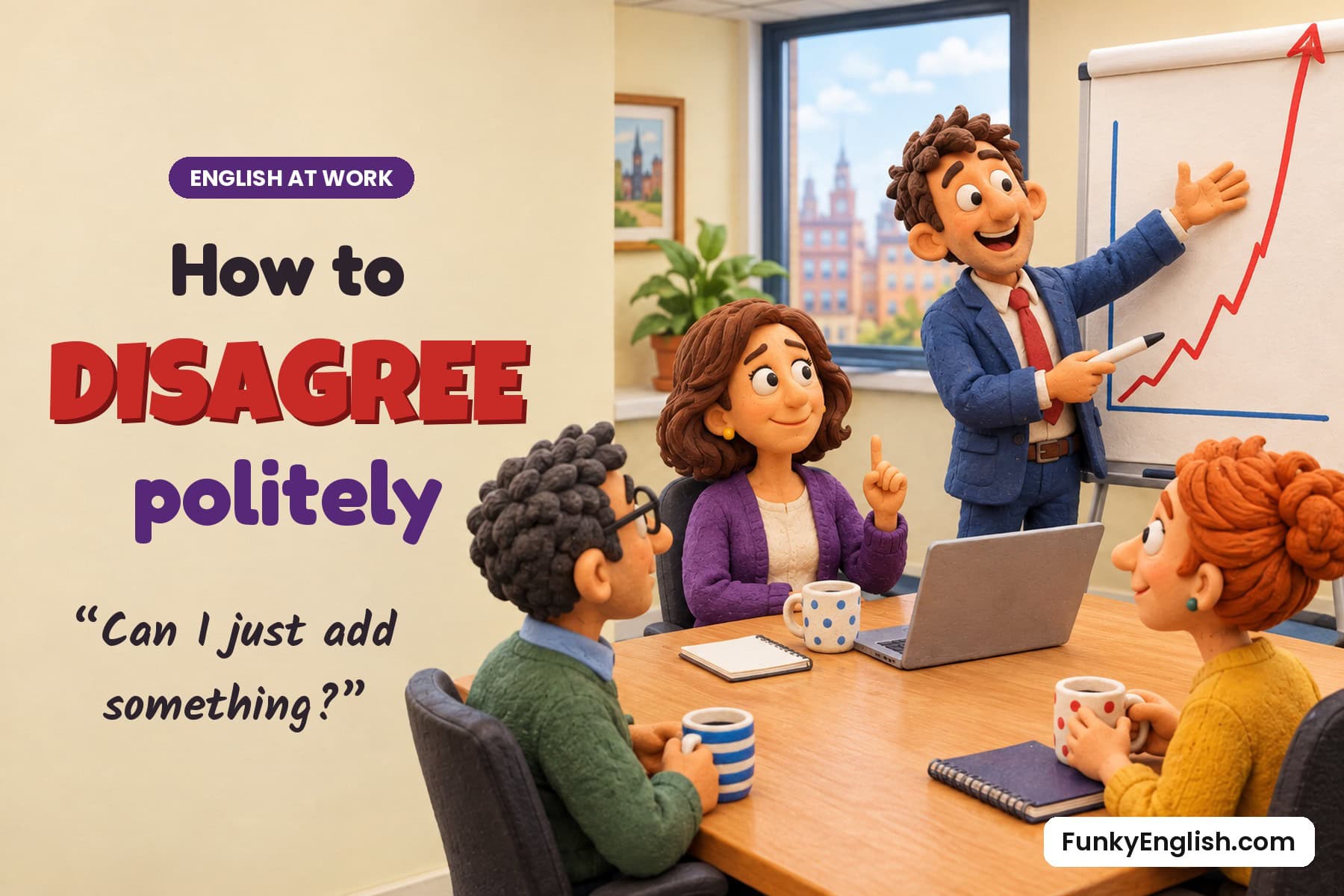
Your colleague is showing a chart where sales go up by 400% next month. Everyone is nodding. You know the numbers are wrong. Do you say something, or do you sip your tea and hope someone else does? In English, you can disagree with almost anyone, even your boss, as long as you do it politely. Here’s how.
Why “You’re Wrong” Doesn’t Work
“You’re wrong” and “I disagree” are clear, but in English they can sound like an attack. In a meeting, people usually disagree with the idea, not the person. A polite disagreement usually has three parts:
- Say something positive first: “That’s a really good point.”
- Add a soft “but”: “I’m not sure the numbers work, though.”
- Explain or suggest: “Could we look at last year’s figures first?”
How to Jump In Politely
First, you need a way in. These phrases let you interrupt without sounding rude:
- “Can I just add something?”
- “Sorry to interrupt, but…”
- “Could I come in here?”
- “Just a quick thought…”
Soft Ways to Disagree
Use these with colleagues, clients and anyone you want to keep on your side.
- “I see what you mean, but…”
- “That’s a good point. I wonder if…”
- “I’m not sure I agree with that.”
- “I might be wrong, but I think…”
- “Have we thought about…?”
Firmer Ways to Disagree
When something really matters, you can be clearer and still polite:
- “I’m afraid I don’t agree.”
- “I have to disagree with you there.”
- “I see it differently.”
- “I have some concerns about this.”
- “I don’t think that will work, because…”
Ask a Question Instead
This is the cleverest trick of all. Instead of saying “that’s wrong”, ask a question that helps everyone see the problem. Nobody loses face.
- “How did we get to that number?”
- “What happens if the client says no?”
- “Could we look at the figures again?”
- “Is there another way we could do this?”
Disagreeing by Email
Emails can sound colder than you mean, so add a little extra warmth. Here’s an example:
Subject: Re: New sales targets
Hi Mark,
Thanks for sharing the new targets. I can see a lot of work has gone into them.
I do have some concerns about the December figure, though. It’s four times higher than last year, and two of our biggest clients have already cut their orders. Could we talk it through before Friday’s meeting?
Best wishes,
Anna
Say This, Not That
| Sounds rude | Sounds polite |
|---|---|
| You’re wrong. | I see it a bit differently. |
| That’s a bad idea. | I’m not sure that will work. |
| That makes no sense. | Could you explain that part again? |
| No, listen to me. | Can I just add something? |
| Your numbers are wrong. | Could we double-check the numbers? |
What British People Say When They Disagree
British people often disagree so politely that visitors don’t notice it’s happening. Listen out for these:
- “With respect…” I think you’re wrong. (“With the greatest respect” means very wrong.)
- “That’s a very brave idea.” That’s a terrible idea.
- “I hear what you’re saying.” I don’t agree, and I’m not going to change my mind.
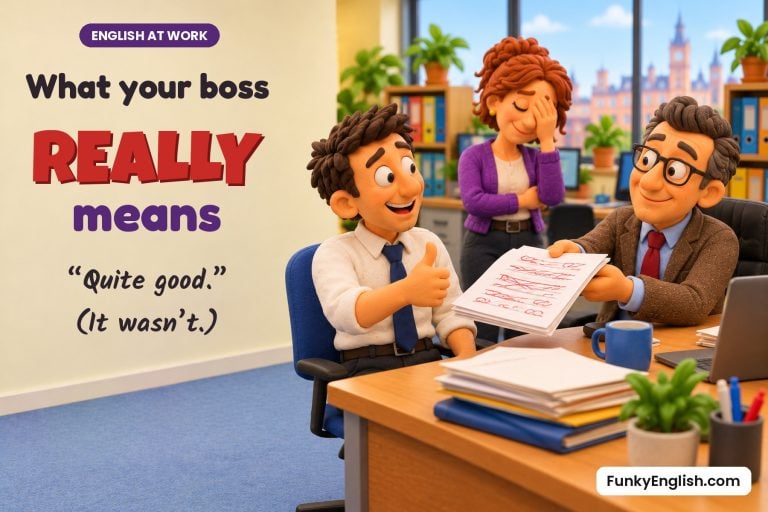
- “Quite good.” Not very good at all.
- “Correct me if I’m wrong, but…” I’m right, and I’m about to prove it.
Our advice: use the polite phrases above, but say what you actually mean. Your colleagues from other countries will thank you, and so will Mark’s chart.
More English at Work
This lesson is part of our English at Work series. Next, learn what British colleagues really mean, how to start and end an email, how to make small talk at work, how to apologise at work, how to follow up politely, how to ask for help politely, how to say no politely, or brush up on 16 workplace idioms and phrasal verbs for the office. For the full meaning of disagree, see the Cambridge Dictionary.
Frequently Asked Questions
Focus on the idea, not the person, and ask questions: “Could we look at the figures again?” If it’s a big disagreement, talk to your boss privately after the meeting.
Not rude, but very direct. Soften it with “I’m afraid I disagree” or “I’m not sure I agree with that”, and give a reason.
Wait for a small pause, then say “Sorry to interrupt, but…” or “Can I just add something?” Keep your point short.
Test Yourself
Quick Check
What is FunkyEnglish?
FunkyEnglish is a website that helps you improve your English. We offer quick lessons that teach idioms, slang, phrasal verbs and more. Visit our homepage to see our latest articles, or use the menu to find specific content!