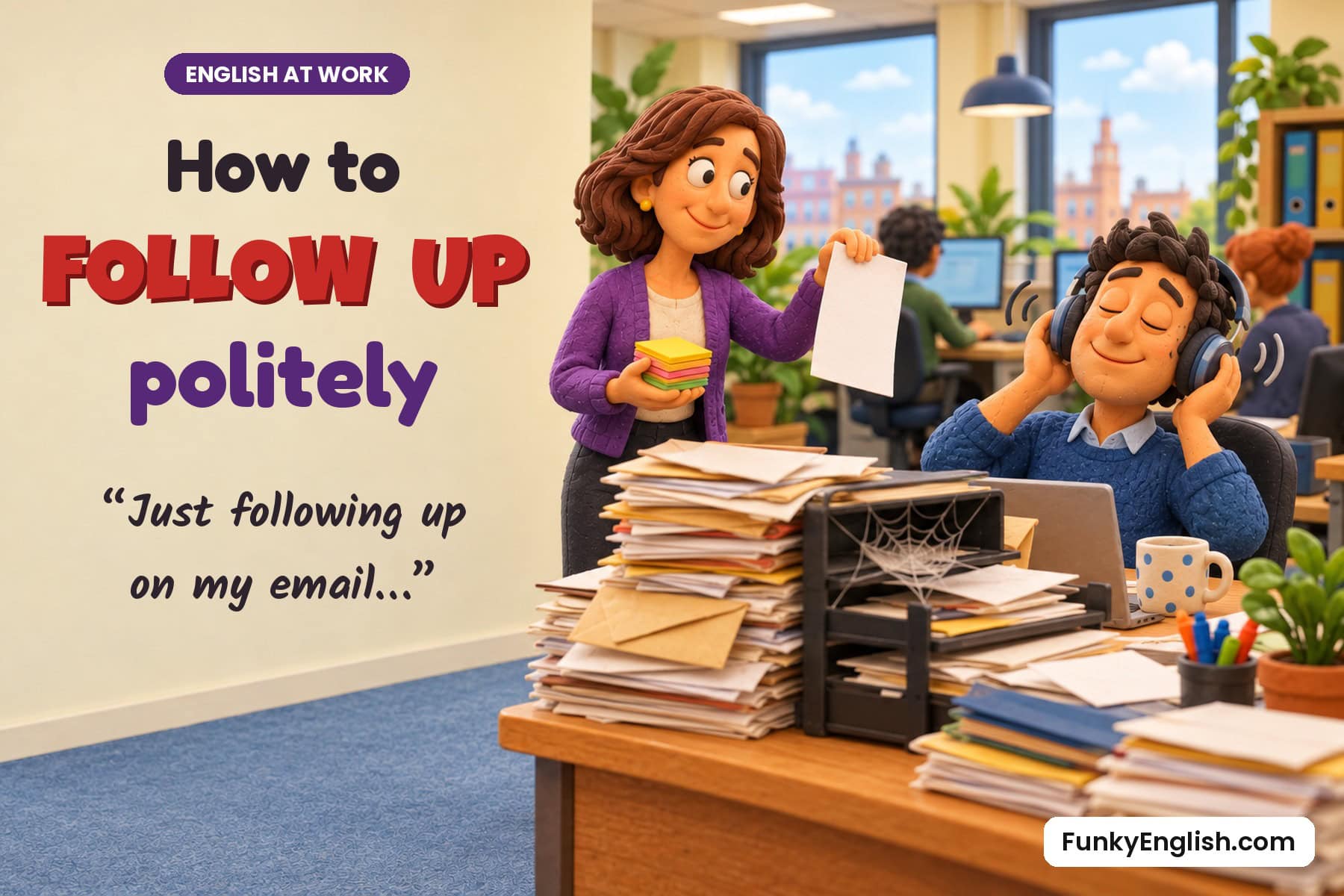
You sent the email two weeks ago. You’ve walked past his desk three times. He’s wearing headphones, there’s a cobweb on his in-tray, and you still don’t have your report. You need to remind him, but you don’t want to sound like a nagging parent. Here’s how to follow up politely in English.
Follow Up or Chase?
In British offices you’ll often hear “I’ll chase him” or “Can you chase that up?” It just means “remind someone about something they haven’t done yet”. It’s fine to say about someone, but when you speak to them, use friendlier phrases like “just following up” or “just checking in”.
The Polite Formula
A good reminder is short and friendly. It usually has three parts:
- A friendly opener: “I hope your week’s going well.”
- A gentle reminder: “Just following up on my email about the sales report.”
- A clear next step: “Could you send it over by Thursday?”
First Reminder: Keep It Light
Assume they’re just busy. They probably are.
- “Just following up on my email from Monday.”
- “I just wanted to check in on the report.”
- “Did you get a chance to look at my email?”
- “Just a quick reminder about Friday’s deadline.”
- “I know you’re busy, but have you had a chance to…?”
Second Reminder: A Little Firmer
Still polite, but now with a date and a reason:
- “I’m following up again on the report.”
- “Could you let me know by Thursday?”
- “We need it by Friday to send it to the client.”
- “Is there anything I can do to help move this forward?”
Final Reminder: Firm but Fair
When you really need an answer, be clear about what happens next:
- “I haven’t heard back about the report, so I’m following up once more.”
- “This is now urgent.”
- “If I don’t hear from you by Friday, I’ll ask Sarah to take it on.”
Following Up in Person
Sometimes it’s quicker to stop by their desk (and wait for them to take their headphones off):
- “Have you had a chance to look at my email?”
- “Any news on the report?”
- “Sorry to nag, but…”
Following Up by Email
Here’s a friendly first reminder:
Subject: Quick follow-up: sales report
Hi Dan,
I hope your week’s going well. Just following up on my email from last Monday about the sales report.
Could you send it over by Thursday? I need it for Friday’s meeting with the client.
Thanks so much,
Emma
Say This, Not That
| Sounds rude | Sounds polite |
|---|---|
| Why haven’t you replied? | Did you get a chance to look at my email? |
| I’m still waiting. | Just checking in on this. |
| Reply ASAP. | Could you let me know by Thursday? |
| You forgot. | I know things are busy, so here’s a quick reminder. |
| As I already told you… | Just to recap… |
What British People Say When They Follow Up
Office emails are full of polite phrases with hidden meanings. Here’s the translation:
- “As per my last email…” Did you even read it?
- “Just circling back…” I’m starting to get annoyed.
- “Gentle reminder…” This is not a gentle reminder.
- “No rush!” Please rush.
- “Hope you had a lovely weekend!” (sent on a Tuesday) Where is my report?
Use the polite versions, but be careful with “as per my last email”. It can sound a bit passive-aggressive, and everyone knows what it really means.
More English at Work
This lesson is part of our English at Work series. Next, learn what British colleagues really mean, how to start and end an email, how to make small talk at work, how to apologise at work, how to ask for help politely, how to say no politely and how to disagree politely. For the full meaning of follow up, see the Cambridge Dictionary.
Frequently Asked Questions
Keep it short and friendly: “Just following up on my email from Monday. Could you let me know by Thursday?” Assume they’re busy, not lazy.
For a normal work email, two or three working days is fine. If something is urgent, say so in your first email and follow up sooner.
It isn’t rude on paper, but many people read it as passive-aggressive. “Just to recap” or “as I mentioned” sound friendlier.
Test Yourself
Quick Check
What is FunkyEnglish?
FunkyEnglish is a website that helps you improve your English. We offer quick lessons that teach idioms, slang, phrasal verbs and more. Visit our homepage to see our latest articles, or use the menu to find specific content!