In this English lesson we’ll take a look at how we use the future simple tense when talking about things that will happen in the future – decisions, promises, predictions and plans.
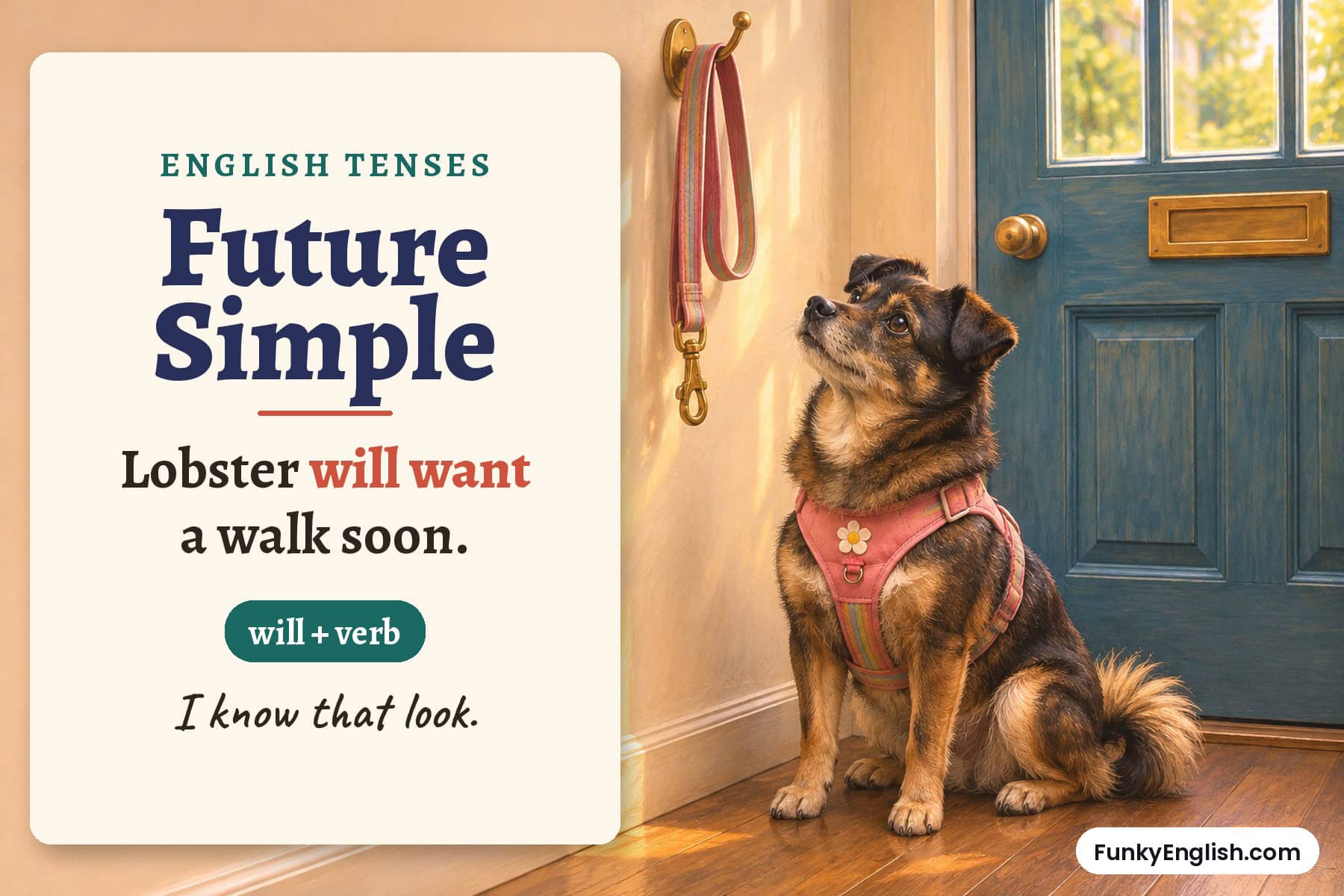
Lobster, Teacher’s dog, is sitting by the front door staring at her lead. You don’t need to be a fortune teller: she will want a walk soon. We often use will for predictions like this. Because the evidence is right in front of us, “She’s going to want a walk” is also natural; see the Will or Going To? section below. And at three o’clock? Find out in the future continuous.
What Is the Future Simple Tense?
The future simple tense is the most common way to talk about the future. It’s formed with will + the base form of the verb (the verb with no -s, -ed or -ing).
- “I will call you tomorrow.”
- “It will be sunny at the weekend.”
- “She will love this present!”
- “They won’t arrive before 9pm.”

How to Form It
Will never changes – it’s the same for I, you, he, she, it, we and they. In speech we usually shorten it.
- Positive: subject + will + verb – I’ll help you.
- Negative: subject + will not (won’t) + verb – I won’t be late.
- Question: Will + subject + verb? – Will you help me?
- Short answers: Yes, I will. / No, I won’t.
Remember: after will, the verb stays in its base form. We say “She will go”, not “She will goes”.
When Do We Use It?
- Decisions made at the moment of speaking: “It’s cold in here. I’ll close the window.”
- Promises and offers: “I’ll help you with your homework.”
- Predictions based on opinion: “I think England will win the match.”
- Facts about the future: “The sun will rise at 6.15 tomorrow.”
Will or Going To?
English has another very common way to talk about the future: be going to + verb. The difference is usually about when you made the decision, and what your prediction is based on.
- Use going to for plans you have already made: “I’m going to visit my grandma on Saturday.”
- Use will for decisions you make right now: “Oh, the phone’s ringing – I’ll get it!”
- Use going to for predictions based on what you can see now: “Look at those clouds – it’s going to rain.”
For a fuller grammar reference, see the British Council’s guide to future forms: will, be going to and the present continuous.
What Will You Do…?
To answer this question, we usually use the future simple:
- “What will you do after the exam?” — “I’ll celebrate with my friends!”
- “What will you do if it rains tomorrow?” — “I’ll stay at home and watch a film.”
- “What will you do with your first pay cheque?” — “I’ll buy some new trainers.”
Example: Steve’s New Year’s Resolutions
Steve has decided to make some changes next year. Here are his promises.
- I will get up earlier every morning.
- I will go to the gym three times a week.
- I won’t eat so much chocolate.
- I will learn to cook a proper Sunday roast.
- I will call my mum every weekend.
- I won’t spend all my money on football shirts.

Note:
New Year’s resolutions are promises we make to ourselves at the start of the year – perfect for practising the future simple tense! Whether Steve will keep them is another question…
Try It Yourself
Have a go at answering these questions using the future simple tense. You can write about your real plans or just use your imagination. Have some fun with it! We just want to see you using will correctly.
- What will you do this evening?
- What will you eat for dinner tomorrow?
- Where will you go on your next holiday?
- What will you do if you win the lottery?
- What will you be like in 20 years?
More Tense Lessons
- All 9 English Tenses – The Complete Guide
- Present Simple Tense – Daily Routine
- Present Continuous Tense – What Are You Doing?
- Present Perfect Tense – Have You Ever…?
- Past Simple Tense – What Did You Do?
- Past Continuous Tense – What Were You Doing When…?
- Past Perfect Tense – What Had Happened?
- Future Continuous Tense – What Will You Be Doing…?
- Future Perfect Tense – What Will You Have Done?
Frequently Asked Questions
Use will + the base form of the verb, for example “I will go” or “She will help”. The negative is will not (won’t).
Use “will” for decisions made at the moment of speaking, promises and opinions. Use “going to” for plans already made and predictions based on what you can see now.
Test Yourself
What is FunkyEnglish?
FunkyEnglish is a website that helps you improve your English. We offer quick lessons that teach idioms, slang, phrasal verbs and more. Visit our homepage to see our latest articles, or use the menu to find specific content!