
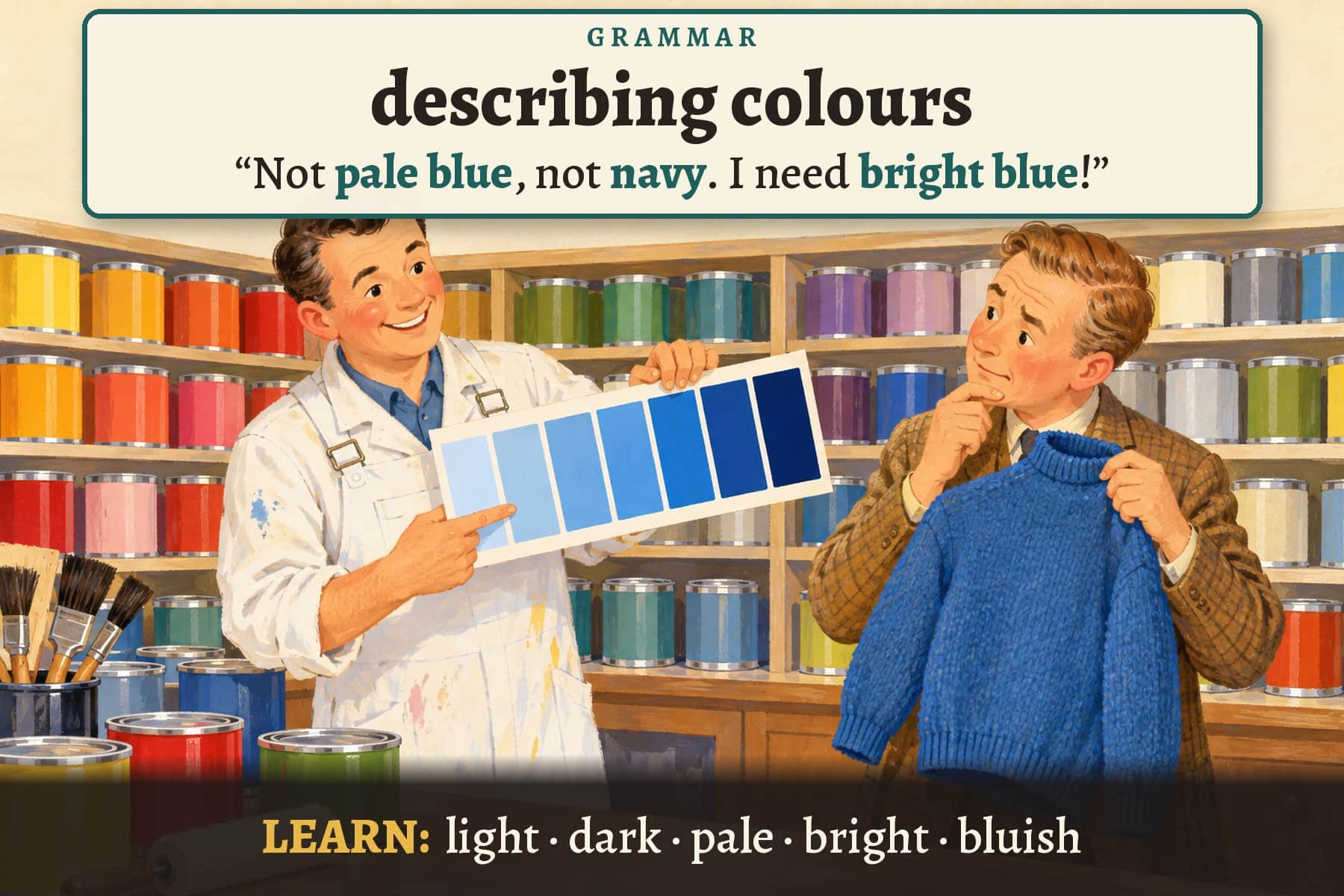
A student once held up her jumper and said, “Teacher, it’s blue… but not blue blue.” She knew exactly what she meant. She just didn’t have the words. English has lots of simple ways to make colours more exact, and once you know them, you’ll never be stuck with “blue but not blue blue” again.
In this lesson you’ll learn how to make colours lighter, darker, softer and stronger, how to say “sort of red”, how to name colours after real things, and where colour words go in a sentence.
Light, Dark, Pale and Bright
Put one of these words before the colour to change it:
| Word | What it does | Example |
|---|---|---|
| light | less colour, more white | a light blue shirt |
| dark | more black, deeper | dark green trousers |
| pale | very light and soft | a pale pink bedroom |
| bright | strong and eye-catching | a bright yellow raincoat |
| deep | strong and dark, often rich | a deep red rose |
You can also use them on their own: “Do you want the light one or the dark one?”
Add -ish to Mean “Sort Of”
Not quite red? Add -ish. It means “a bit” or “sort of”, and British people use it all the time.
- red → reddish (double the d)
- green → greenish
- yellow → yellowish
- blue → bluish (drop the e)
- grey → greyish
- white → whitish (drop the e)
“The sky went a reddish colour just before the storm.”
Here’s a handy rule when you mix two colours: the last colour is the main one. A greenish-blue sea is mostly blue with a bit of green. A bluish-green sea is mostly green with a bit of blue. You can also simply say blue-green when both are equal.
(Bonus: -ish works with times and ages too. “See you at sevenish.” “He’s fortyish.”)
Colours Named After Things
Sometimes the clearest way to describe a colour is to compare it with something everyone knows. Put the thing before the colour:
| Colour | Think of… |
|---|---|
| sky blue | a clear summer sky |
| navy blue | a sailor’s uniform (very dark blue) |
| lemon yellow | a fresh lemon |
| bottle green | an old glass bottle |
| blood red | a deep, strong red |
| chocolate brown | a bar of chocolate |
| jet black | completely black, very shiny |
| snow white | fresh snow |
“She’s got jet black hair and a bottle green coat.” For more colour words, see our rainbow vocabulary.
Where Does the Colour Go?
A colour can go before a noun (a red bus) or after verbs like be, look, go and turn (The bus is red. The leaves are turning brown.).
When you use several adjectives, the colour usually comes after opinion, size, age and shape, but before where it’s from and what it’s made of:
| Opinion | Size | Age | Colour | Origin | Material | Noun |
|---|---|---|---|---|---|---|
| lovely | big | old | red | London | bus | |
| red | wooden | door | ||||
| beautiful | blue | Italian | silk | scarf |
Don’t worry: in real life people rarely use more than two or three adjectives together. “A lovely red wooden door” is plenty!
Common Mistakes
- Ask “What colour is it?”, not “What colour does it have?”
- Say “It’s blue.” You don’t need “It’s a blue colour.”
- Colour words don’t take a plural -s before a noun: two red cars, not “two reds cars”.
- To change colour, use go or turn: “Bananas go brown quickly.” “Her face turned red.”
Colour or Color? Grey or Gray?
Both are correct. Colour and grey are British spellings. Color and gray are American. Just pick one style and stick to it.
Colour Idioms
Once you know your colours, try these colourful idioms: feel blue, tickled pink, caught red-handed, paint the town red, the green-eyed monster, green fingers, once in a blue moon, in someone’s black books, yellow-belly, chase rainbows.
Frequently Asked Questions
Add -ish: reddish. It means a bit red, or nearly red. You can also say “a reddish colour” or “red-ish”. The same works for greenish, bluish, yellowish and greyish.
Usually after opinion, size, age and shape, but before origin and material: “a lovely old red wooden door”. After verbs like be, look and turn, the colour comes on its own: “The door is red.”
Both mean less colour. Light is the everyday word (light blue, light green). Pale sounds softer and weaker, and is common with pink, yellow and blue, and with faces: “You look pale. Are you OK?”
Test Yourself
What is FunkyEnglish?
FunkyEnglish is a website that helps you improve your English. We offer quick lessons that teach idioms, slang, phrasal verbs and more. Visit our homepage to see our latest articles, or use the menu to find specific content!


