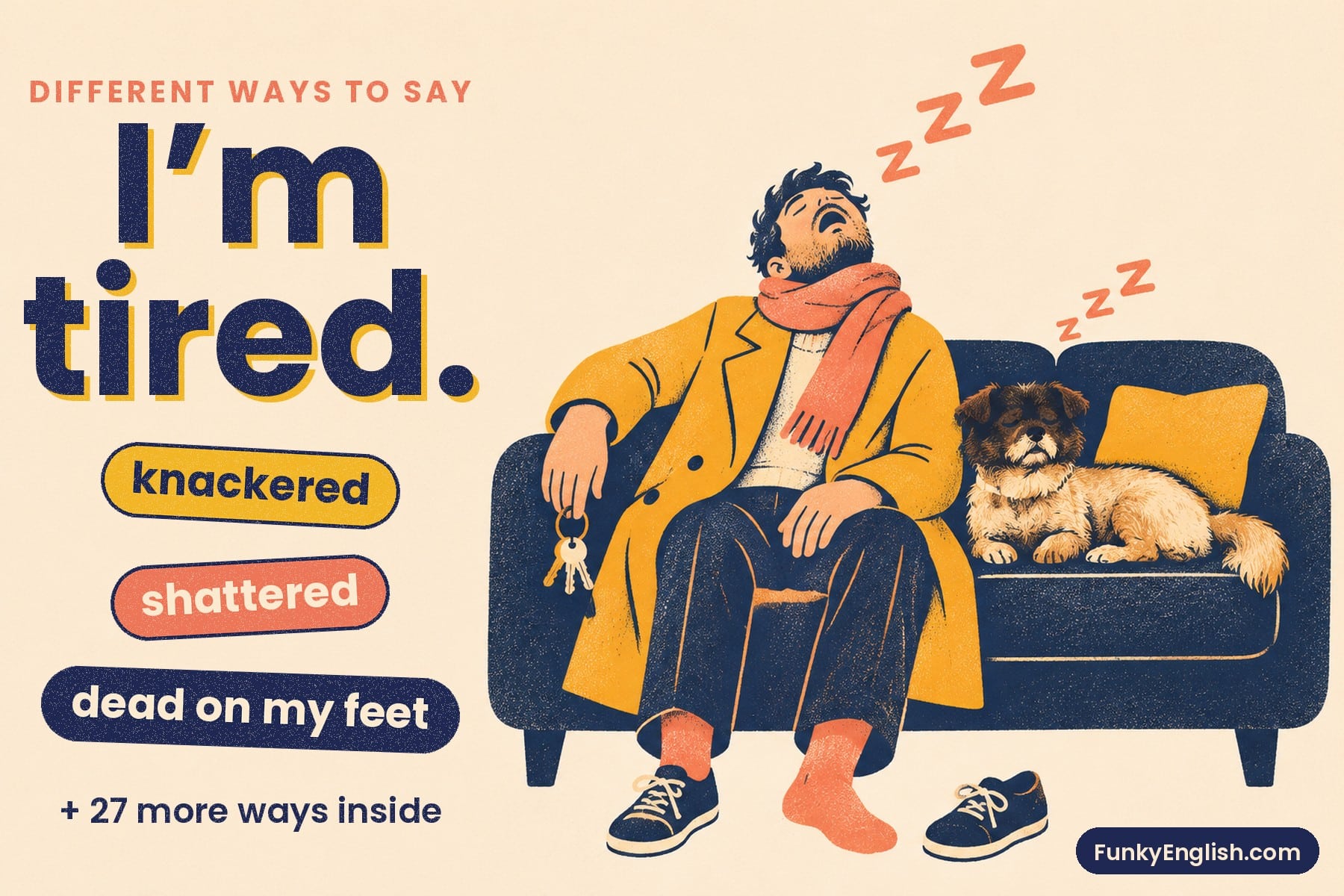
“How are you?” “Tired.” It might be the most common answer in the English-speaking world, especially on a Monday. But saying tired every single time gets, well, tiring. English has dozens of ways to say you need a sit-down, from the polite to the very, very British. Here are the best ones, with examples, and a guide to how tired each one really is.
Everyday Ways to Say You’re Tired
- sleepy: you want to sleep, often after eating or when it’s late. Gentle and a little cute. “I always get sleepy after Sunday lunch.”
- worn out: very tired after a lot of work or activity. “The kids have worn me out. Three hours at the park!”
- exhausted: extremely tired, with no energy left. “I was exhausted after the night shift.”
- drained: tired in your mind as well as your body, often after something stressful or emotional. “That meeting went on for three hours. I feel completely drained.”
- run down: tired and a little unwell, as if you might be getting a cold. “I’ve been feeling run down all week.”
- fatigued: formal or medical. You’ll see it in health advice and hear it from doctors, but rarely in conversation. “Patients may feel fatigued for several days.”
- weary: tired, especially of something long or difficult. It sounds a little old-fashioned or literary. “The weary travellers finally reached the hotel.”
British Slang for Tired
This is where British English really shines. These are informal, so use them with friends, family and colleagues you know well.
- knackered: very tired. Probably the most British word on this page. “I’ve been decorating all weekend. I’m knackered.”
- shattered: extremely tired, as if you’ve been broken into pieces. “Don’t ask me to cook tonight. I’m shattered.”
- cream crackered: Cockney rhyming slang for knackered. Jokey, and guaranteed to make a British person smile. “I’m cream crackered, mate.”
- done in: completely exhausted. “After that hike, I was absolutely done in.”
- wiped out: so tired you can’t do anything else. “The flu has wiped me out.”
- zonked: so tired you could fall asleep anywhere. You can also zonk out (fall asleep suddenly). “I zonked out on the sofa at nine o’clock.”
- dead on my feet: so tired you can barely stand up. “By the end of the Christmas rush, the shop staff were dead on their feet.”
American and Australian English have a few of their own: beat (“I’m beat”), bushed and the slightly childish pooped. British people understand them, but don’t use them as much.
Idioms for Being Very Tired
- dog tired: very, very tired, like a dog after a long walk. Ask Lobster, Teacher’s dog. She’s the expert. “After a five-mile walk, Lobster was dog tired.”
- running on empty: still going, but with no energy left, like a car with no petrol. “I’ve had four hours’ sleep. I’m running on empty.”
- burning the candle at both ends: working late and getting up early, until you’re exhausted. “She’s been burning the candle at both ends to finish her dissertation.”
- can’t keep my eyes open: so tired you’re falling asleep. “Sorry, I can’t keep my eyes open. I’m going to bed.”
- ready to drop: so tired you feel you might fall over. “Three weddings in one month? I’m ready to drop.”
- on my last legs: extremely tired, as if you can’t keep going much longer. People also say it, jokingly, about old cars and phones. “I’m on my last legs. Is it Friday yet?”
- hit a wall: to suddenly run out of energy completely, especially during exercise or long work. “I was fine until mile twenty, then I hit a wall.”
Ways to Say You’re Going to Sleep
Once you’re tired, these phrases come in handy:
- hit the sack / hit the hay: go to bed. “Right, I’m going to hit the sack.”
- nod off: fall asleep without meaning to, often sitting up. “Grandad nodded off in the middle of the film.”
- crash: fall asleep quickly because you’re exhausted, or sleep at someone’s house. “Can I crash on your sofa tonight?”
- forty winks: a short sleep during the day. “I’m just going to have forty winks before dinner.”
- power nap: a short sleep to give you energy. “A twenty-minute power nap and I’m a new person.”
Careful! “Tired of” Means Something Different
If you’re tired of something, or sick and tired of it, you aren’t sleepy. You’re fed up and annoyed.
- “I’m sick and tired of this weather.” (= I’m fed up with it.)
- “She’s tired of waiting for him to call.” (= She’s had enough.)
- “I’m fed up.” (British, very common. Annoyed or bored, not sleepy.)
So “I’m tired” and “I’m tired of you” are two very different things to say to your partner at the end of the day.
How Tired Are You? From a Little to a Lot
A rough guide, from least tired to most tired:
- sleepy: you could have a nap.
- tired: the standard word.
- worn out / drained: a long, busy day.
- exhausted / knackered / shattered: no energy left at all.
- dead on my feet / dog tired / ready to drop: you could fall asleep standing up.
Add absolutely or completely for extra drama: “I’m absolutely shattered.” But not “very exhausted”. Strong words like exhausted and shattered already mean “very”, so we use absolutely instead.
Related Pages You Might Like
Knackered · Dog Tired · Hit the Sack · Different Ways to Say Someone Is Pregnant · 50 British Slang Words
What is an idiom?
An idiom is a word or phrase that is not taken literally. An idiom is an expression that cannot be understood from the meanings of its individual words, but has a separate meaning of its own.
Frequently Asked Questions
Common alternatives are sleepy, worn out, exhausted and drained. In British slang, people say knackered, shattered or done in. In formal or medical English, fatigued is used.
The most common British slang words for tired are knackered and shattered. You’ll also hear done in, wiped out, zonked and the jokey rhyming slang cream crackered.
It’s better to say “absolutely exhausted” or “completely exhausted”. Exhausted already means very tired, so it sounds more natural with absolutely or completely than with very.
Test Yourself
What is FunkyEnglish?
FunkyEnglish is a website that helps you improve your English. We offer quick lessons that teach idioms, slang, phrasal verbs and more. Visit our homepage to see our latest articles, or use the menu to find specific content!