Long white neck, snowy feathers and a calm, elegant way of moving: few birds are as beautiful as the swan. You’ll see them on rivers, lakes and park ponds all over Britain, where they also have some surprising history. Here are the words you need.
Words in the Photo
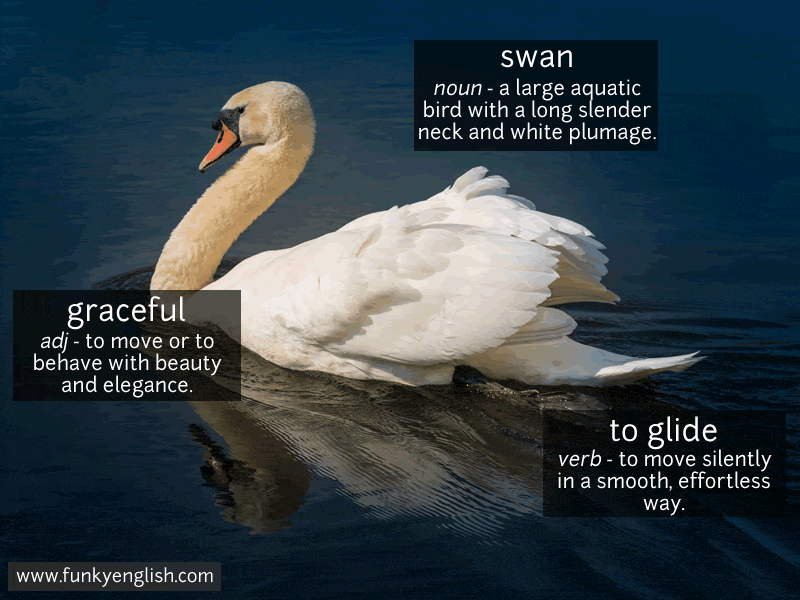
Three words you can see in the photo at the top of this page, in alphabetical order.
glide (verb): to move smoothly and quietly, as if without any effort. · In the photo
“The swans glided across the lake in the morning mist.”
graceful (adjective): moving in a smooth, elegant and attractive way. · In the photo
“She’s a very graceful dancer.”
swan (noun): a large white water bird with a long, curved neck. · In the photo
“There’s a family of swans living on the river.”
12 More Swan Words
From beaks to babies, the words you’ll need for swans and other water birds.
beak (noun): the hard, pointed mouth of a bird.
“Mute swans have an orange beak with a black knob on top.”
cob (noun): a male swan.
“The cob guarded the nest while the female sat on the eggs.”
cygnet (noun): a baby swan.
“The cygnets were fluffy and grey, not white at all.”
feathers (noun, plural): the soft, light parts that cover a bird’s body.
“A swan has about 25,000 feathers.”
flap (verb): to move wings up and down quickly.
“The swan flapped its wings and ran across the water to take off.”
hiss (verb): to make a long “sss” sound, often as a warning.
“The swan hissed at the dog to keep it away from the cygnets.”
mute swan (noun): the most common swan in Britain, with an orange beak.
“Mute swans aren’t really silent. They grunt, snort and hiss.”
paddle (verb): to move through water by pushing with your feet or hands.
“Underneath the water, the swan was paddling hard.”
pen (noun): a female swan.
“The pen laid six eggs in the nest.”
pond (noun): a small area of still water.
“We fed the ducks at the pond in the park.”
preen (verb): (of a bird) to clean and tidy its feathers with its beak.
“The swan spent ages preening on the riverbank.”
wingspan (noun): the distance from the end of one wing to the end of the other.
“A swan’s wingspan can be over two metres.”
Swans in Britain
- Swan Upping: every July, an old ceremony takes place on the River Thames. People in rowing boats count the swans and check the cygnets are healthy. It has been happening for hundreds of years.
- Swans often stay with the same partner for life.
- Swans are beautiful, but don’t get too close, especially in spring. A swan protecting its cygnets will hiss, flap and chase you!
Swan expressions: a swan song is someone’s last performance or piece of work before they stop. An ugly duckling is someone who seems plain at first but grows into someone beautiful or successful. In British English, to swan around (or swan off) means to go around in a relaxed way while other people are working: “He’s been swanning around Italy all summer!”
People also say a calm person is like a swan: graceful on the surface, but paddling like mad underneath. For more birds, see our bird vocabulary and birds of a feather flock together.
Learn More
Look it upSwan UppingWikipediaFrequently Asked Questions
A baby swan is called a cygnet. Cygnets are grey and fluffy, and they turn white as they grow up.
A male swan is a cob and a female swan is a pen.
In British English, to “swan around” means to go around in a relaxed, carefree way, often while other people are busy working.
Test Yourself
What is FunkyEnglish?
FunkyEnglish is a website that helps you improve your English. We offer quick lessons that teach idioms, slang, phrasal verbs and more. Visit our homepage to see our latest articles, or use the menu to find specific content!