
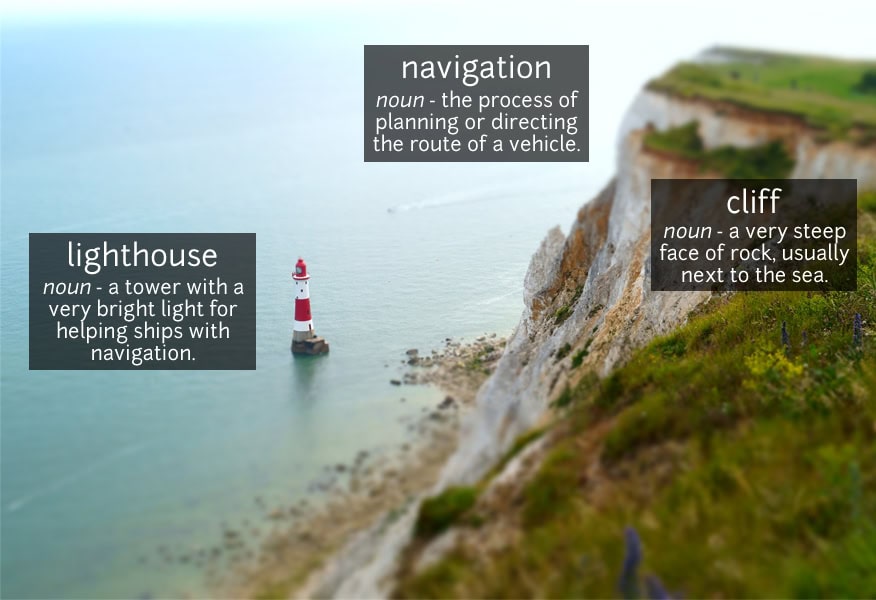
A red and white tower standing at the foot of tall white cliffs, with the sea stretching out to the horizon. Britain is an island, so its long coastline is dotted with lighthouses, and they’ve kept sailors safe for hundreds of years. Here are the words you need for a day by the sea.
Words in the Photo
Three words you can see in the photo at the top of this page, in alphabetical order.
cliff (noun): a high, steep face of rock, often next to the sea. · In the photo
“Don’t stand too close to the edge of the cliff!”
lighthouse (noun): a tower with a powerful light that warns ships about rocks and helps them find their way. · In the photo
“At night, you could see the lighthouse flashing across the bay.”
navigation (noun): the skill of planning a route and finding your way, especially at sea. · In the photo
“Before satellites, sailors relied on the stars and lighthouses for navigation.”
12 More Coastal Words
The words you’ll need on the coast, on a boat or on a clifftop walk.
beam (noun): a line of light shining from something bright.
“The lighthouse beam swept across the dark water.”
buoy (noun): a floating object in the sea that marks a safe route or a danger (British pronunciation: “boy”).
“Keep to the left of the red buoy.”
chalk (noun): a soft white rock. Many British cliffs are made of it.
“The White Cliffs of Dover are made of chalk.”
coastguard (noun): the service that watches the sea and rescues people in danger.
“Someone called the coastguard when the boat’s engine failed.”
coastline (noun): the shape or edge of the land along the sea.
“Cornwall has a beautiful, rocky coastline.”
foghorn (noun): a horn that makes a very loud, deep sound to warn ships in fog.
“We could hear the foghorn all night.”
harbour (noun): a sheltered area of water where boats can stay safely (American spelling: harbor).
“The fishing boats came back into the harbour at dawn.”
headland (noun): a high piece of land that sticks out into the sea.
“There’s a lighthouse on the headland.”
lighthouse keeper (noun): a person who lived at a lighthouse and looked after the light.
“The lighthouse keeper climbed 120 steps every evening.”
shipwreck (noun): the remains of a ship that has sunk or been destroyed.
“Divers explored the old shipwreck off the coast.”
tide (noun): the regular rise and fall of the sea.
“The tide is coming in. We’d better move our towels!”
waves (noun, plural): moving lines of water on the sea.
“Huge waves crashed against the rocks.”
Britain’s Lighthouses
- With thousands of miles of coastline, Britain has hundreds of lighthouses, from tall towers on rocky islands to little lights at the end of harbour walls.
- Each lighthouse has its own pattern of flashes, so sailors can tell which one they’re looking at in the dark.
- For centuries, lighthouse keepers lived at the lights and kept them working. Today, the lights are automatic, and many old keepers’ cottages are now holiday homes.
- Some of Britain’s most famous cliffs, like the White Cliffs of Dover, are made of bright white chalk.
Sea idioms: a big fuss about something small is a storm in a teacup. A difficult time is choppy waters, and if you’re making no progress, you’re treading water. For a calmer day by the water, see our canal vocabulary.
In the News
Spotted in the newsTrinity House (lighthouses of England, Wales and the Channel Islands)trinityhouse.co.ukFrequently Asked Questions
A lighthouse uses a powerful light to warn ships about dangerous rocks and coastlines and to help sailors find their way at night.
In British English, “buoy” sounds like “boy”. Many Americans say “boo-ee”.
No. British lighthouses are now automatic and controlled remotely, so keepers no longer live at them.
Test Yourself
What is FunkyEnglish?
FunkyEnglish is a website that helps you improve your English. We offer quick lessons that teach idioms, slang, phrasal verbs and more. Visit our homepage to see our latest articles, or use the menu to find specific content!


