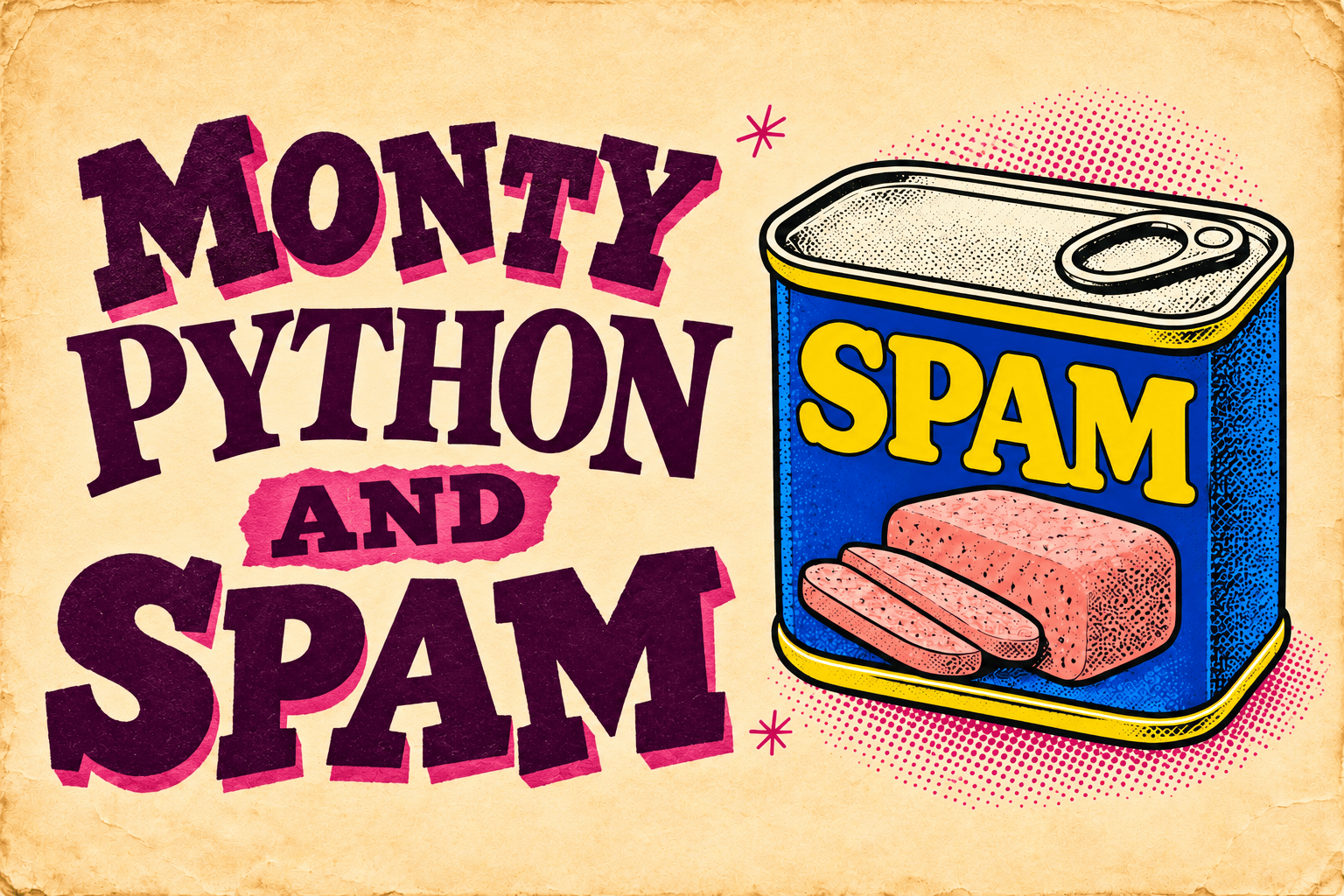
How a British comedy sketch gave junk email its name
When a student asks me why junk email is called spam, I always smile. More than once, we’ve ended up watching the Monty Python sketch together in class. It still makes me laugh.
I grew up watching Monty Python’s Flying Circus and the films. I even had a Monty Python cassette I used to listen to on my Walkman. (Yes, I’m that old.) And over the years I’ve lost count of the Americans I’ve met who light up at the mention of Monty Python. It’s funny how far a very British joke can travel.
But if you’ve only ever seen spam in your inbox, the story starts in a café. A customer wants breakfast without Spam. The waitress reads out the menu. Then the Vikings start singing.
That question from my students is really about how English changes. A Python sketch gave internet users the word spam, the group’s name inspired the adjective Pythonesque, and a dead parrot showed how much comedy you can squeeze out of a polite complaint. Listen to how their characters say things as well as what they say.
Who were Monty Python?
Who do you need to make a television show about dead parrots, silly walks and singing Vikings? In 1969, the answer was Graham Chapman, John Cleese, Terry Gilliam, Eric Idle, Terry Jones and Michael Palin. Together they were Monty Python. They wrote their own sketches and played a whole parade of characters between them. Gilliam, who was born in the United States and became a British citizen in 1968, made the cut-out animations that carried viewers from one bit of nonsense to the next.
Their BBC sketch show, Monty Python’s Flying Circus, ran for four series from 1969 to 1974. That was when the group first became famous. The films, records and stage shows took their comedy to a wider audience over the following decade. The records also explain how some of us ended up listening to sketches on the bus.
What made Flying Circus different?
A sketch is a short comic scene. In Flying Circus, one sketch could turn into another before you’d even worked out where the first one was going. Gilliam’s cut-out animations linked scenes with bits of old photographs and illustrations. Anything could wander into the picture, including an enormous foot.
In Dead Parrot, a customer tries to return a dead bird while the shopkeeper insists it’s fine. Listen to the increasingly elaborate ways the customer says the same thing. The shopkeeper claims the bird is “pining for the fjords”. To pine for something is to miss it or long for it. The shopkeeper is pretending the dead bird just misses home. A homesick parrot sounds better than a refund. In The Ministry of Silly Walks, John Cleese treats a ridiculous way of walking as a serious matter of government. Both jokes get funnier because the characters carry on as if they’re doing a perfectly normal job. Next time you watch Flying Circus, look out for The Ministry of Silly Walks and notice how seriously Cleese discusses the funding.
The films that took Python beyond television
And Now for Something Completely Different (1971). A collection of sketches from the television series, filmed again for the cinema. It gives you an idea of the range of the show in one sitting.
Monty Python and the Holy Grail (1975). King Arthur and his knights go looking for the Holy Grail, a sacred cup. Their grand adventure starts with the sound of horses’ hooves. Or does it?
Life of Brian (1979). Brian is an ordinary man born around the same time as Jesus. People mistake him for a messiah, someone they believe has come to save them. The film makes fun of how quickly people follow a crowd and how stubbornly they can stick to a belief.
The Meaning of Life (1983). A return to sketches, loosely arranged around the stages of life. The title promises an answer to the biggest question of all. In true Python fashion, the journey takes in a great deal of silliness along the way.
How Monty Python changed British comedy
The Pythons made institutions look ridiculous by taking their rules seriously. In one sketch, a government department has a budget for silly walks. A medieval king has to explain why anyone should listen to him. The people with the grandest titles often have the weakest grasp of what’s going on.
The show also demonstrated how much a sketch programme could get away with. A scene could simply stop, a cartoon could interrupt the action and a joke could return much later in the episode. That freedom is part of what people mean when they describe a scene as Pythonesque. You could use it about a real meeting, too. “The meeting went on for an hour because nobody could agree who was in charge of ending it. It was all rather Pythonesque.”
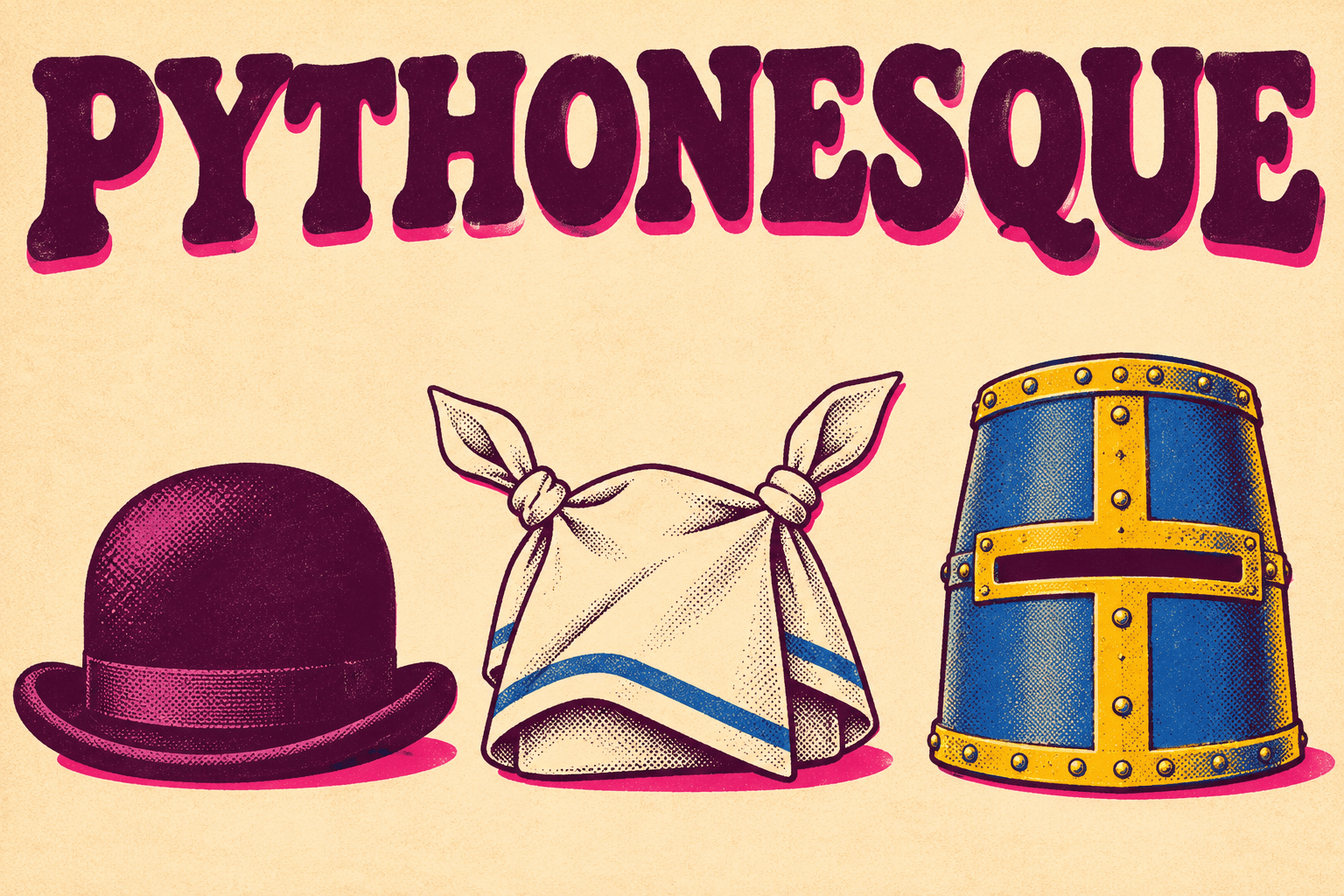
The comedy travelled well. The films and recordings helped it find an international audience, and Holy Grail eventually became the stage musical Spamalot. You can still recognise a Python fan by what happens when someone mentions a dead parrot.
A café with rather a lot of Spam
In the 1970 sketch, a customer wants breakfast without Spam, a brand of tinned meat. The waitress reads out the dishes, with more and more Spam in each one. A group of Vikings joins in and sings so loudly that an ordinary conversation becomes almost impossible.
Watch and Listen
Watch the café scene twice. Each time, listen for something different.
- First watch — What’s on the menu? Name two foods besides Spam. What is the customer trying to order?
- Second watch — When does Spam take over? Listen for the repeated word as the waitress reads the menu. What happens to the conversation when the Vikings join in?
Watch Spam! on Monty Python’s official channel
Check what you heard
- First watch. You can hear eggs, bacon and sausage. The customer wants something without Spam.
- Second watch. The waitress says “Spam” again and again. When the Vikings start singing, it’s hard to hear the people talking.
How Spam got into your inbox
Early internet users borrowed spam for repetitive messages that filled a screen or swamped a discussion. If you’ve opened a group chat to find that one person has sent forty messages in a row, you already understand the connection. The word went on to become the everyday name for junk email. Mass advertising email existed by 1978, before the term caught on.
The name Python took a different route into computing. Guido van Rossum was reading published scripts from Monty Python’s Flying Circus when he began creating the programming language. He wanted a short, distinctive name with a bit of mystery, so he chose Python. The next time you see a snake on a Python textbook, spare a thought for the comedians who inspired the name. Read the naming story in the official Python FAQ.
What Monty Python can teach us about English
Start with the parrot. The customer keeps finding more elaborate ways to say that the bird is dead. That’s useful listening practice: English speakers often restate the same idea more strongly when they think someone is refusing to understand. In the café, the joke goes the other way. The same word is repeated until it takes over. That repetition is the part that early internet users borrowed.
How to use spam in everyday English
- “I got a lot of spam.” For junk messages in general, spam is uncountable. To count individual messages, say three spam emails.
- “Check your spam folder.” Email services put suspected junk there. A genuine message can end up there too.
- “Stop spamming the group chat!” Here, spam is a verb. You’re asking someone to stop sending so many repetitive or unwanted messages. Twelve photos of the same sandwich would do it.
- “I marked it as spam.” You used the email controls to tell your email service that you considered the message junk. Write Spam for the food brand and spam for the online meaning.
One more Python word
In Upper Class Twit of the Year, posh contestants compete to see who can be the most hopeless. The title works because it sounds like a prestigious award until you get to the insult. For the meaning and examples of when it sounds teasing, see the lesson on twit.
Keep learning
Spam started at a café table and ended up in your inbox. Other expressions travelled the opposite way, from computers into everyday conversation. Explore more of those expressions in Computer Idioms.
The next time a student asks me why it’s called spam, I know exactly what we’ll be watching.
Read More
For the story of how the group took its television comedy to cinemas around the world, see Monty Python at the Movies.
Frequently Asked Questions
Early internet users borrowed the word from a Monty Python sketch in which repeated singing about Spam drowns out a café conversation.
Yes. If someone is spamming a group chat, they are filling it with unwanted or repetitive messages. You can say spam, spammed and spamming.
It describes something absurd or surreal in a way that reminds people of Monty Python, especially when everyone treats a ridiculous situation perfectly seriously.
A twit is a foolish person. It can sound playful between friends, but tone and context matter.
Key Vocabulary
- Sketch (noun) — a short comic scene.
- Pine for (verb) — to miss someone or something deeply, or to long for it.
- Pythonesque (adjective) — absurd or surreal in a way that reminds you of Monty Python. The characters often take a ridiculous situation very seriously.
- Spam (noun) — unwanted messages, often sent in bulk. Spam (verb) — to send unwanted or repetitive messages. The food brand Spam takes a capital S.
Test Yourself
Four quick questions on the English you’ve just learned.
What is FunkyEnglish?
FunkyEnglish helps you learn the English you hear in everyday life, from British slang and idioms to phrasal verbs and the stories behind familiar words. Browse the latest lessons and quizzes on the FunkyEnglish homepage.