
Fine dining is the kind of restaurant where the menu has no prices, the napkin costs more than your shirt and there are three forks next to your plate. Don’t panic. Learn these words and you’ll look like you do this every week, even if it’s your first time and you’re quietly checking which fork to use.
What is Fine Dining?
Fine dining means a high-end restaurant with excellent food, impeccable service and an elegant atmosphere. Meals usually come as several small courses, each one beautifully presented. Expect white tablecloths, waiters who appear at exactly the right moment, and a bill that may make you sit down again.
Fine Dining Vocabulary
- à la carte (phrase): choosing separate dishes from the menu, each with its own price.
“We skipped the set menu and ordered à la carte.” - ambience (noun): the feeling or mood of a place. Also spelt ambiance.
“Candles, soft music, a view of the river. The ambience was perfect. The prices were less perfect.” - course (noun): one part of a meal, such as the starter, main course or dessert.
“It was a seven-course dinner. I needed a nap after course four.” - cuisine (noun): a style of cooking from a particular country or region.
“The restaurant specialises in modern French cuisine.” - high-end (adjective): expensive and of very high quality.
“It’s a high-end restaurant, so book early and bring your best manners.” - impeccable (adjective): perfect, with no mistakes at all.
“The service was impeccable. My glass was never empty.” - presentation (noun): the way food is arranged on the plate. Chefs also call this plating.
“The presentation was so beautiful that nobody wanted to eat it. For about four seconds.” - sommelier (noun): a wine expert who helps you choose wine.
“I asked the sommelier for something “not too expensive”. He smiled politely.” - starter (noun): a small dish before the main course. Americans say appetizer.
“For a starter, I’ll have the soup, please.” - tasting menu (noun): a set menu of many small dishes chosen by the chef.
“The tasting menu had twelve dishes, and each one was the size of a coin.”
Are you feeling hungry? Check out these activities and expressions related to food and eating:
- Continental Breakfast (Photo Vocabulary)
- Eat In (Phrasal Verb)
- Eat Out (Phrasal Verb)
- Egg (Photo Vocabulary)
- Fish and Chips (British Culture)
- Foodie (Slang)
- Pig Out (Phrasal Verb)
- Scrumptious (Slang)
- Whet Your Appetite (Idiom)
- Yummy (Slang)
Cutlery and Table Setting Vocabulary
At a fine dining restaurant, the table is set with several pieces of cutlery (silverware in American English). The golden rule: start from the outside and work in, one set for each course.
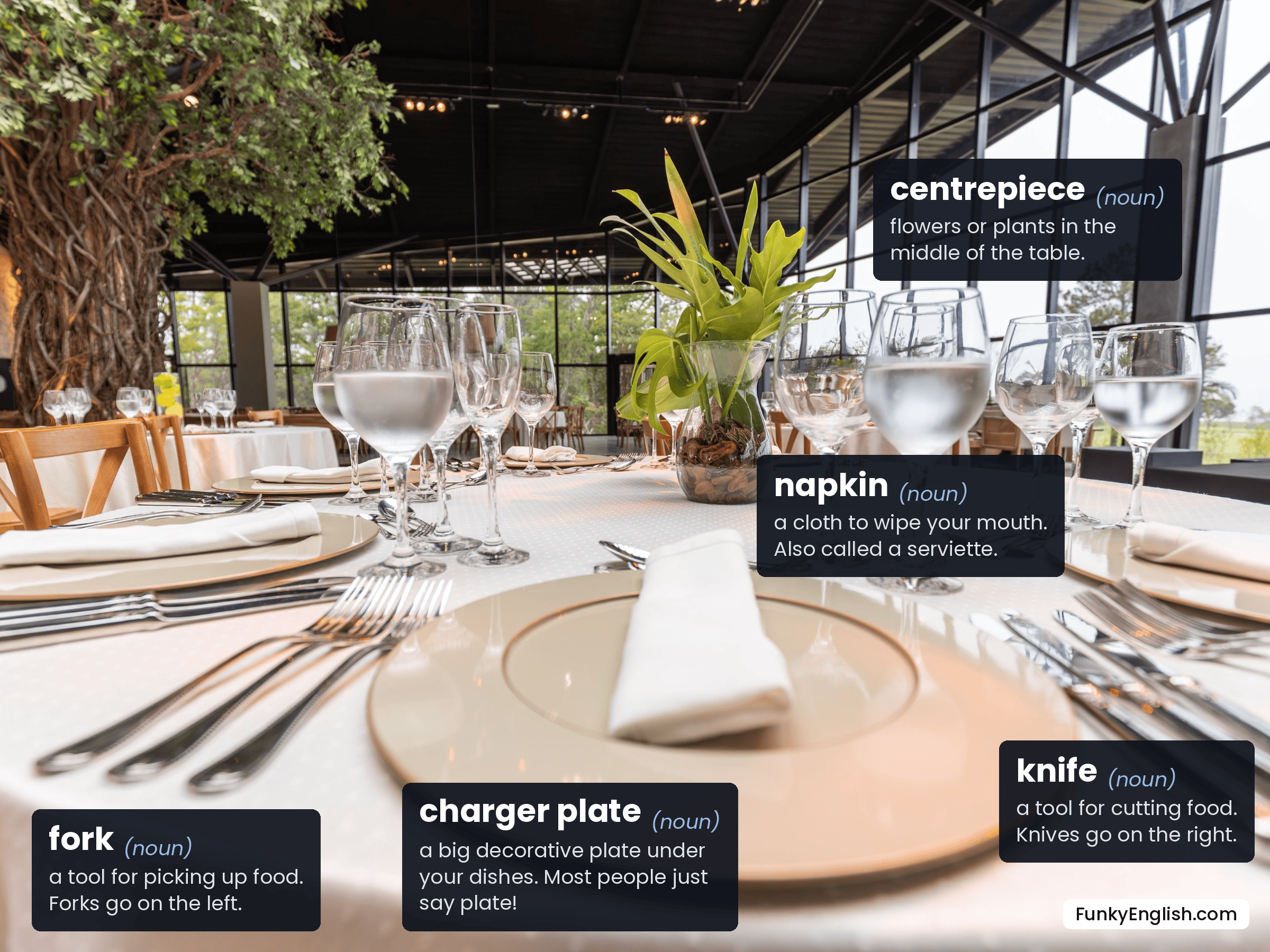
- Knife, fork and spoon (nouns): the three basic pieces of cutlery. Forks go on the left, knives on the right.
- Soup spoon (noun): a large, round spoon for soup.
- Dessert spoon / dessert fork (nouns): smaller pieces, often placed above the plate.
- Steak knife / fish knife (nouns): special knives for meat and fish.
- Napkin (noun): a cloth for wiping your mouth and hands. Serviette is also used in British English.
- Side plate (noun): a small plate for bread, on your left.
- Charger plate (noun): a big decorative plate that your dishes sit on. You’ll see the word in restaurants and wedding venues, but most people just say “plate”.
- Place setting (noun): all the cutlery, plates and glasses for one person.
- Wine glass / water glass (nouns): usually placed above your knife, on the right.
Useful Phrases at a Fine Dining Restaurant
- “I’d like to book a table for two at eight o’clock, please.”
- “We have a reservation under the name Smith.”
- “Could we see the wine list, please?”
- “What would you recommend?”
- “Which wine would go well with the fish?”
- “Could we have the bill, please?” (British English; Americans say “the check”)
- “My compliments to the chef!” (a polite way to say the food was excellent)
Fine Dining, British Style
A few things that surprise visitors to British restaurants:
- Service charge: many restaurants add a discretionary service charge to the bill, often around 12.5%. “Discretionary” means you can ask for it to be removed, but most people pay it. If there’s no service charge, a 10 to 15% tip is normal.
- “Is everything all right with your meal?” Your waiter will ask this when your mouth is full. The correct British answer is “Lovely, thank you”, even if it isn’t.
- Pudding: in British English, “pudding” often just means dessert. “Are you having pudding?” doesn’t mean a specific dish.
- Starter, main, pudding: the British way to say appetizer, entrée and dessert. Careful: in American English an entrée is the main course, but in British English it can mean a starter.
Want to learn how the kitchen works? See our Chef Vocabulary page.
Frequently Asked Questions
A high-end restaurant experience with excellent food, perfect service and an elegant atmosphere, usually served as several courses.
Start from the outside and work in. The cutlery furthest from your plate is for the first course.
Many British restaurants add a service charge of around 12.5% to the bill. If there is no service charge, a tip of 10 to 15% is normal.
Test Yourself
Quick Check
What is FunkyEnglish?
FunkyEnglish is a website that helps you improve your English. We offer quick lessons that teach idioms, slang, phrasal verbs and more. Visit our homepage to see our latest articles, or use the menu to find specific content!


