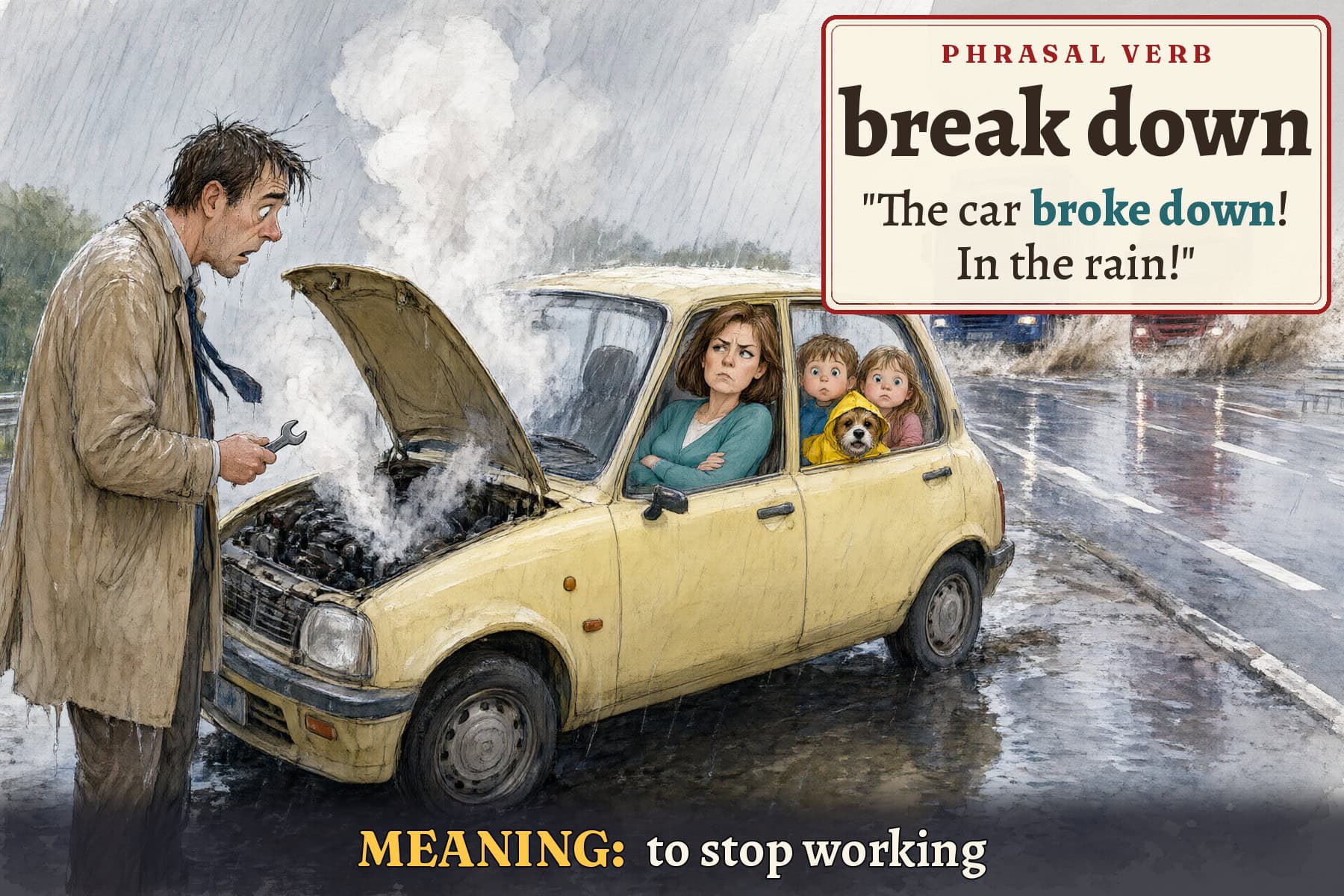
Phrasal Verb – Break down.
To stop working; also to start crying, to fail, to split into smaller parts, or to knock something down.
The Hendersons are driving to Cornwall for their summer holiday. It’s pouring with rain, the kids are arguing in the back, and then… clunk. Steam pours out from under the bonnet. Dad pulls over, stares at the engine and says nothing. Mum sighs: “Of course the car broke down. In the rain. On the motorway.”
Break down is one of the most useful phrasal verbs in English. It can describe a car, a person, a business deal or even a maths problem. Here are the five meanings you’ll hear most.
The 5 Meanings of “Break Down”
1. To stop working
A machine or vehicle breaks down when it stops working because something is wrong with it.
“The washing machine broke down again, so I’m off to the launderette.”
2. To start crying
A person breaks down (or breaks down in tears) when they suddenly can’t control their feelings.
“When they played our wedding song, Grandad broke down in tears.”
3. To fail
Talks, plans and relationships can break down when they stop working and people can’t agree.
“Talks between the two companies broke down after just one hour.”
4. To split into smaller parts
You break something down when you divide it into smaller, simpler parts so it’s easier to understand.
“This looks hard, but let’s break it down into three easy steps.”
5. To knock something down
If you break down a door or a wall, you hit it until it falls or opens.
“The firefighters had to break down the door to get in.”
How to Use It
This phrasal verb works in two different ways:
- No object (meanings 1, 2 and 3): something just breaks down by itself. “My laptop broke down.” You can’t say “My laptop broke down it.”
- With an object (meanings 4 and 5): you break something down. The object can go in the middle or at the end: “break down the problem” or “break the problem down”. With it or them, it must go in the middle: “break it down”, never “break down it”.
The Noun: A Breakdown
The noun breakdown (one word) is very common too:
- a breakdown: when a car stops working. “We had a breakdown on the way to the airport.”
- breakdown cover (British): insurance that sends a mechanic if your car breaks down. “Thank goodness we’ve got breakdown cover!”
- a breakdown of something: a detailed list showing all the parts. “Can you send me a breakdown of the costs?”
In the News
Spotted in the newsBreak has lots of phrasal verbs. Next, try break up (to end a relationship, or to finish school for the holidays). On the road? See pull over, and for when things go badly wrong, crash. You can also check the Cambridge Dictionary entry for break down.funkyenglish.comWhat is a phrasal verb?
A phrasal verb is a verb combined with 1 or 2 small words. These small words are particles. A particle can be a preposition or adverb. The phrasal verb has a different meaning from the verb alone because the particle changes the meaning of the verb.
Frequently Asked Questions
Its most common meaning is to stop working, like a car or a machine. It can also mean to start crying, to fail (for example, talks), to divide something into smaller parts, or to knock something down.
“Break down” (two words) is the verb: “Our car broke down.” “Breakdown” (one word) is the noun: “We had a breakdown on the motorway.”
Always “break it down”. With pronouns like it and them, the pronoun goes between “break” and “down”.
Test Yourself
What is FunkyEnglish?
FunkyEnglish is a website that helps you improve your English. We offer quick lessons that teach idioms, slang, phrasal verbs and more. Visit our homepage to see our latest articles, or use the menu to find specific content!