Recently in class, one of my students pointed at the little square icon in the corner of the screen and asked, “Teacher, what’s that supposed to be?” It was the save icon. She had never seen a floppy disk in her life. That sent me down a rabbit hole, and I discovered that English is full of words like this: little fossils of old technology that we still use every day, often without realising.
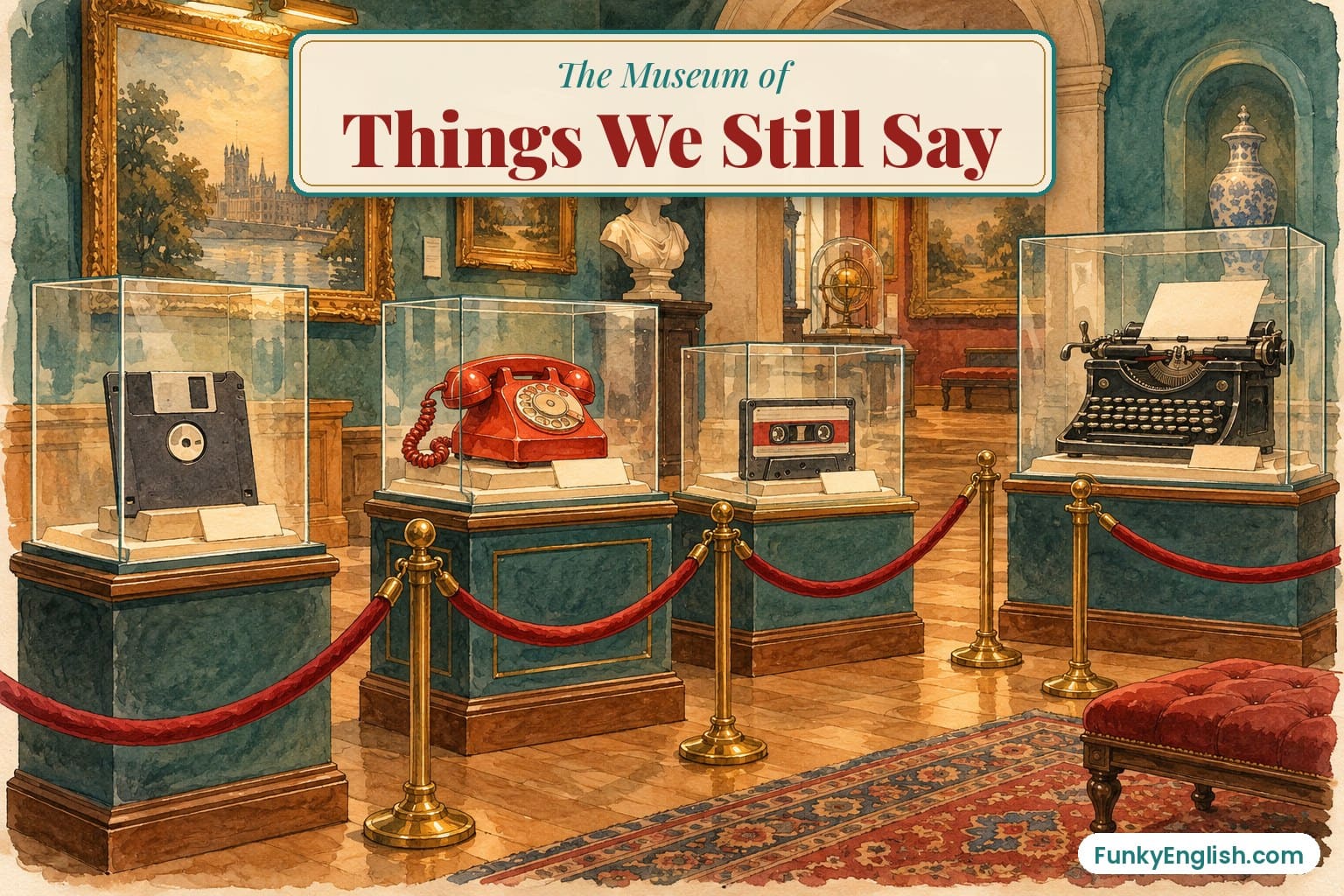
So welcome to the Museum of Things We Still Say. We still hang up phones that have nothing to hang on, rewind videos with no tape inside, and CC people on emails with no carbon in sight. Some of these technologies are still around. What’s changed is that most of us now use the words without ever touching the original objects.
Rooms in the museum: The Telephone Room · The Recording Room · The Office Before Email · The Printing and Typing Room · The Coach House · The Future Wing · Museum Quiz
Exhibit 1: The Save Icon
Why does the save icon look like a square?
Because it’s a picture of a floppy disk. In the 1980s and 1990s, floppy disks were how most people saved and carried their files. The disks have almost vanished, but the picture stayed on the button, so millions of people now click a “save” symbol for an object they’ve never held.
Then: a small plastic disk you pushed into the computer.
Now: the icon on the save button.
“Don’t forget to click save before you close it!”
The Telephone Room

Why do we say “hang up the phone”?
Because early telephones really were hung up. On many old phones, the earpiece (the receiver) hung on a hook on the side of the phone, and hanging it back on the hook ended the call. The phone sense of “hang up” was in use by 1911. Today we press a red button, but we still “hang up”.
Then: putting the receiver back on its hook.
Now: ending any call, even on a smartphone.
“I’ll call you back. Don’t hang up!”
Why do we still “dial” a number?
Because older phones had a round dial with holes for each number. You put your finger in a hole and turned the dial, then waited for it to spin back before the next number. It was a separate invention from the hook, and much slower than tapping a screen. We still “dial” numbers today, even with no dial anywhere.
Then: turning a rotary dial for each number.
Now: calling a number on any phone.
“Dial 999 in an emergency.”
Why do British people say “give me a bell”?
Because old telephones had a real metal bell inside. When someone called, a little hammer hit the bell and the whole house knew about it. That is also why we say a phone rings. Most phones now play a tune or just buzz, but in British English you can still “give someone a bell”, and it is friendly and informal.
Then: a bell ringing inside the telephone.
Now: phoning someone (informal, very British).
“Give me a bell when you get to the station.”
The Recording Room

What are we rewinding when we “rewind” a video?
With videotapes, rewinding meant physically winding the tape back onto a reel. The verb rewind is older than recorded sound (people rewound thread long before), but tape gave us the meaning we use today. Cassettes and video tapes stored sound and pictures on a long ribbon of tape wound between two little wheels (reels), so to watch something again, you had to wind the tape back. Today we just drag a bar on a screen, but we still say “rewind”.
Then: winding tape back onto its reel.
Now: going back to an earlier point in a video or conversation.
“Can you rewind that bit? I missed it.”
Why do we say someone sounds like a “broken record”?
Because a scratched vinyl record can get stuck, so the needle jumps back and plays the same few seconds again and again. A person who keeps repeating the same thing “sounds like a broken record”. Don’t mix it up with like talking to a brick wall: a broken record keeps repeating itself, but talking to a brick wall means you get no useful response and feel ignored.
Then: a damaged record repeating the same bit.
Now: someone who keeps saying the same thing.
“I know I sound like a broken record, but please tidy your room.”
Why do people still talk about “footage”?
Because film was measured in feet. Cameras used long strips of film, and “footage” meant how many feet of film were used. The film sense dates from around 1916. Now “footage” just means video, even when it’s recorded on a phone.
Then: the length of film, in feet.
Now: any recorded video.
“The news showed footage of the storm.”
The Office Before Email

What does CC stand for in email?
Carbon copy. Before photocopiers and office printers became common, office workers put a thin sheet of carbon paper between two sheets of paper. When you typed or wrote on the top sheet, the pressure pressed carbon onto the sheet underneath, making a copy. “CC” at the bottom of a letter meant “a copy has gone to…”. Email borrowed the idea, and so did “BCC” (blind carbon copy).
Then: a copy made with carbon paper.
Now: sending a copy of an email to someone else.
“Please CC me on your reply.”
Why does a computer have a desktop, files and folders?
Because computer designers copied the real office. The Xerox Star (1981) was one of the first computers to show a “desktop” with little pictures of documents and folders, so office workers would feel at home. Real desks, files and folders are still very much with us. The computer simply borrowed their names.
Then: a real desk with paper files in cardboard folders.
Now: the main screen of a computer and how we organise files.
“Save it in the “Holidays” folder on your desktop.”
Why do we “cut and paste” on a computer?
Because people once did it with real scissors and glue. Writers and editors cut paragraphs out of a printed page and stuck them somewhere else with paste, a simple glue. Computers borrowed the name, and even the little scissors picture for “cut” in many programs.
Then: cutting paper with scissors and sticking it down with paste.
Now: moving text or images on a screen.
“Cut and paste the address into the email.”
The Printing and Typing Room

Why are letters called uppercase and lowercase?
Because of where printers kept them. In old print shops, every letter was a small piece of metal type, stored in wooden trays called cases. The capital letters lived in the case placed higher up on the sloping desk (the upper case), and small letters in the lower one (the lower case).
Then: the top and bottom trays in a printer’s workshop.
Now: capital and small letters.
“Your password must include an uppercase letter.”
What did the Shift and Return keys originally do?
On many mechanical typewriters, each typebar carried two characters. Pressing Shift moved part of the mechanism so the other character struck the paper. (Not every early machine had one: the Remington No. 2 of 1878 was one of the first with lowercase letters and a shift key.) When you reached the end of a line, a lever sent the carriage (the part holding the paper) back to the start. Later typewriters turned that into a key: Return. Our keyboards kept both names.
Then: switching between two characters, and sending the carriage back.
Now: typing capitals and starting a new line.
“Press Shift and Return together.”
The Coach House
Why is it called a dashboard?
Because of horses. Horse-drawn carriages had a wooden or leather board at the front to stop mud from being dashed (thrown hard) up at the driver by the horses’ hooves. The word was in use by the 1840s. When cars arrived, the name moved to the panel in front of the driver, and now apps and websites have dashboards too.
Then: a board that kept mud off the carriage driver.
Now: the panel of dials in a car, or a screen showing key information.
“The warning light on the dashboard means you need petrol.”
The Future Wing: What Joins the Museum Next?
This room is pure guesswork. Feel free to disagree! These are everyday expressions that might one day feel as old-fashioned as “dial”:
- Switch gears: as automatic and electric cars become normal, will people still understand the gearstick behind this idiom?
- Google it: if more people ask AI assistants instead, will “Google it” still mean “look it up”?
- Behind the wheel: will we still say it if cars drive themselves?
- Put pen to paper: it already means “start writing”, even on a laptop. Will it last?
- Click here: does it still make sense when we tap, swipe and talk to our devices?
Which everyday expression do you think belongs in the next room? Tell me on X at @EnglishStudy.
More Tech English
Enjoyed this? Try our common computer idioms, computer vocabulary and fat fingers, or see where the penny dropped in our idioms from old technology. For more word origins, the Online Etymology Dictionary is a great place to explore.
Sources for the dates
- Hang up (phone sense, 1911): Online Etymology Dictionary
- Rewind: Online Etymology Dictionary
- Footage (film sense, about 1916): Online Etymology Dictionary
- Carbon copy: The Phrase Finder
- Xerox Star desktop (1981): How-To Geek
- Upper case and lower case: Online Etymology Dictionary
- Shift key and the Remington No. 2: Smithsonian
- Dashboard (1846): Online Etymology Dictionary
Frequently Asked Questions
Floppy disks were the main way people saved and carried files in the 1980s and 1990s. The disks have mostly gone, but the picture stayed on the save button.
CC stands for “carbon copy”. It comes from carbon paper, which was used to make copies of letters. In email, CC sends a copy to another person.
On many early telephones, the receiver hung on a hook, and putting it back on the hook ended the call. We still use the phrase for any phone.
Museum Quiz
Quick Check
What is FunkyEnglish?
FunkyEnglish is a website that helps you improve your English. We offer quick lessons that teach idioms, slang, phrasal verbs and more. Visit our homepage to see our latest articles, or use the menu to find specific content!